

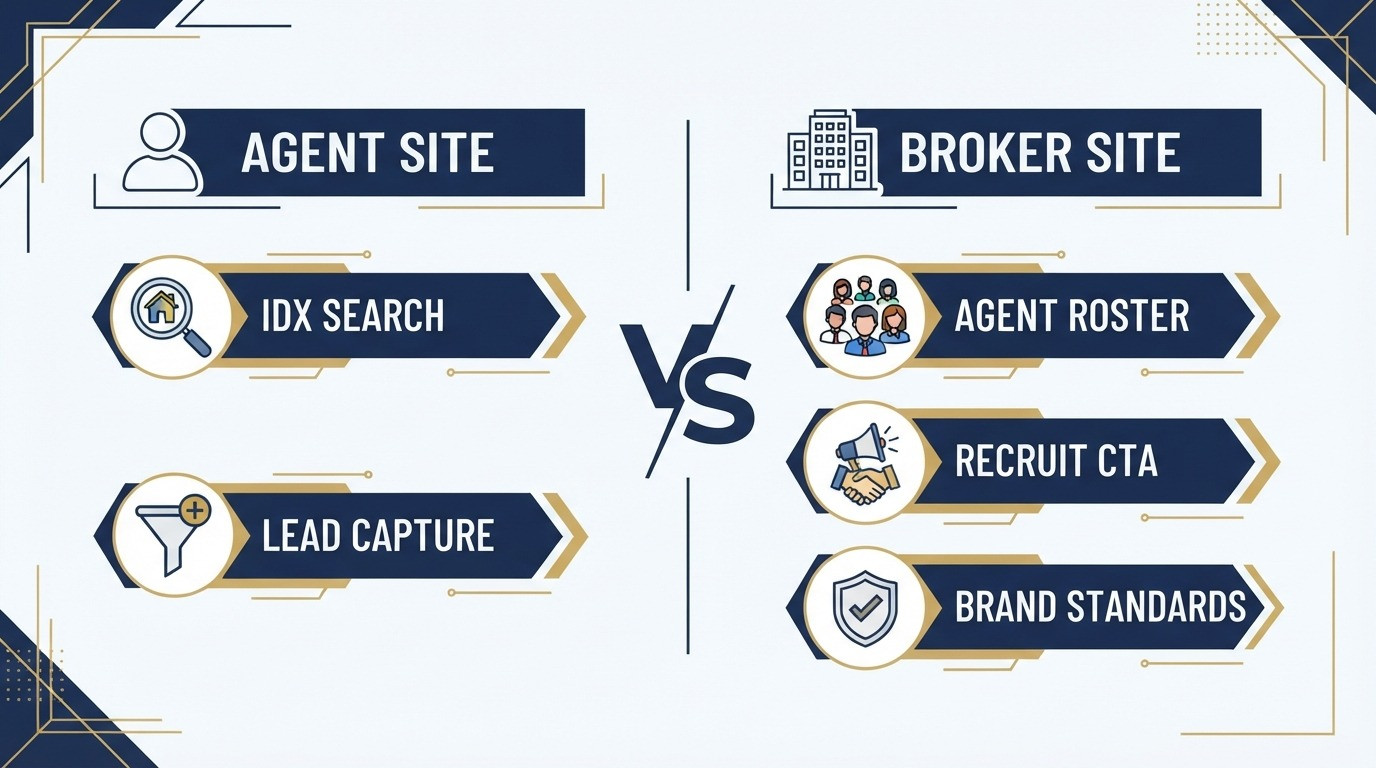
Real estate broker website design serves a different function than agent websites. Broker website design, often shortened to just broker web design, has to work for three different audiences at once instead of one. Where an individual agent’s website is primarily a lead generation tool for buyers and sellers, a brokerage website must simultaneously serve potential home buyers and sellers looking for representation, current agents looking for support and resources, and prospective agent recruits evaluating whether to join the brokerage. A real estate broker website design that optimizes for only one of these audiences underserves the other two. The brokerages with the strongest online presence build websites that serve all three audiences without confusion.

What Real Estate Broker Website Design Must Accomplish
The primary distinction between real estate broker website design and individual agent websites is the dual audience problem. Buyers and sellers who arrive at a brokerage website are looking for an agent to work with – the broker site needs to make finding and contacting an agent frictionless. Prospective agent recruits who arrive are evaluating the brokerage’s culture, support systems, commission structure, and market presence – the broker site needs to answer these questions persuasively without appearing primarily sales-focused to consumer visitors.
Brokerages that resolve this tension successfully typically use architecture-level solutions: a clear homepage navigation split between “Find an Agent” and “Join Our Team” paths, agent roster pages that serve both audiences (consumer visitors find agents; recruit visitors see who they would be working alongside), and separate landing pages for each recruitment campaign that do not disrupt the consumer experience on the main site.

Core Elements of Effective Broker Website Design
Agent roster with individual agent pages. Every producing agent at the brokerage should have their own page with their photo, bio, recent sales, market specialization, and direct contact information. This serves consumer visitors (who can find an agent who matches their needs) and recruit visitors (who can see the caliber and diversity of the agent team). Agent pages are also individually indexable by search engines – a brokerage with 40 well-built agent pages captures 40x the organic search surface area of a brokerage with only a roster list.
Recruitment section that answers the questions recruits actually ask. Agent recruits visiting a real estate broker website design are typically evaluating: commission splits, training and mentorship programs, technology stack, marketing support, office culture, and transaction volume. A recruiting page that addresses these topics directly – with specific numbers, not vague claims – converts passive interest into genuine conversations. “Our agents average 23 transactions per year with our lead generation system” outperforms “We support our agents with cutting-edge technology.”
IDX integration for consumer property search. Broker websites that include IDX property search capture buyer leads directly rather than routing them to Zillow or Realtor.com. The search can be configured to present matched agents as the next step after a buyer registers – creating a warm handoff from website to agent. For brokerages that do lead distribution, IDX on the broker site is the source of the leads being distributed.
Brand standards that scale across agent marketing. The visual identity established in the real estate broker website design – color palette, typography, photography style, logo usage – becomes the foundation for every agent’s co-branded marketing materials. Brokerages whose website does not reflect the actual visual standards they want agents to use create brand confusion across all their marketing. The broker website sets the standard; agent materials follow from it.
Platform Options for Real Estate Broker Website Design
Brokerages have more complex requirements than individual agents, and most individual-agent platforms are not built to handle agent roster management, multi-agent IDX routing, or recruitment content architecture at scale. The platforms best suited for real estate broker website design include:
Luxury Presence for Brokerages: Luxury Presence builds custom brokerage websites with individual agent page management, recruitment sections, and the design quality that premium brokerages need. The managed service approach means the brokerage does not need in-house technical capacity to maintain the site.
Sierra Interactive for Multi-Agent Teams: Sierra Interactive handles multi-agent lead routing, agent roster pages, and IDX integration at a scale that individual agent platforms cannot. Brokerages with established internet lead programs find Sierra’s architecture well-suited to the complexity of routing and attribution.
Custom WordPress Builds: Brokerages with specific functionality requirements – custom agent portal, proprietary listing presentation tools, integration with in-house CRM systems – typically need a custom WordPress build from a specialized real estate web design agency. The upfront investment is higher, but the result is a website that fits the brokerage’s actual operations rather than the platform’s defaults.
Connecting Broker Website Design to Agent Success
The strongest argument for investing in professional real estate broker website design is its direct effect on agent recruitment and retention. Recruits evaluating competing brokerages form opinions based on visible signals of quality and sophistication. A brokerage with a polished, current website communicates that it invests in its brand and its agents’ marketing presence. A brokerage with a dated, slow, template-looking website communicates the opposite – regardless of what the recruiting presentation says about marketing support.
For a full breakdown of the design decisions that affect website performance for individual agents within a brokerage, see our guide to how an agent page should be built. For platform comparisons that include multi-agent and brokerage-level features, see our guide to which builder scales past a single agent.
Final Thoughts
Effective real estate broker website design is a business infrastructure investment, not a marketing expense. It establishes the brand standard that every agent’s marketing reflects, supports recruitment with a 24/7 presentation of the brokerage’s value proposition, and generates consumer leads that become the foundation of agent production. Brokerages that treat their website as a one-time project rather than an ongoing asset consistently lose ground to competitors who understand that the website is the most visible and persistent representation of everything the brokerage stands for.
