

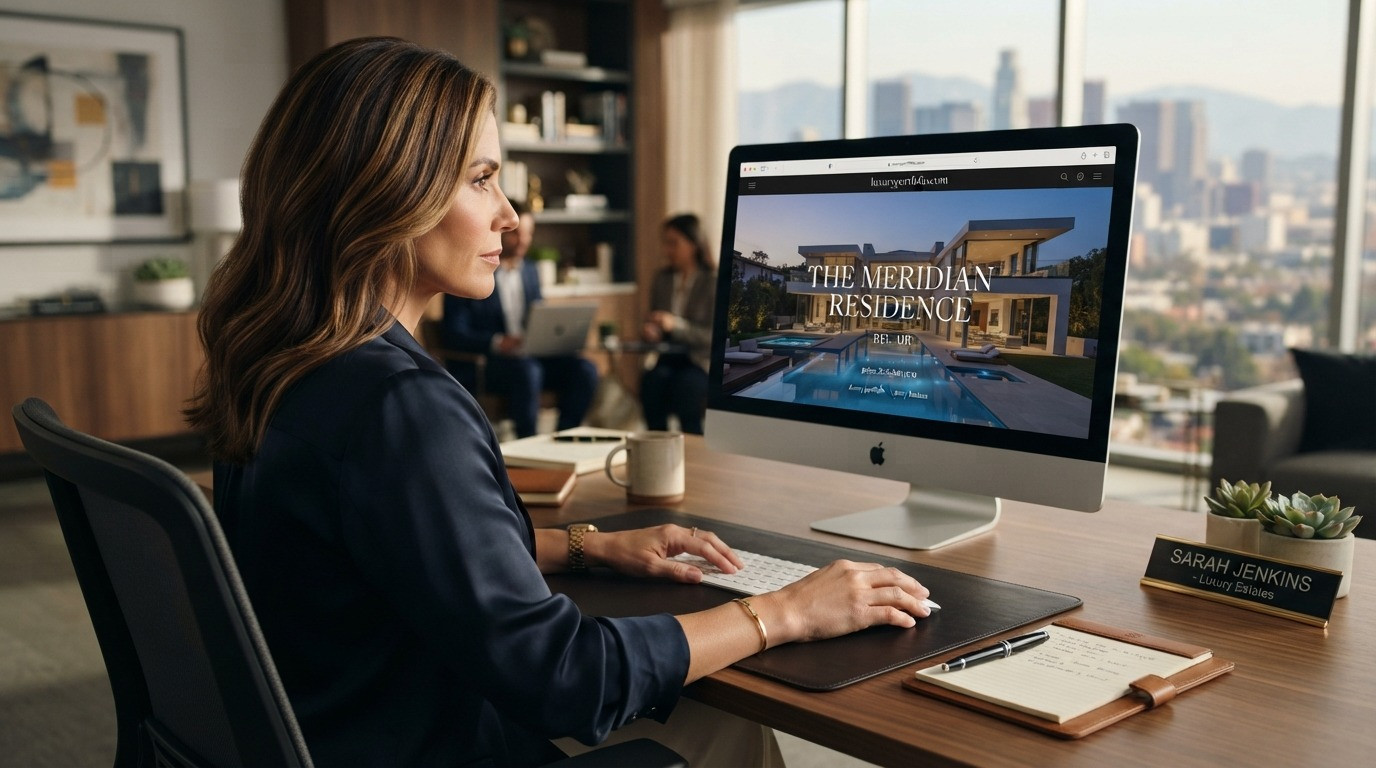
Luxury real estate website design is not simply a standard real estate website with higher-quality photography. It is a fundamentally different design philosophy – one where every visual and functional decision communicates the same thing to a high-net-worth buyer: this agent understands what premium looks like and operates at that level. Luxury buyers are accustomed to premium experiences across every category they purchase in. When a $4 million home buyer arrives on an agent’s website and encounters a template site with stock photography and a generic contact form, they draw conclusions about the agent’s market positioning immediately. Luxury real estate website design eliminates that mismatch and replaces it with a presentation that matches the expectation the listing itself creates.
What Luxury Real Estate Website Design Communicates
The primary function of luxury real estate website design is not lead capture in the traditional sense – it is trust establishment. High-net-worth buyers and sellers do not fill out contact forms on websites they found via Google the way first-time buyers might. They arrive through referrals, social proof, and reputation – and they use the website to confirm or contradict what they have already heard. A luxury agent’s website that signals premium positioning confirms the referral. A website that looks generic contradicts it and raises doubt.
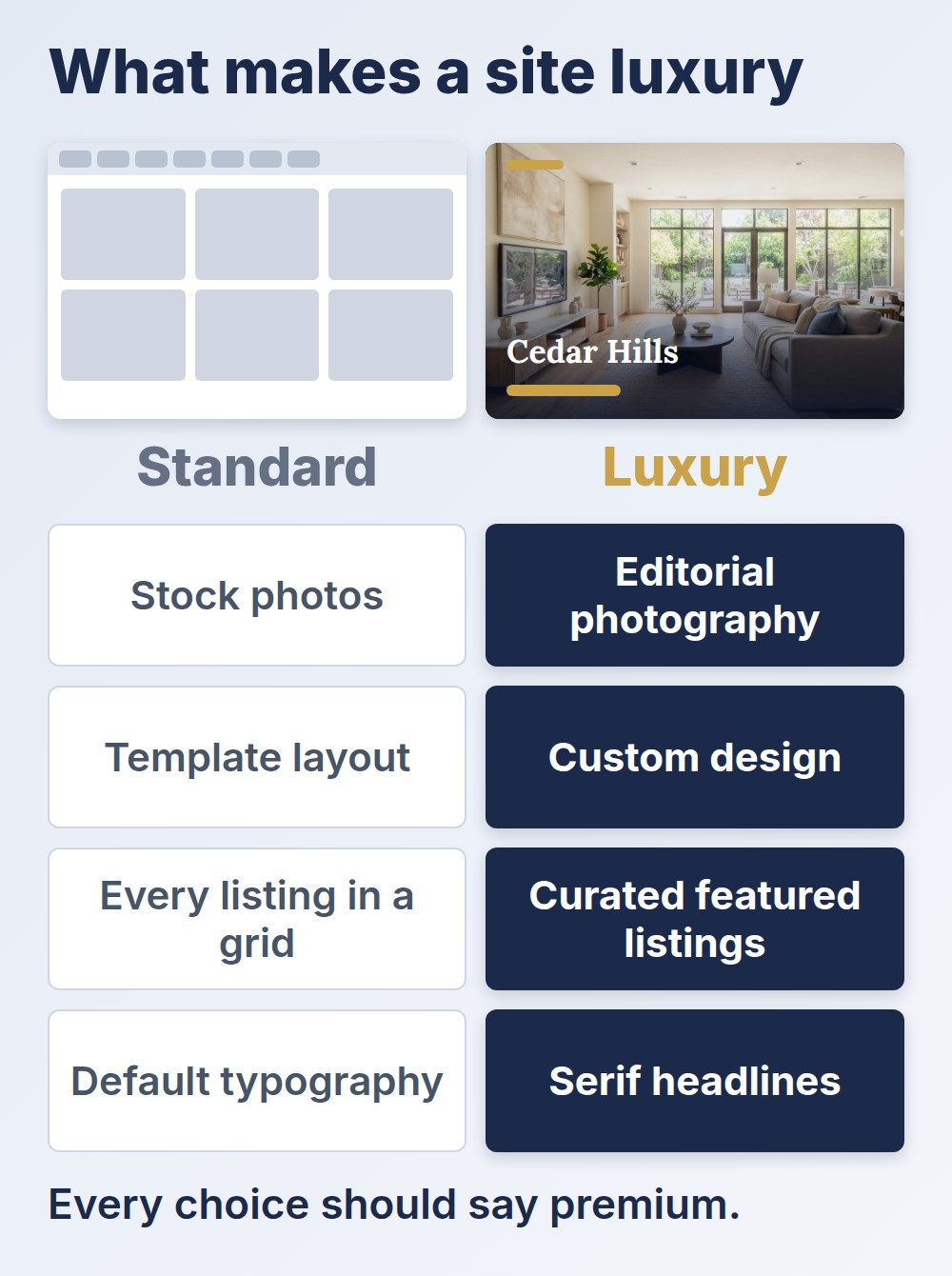
The design signals that communicate premium to luxury buyers are specific: full-screen property photography with no competing visual noise, serif typography that reads as sophisticated rather than casual, loading speed that is imperceptibly fast (luxury buyers notice lag in a way that entry-level buyers may not), and the complete absence of any element that reads as “mass market” – stock photography, generic template layouts, or cluttered navigation with too many options.

Core Design Features of Luxury Real Estate Websites
Full-screen editorial property photography. The hero section of a luxury real estate website design is almost always a full-screen photograph – not a carousel of multiple images, not a video, not a split-screen with text competing for attention. One photograph, edge to edge, showing a property at its most compelling angle. The photography quality must be editorial-level: professional staging, controlled lighting, and post-processing that renders the property exactly as it would appear in Architectural Digest. Amateur or semi-professional photography undermines everything else the design accomplishes.
Minimal, intentional typography. Luxury brands across every category – watches, fashion, hospitality – use typography to signal sophistication. Luxury real estate websites consistently favor serif typefaces for headlines and display text, paired with clean sans-serif for body copy. Font choices should be made with the same deliberateness as property photography selection. The typography communicates whether the agent understands design aesthetics or is simply using defaults.
Curated listing presentation. Standard real estate websites present every active listing in a grid. Luxury real estate website design presents a curated selection of featured properties with individual presentation – large format photography, a brief narrative description that highlights the property’s story rather than its feature list, and presentation that treats each listing as a portfolio piece rather than a catalog entry. This requires more editorial work but communicates a level of care that high-net-worth clients respond to.
Agent positioning as market authority. Luxury agent websites that perform well do not simply list the agent’s credentials – they position the agent as the definitive authority in their specific luxury market. Transaction history presented as a track record of notable sales, press mentions, luxury brand affiliations, and specific market data the agent commands are all components of this authority positioning. The bio section of a luxury real estate website design is not a resume – it is a case for why this particular agent is the only rational choice for a buyer or seller operating at this price point.
Technical Requirements for Luxury Real Estate Website Design
Sub-two-second load time despite high-resolution imagery. Luxury websites often carry the heaviest images on the internet – full-screen 4K property photography. The technical challenge is delivering this visual quality at load speeds that do not test a high-net-worth buyer’s patience. This requires image compression pipelines, content delivery networks, lazy loading of below-fold content, and hosting infrastructure that matches the visual ambition of the design. A beautiful site that loads in 6 seconds is not a luxury site – it is a liability.
Mobile presentation that matches desktop. Luxury buyers research properties across devices. The luxury real estate website design experience on a phone should feel as deliberate and premium as the desktop experience – not a collapsed version of the desktop layout. This often means mobile-specific design decisions: different image crops, adjusted typography scales, and touch interactions that feel native rather than forced.
Custom domain with SSL and no third-party branding. A luxury agent’s website on a subdomain of their brokerage’s platform, or with “Powered by [Platform]” in the footer, undermines the premium positioning the design is trying to establish. The URL should be the agent’s name or brand, the SSL certificate should be active, and no third-party platform branding should be visible to the end user.
The Right Platform for Luxury Real Estate Website Design
Luxury Presence is the dominant platform for luxury real estate website design in the US market. Their custom design approach, editorial photography integration framework, and deep real estate functionality make them the default choice for agents whose transaction volume justifies premium website investment. For agents who want genuine design uniqueness beyond Luxury Presence’s framework, boutique custom WordPress development from a specialized real estate web design agency is the alternative – at higher upfront cost and longer build time.
For a broader view of design principles that apply across all price points, see our guide to what every agent site needs to get right. For comparing platform options including mid-market alternatives, our guide to options from entry level to premium covers the full range.
Final Thoughts
Luxury real estate website design is an investment in market positioning, not just digital presence. For agents transacting at $2 million and above, the website is a direct reflection of the agent’s aesthetic judgment and market sophistication – two attributes luxury buyers are specifically evaluating when they choose representation. A website that matches the quality of the listings it presents, loads quickly, and positions the agent as the authoritative expert in their luxury market pays for itself in a single transaction. The question is not whether a luxury agent can afford a premium website – it is whether they can afford to operate without one.
