

Real estate testimonials are the short statements from past clients that tell a stranger what it was like to work with you. They matter because people hire agents they trust, and trust is hard to build with a bio alone. This guide covers why real estate testimonials work, what makes one strong, when and how to ask, examples of the structure that works, where to use them, and the rules that keep them honest.

Why Real Estate Testimonials Work
Most clients choose an agent through someone else. NAR’s 2025 Profile of Home Buyers and Sellers, as summarized by Virginia REALTORS’ key takeaways, found that 66% of sellers found their agent through a referral or used an agent they had worked with before, and that 35% said the agent’s reputation was a deciding factor. A testimonial is how that reputation travels to people who have not yet heard your name from a friend.

It works as proof for the claims in your real estate agent bio. A bio says you are responsive and organized, and a testimonial shows a client saying so. Testimonials are one part of your brand, which our five-part real estate brand framework explains in full.
What Makes Real Estate Testimonials Strong
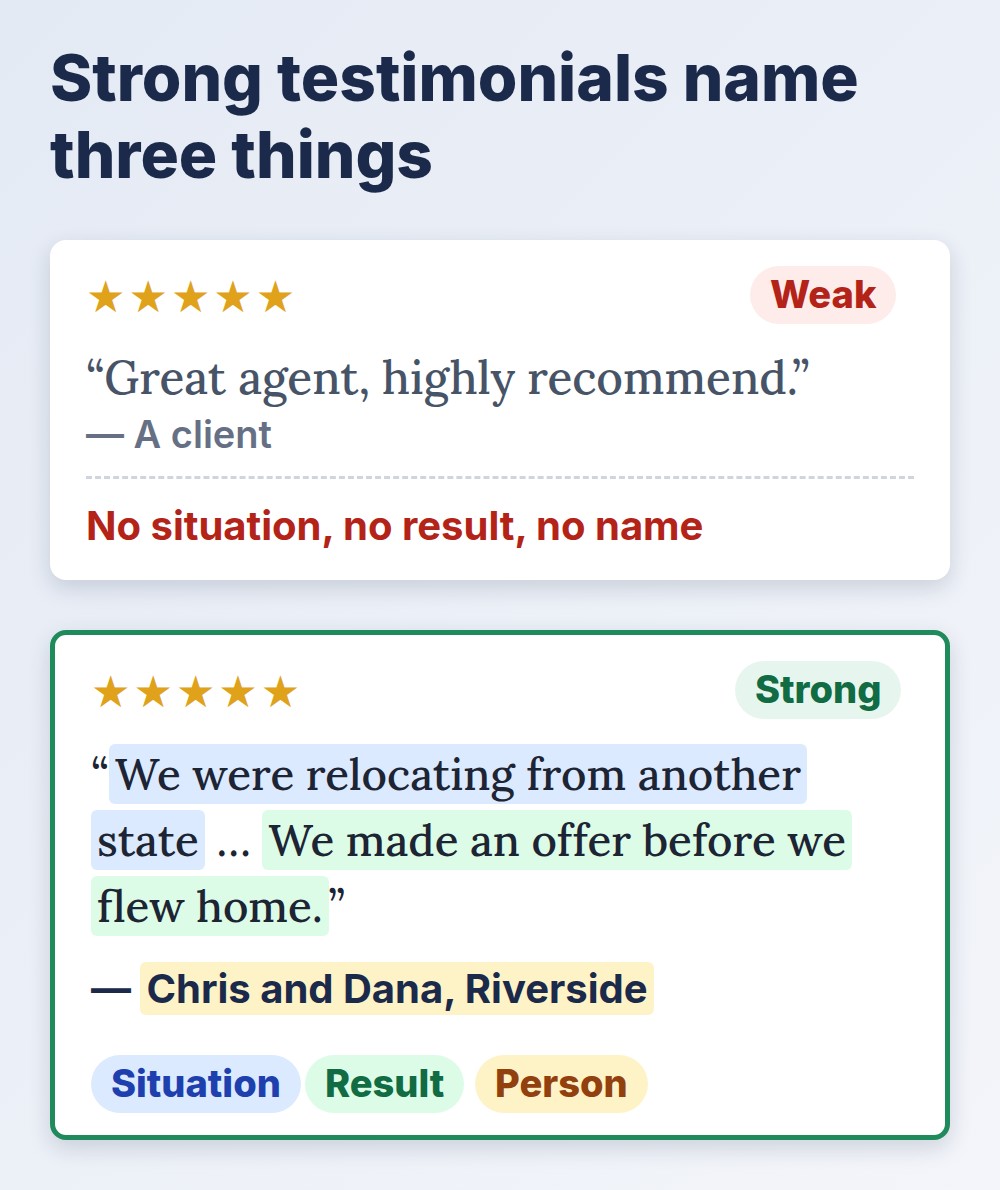
A strong testimonial names a situation, a result, and a person. A weak one is a compliment with nothing behind it. The table shows the difference.
| Weak | Strong | Why It Is Better |
|---|---|---|
| “Great agent, highly recommend.” | “We were relocating from another state and she arranged all our tours in one weekend.” | It names a situation a reader may share |
| “Very professional.” | “He explained every offer term in plain language before we signed.” | It shows what professional meant in practice |
| “Got us a good price.” | “Our home sold in 12 days after we followed her pricing advice.” | It states a result the client can verify |
| “A pleasure to work with.” | “She answered my texts the same evening, even during a long closing.” | It describes behavior a new client wants |
The examples are written to show structure. Use real client statements only, and never publish a line you invented.
When and How to Ask for Real Estate Testimonials
Ask when the client is happiest, which is usually the day of closing or just after it. Waiting a month means the details fade and the reply rate drops. Make the request easy: thank them first, explain in one sentence why it helps, and send a direct link or a few short questions rather than a blank page.
Three questions are enough for most clients:
- What was happening in your life or your plans when you decided to hire an agent?
- What did we do that mattered most during the process?
- What would you tell a friend who is thinking about buying or selling?
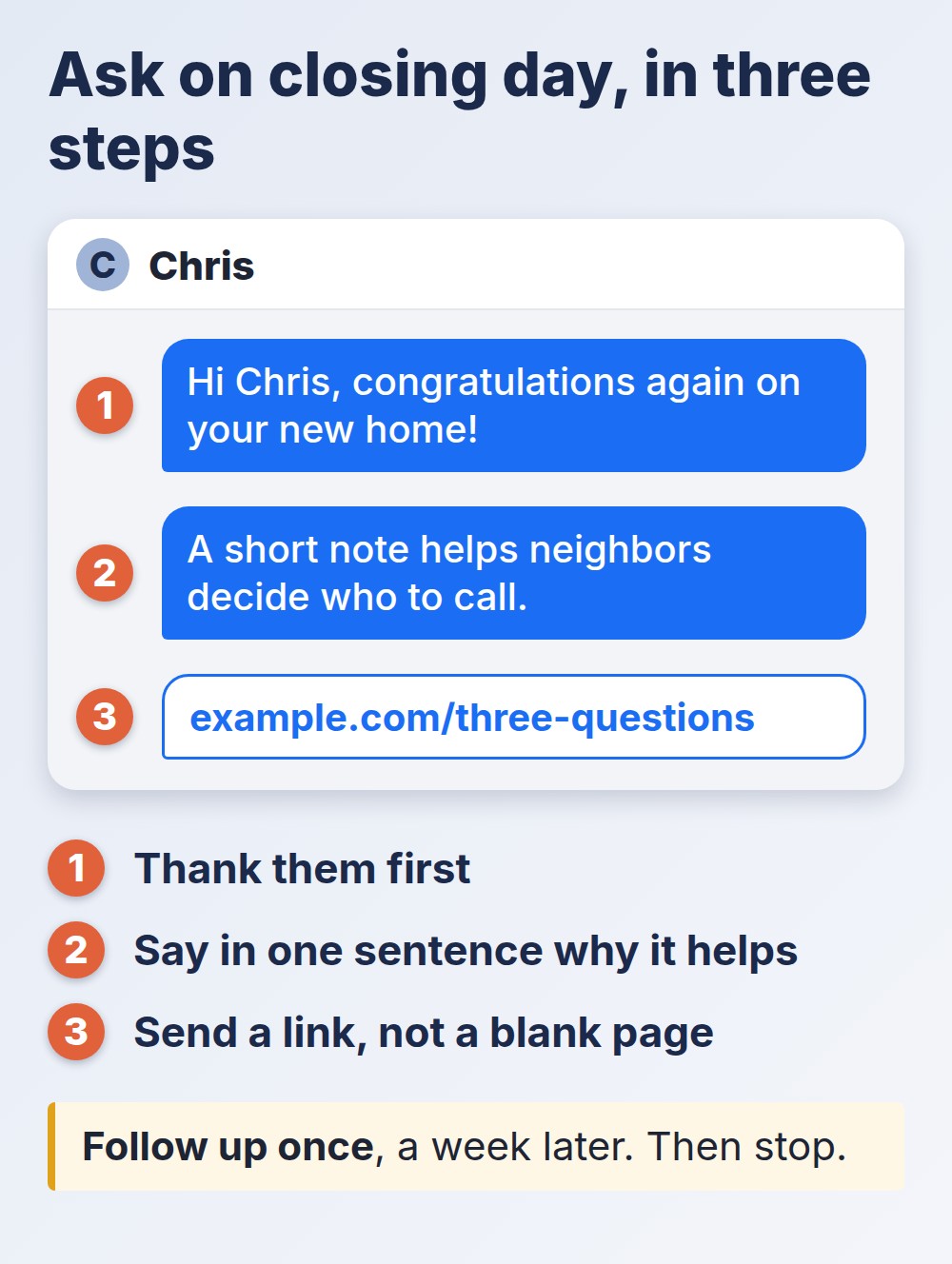
Send the request by email or text, and follow up once a week later if there is no reply. Do not push after that. A request that feels like pressure damages the relationship that earns future referrals, which matters more than one testimonial.
Real Estate Testimonials Examples by Client Type
The invented examples below show how the same structure changes by client. They are not real quotes, and they are here to teach the shape, not to be copied.
- First-time buyer. “I had never made an offer on anything. She walked me through each step before I had to decide, and I never felt rushed.”
- Seller. “She showed us how she priced the home and what she would change before listing. We sold within three weeks and the process felt calm.”
- Relocation buyer. “We toured eight homes in one weekend because she planned the route in advance. We made an offer before we flew home.”
- Investor. “He gave me clear numbers on each property and told me when to walk away. That honesty saved me from one bad deal.”
- Downsizer. “She coordinated the movers, the repairs, and the closing date so we only had one thing to worry about.”
Written, Video, and Third-Party Real Estate Testimonials
Written quotes are the easiest to collect and reuse. A short video of a client saying two sentences about the experience can be more convincing, but it needs written permission to use their face and voice, and it takes more effort from the client, so offer it only to people who volunteer. Reviews on third-party sites carry weight because you do not control them, which is why you should ask for them too and never edit or select them in a misleading way. Use all three, but start with written quotes and a review profile, because they cost the least and cover most of what a visitor wants to see.
How Many Real Estate Testimonials Do You Need?
You do not need dozens. Three to five strong ones on your website, and a steady stream of recent reviews on your profile, cover most visitors. Aim to add one new testimonial after every closing, and retire quotes that are more than two or three years old. Recent and specific beats large and old, because a reader notices dates, and an old quote about a market that no longer exists weakens the rest of your page.
Where to Use Real Estate Testimonials
Use the same few strong lines in every channel, so the proof reaches people wherever they find you.
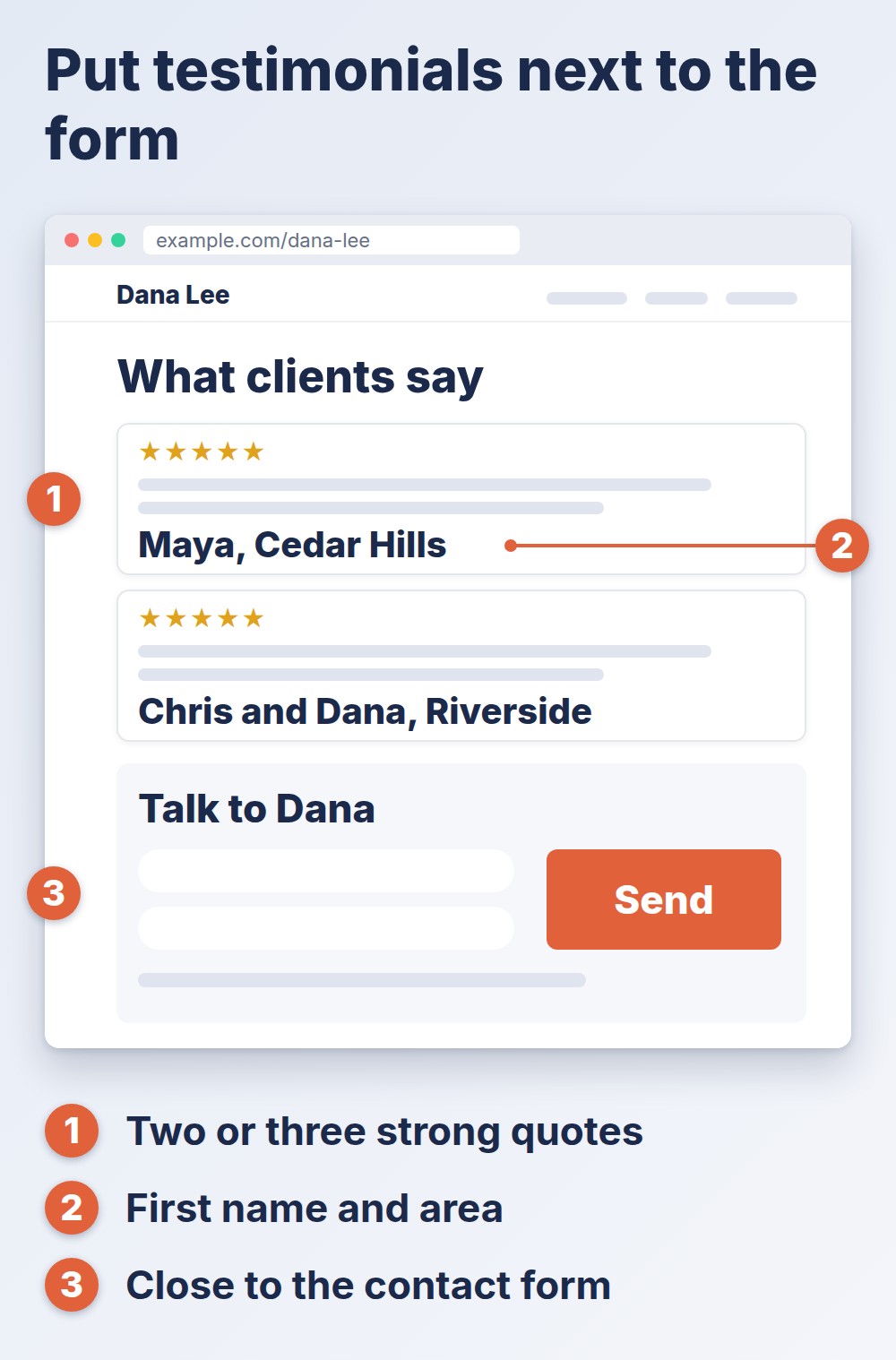
- Your website. Put two or three near your contact form, with the client’s first name and neighborhood.
- Your Google profile. Ask for reviews there too, and follow the rules in our guide to a Google Business Profile for realtors.
- Your bio and listing materials. One short line works well beside your photo.
- Social posts and email. Share a testimonial with the story behind it, with the client’s permission.
The Rules for Real Estate Testimonials
Testimonials are advertising, so the same honesty rules apply. The FTC’s rule on consumer reviews and testimonials, in effect since October 21, 2024, bans fake or false testimonials, buying reviews in a way that requires or implies a particular sentiment, and undisclosed insider reviews. It also bans using intimidation or false accusations to suppress a review. The FTC’s Q&A says the rule covers testimonials a business publishes on its own website, so do not assume your own pages are exempt.
The FTC’s endorsement guidance adds two points. If you gave an endorser something of value, such as a gift, that connection should be disclosed when readers would not expect it. And an unusually good result should not be presented as typical unless you can show it is. Keep it simple: use real words from real clients, get written permission to publish them, and do not edit a quote in a way that changes its meaning.
Fair housing law applies to the wording too. If a client’s quote describes who a home or a neighborhood is for, such as families of a certain kind, do not publish it, because 24 CFR 100.75 on discriminatory advertisements applies to housing advertising. Ask your brokerage whether it has its own testimonial rules before you publish anything.
Handling a Bad Review
A negative review is not a crisis. Reply politely and briefly, say what you will do about it, and take the rest offline. Do not argue in public or accuse the reviewer of something you cannot prove, because the FTC rule bans false accusations meant to change or remove a review. A calm reply often earns more trust than a perfect record would.
Keep a Testimonial File
Store each testimonial with the client’s name, the date, the source, and a note that you have permission to publish it. Review the file each quarter, and replace old quotes with new ones. Add the source of each new client in your CRM, as the simple marketing plan template suggests, so you can see whether testimonials produce conversations.
Final Thoughts
Real estate testimonials turn your reputation into something a stranger can read. Ask at closing, ask three short questions, aim for a specific situation and result, use the same lines across your website, profile, and bio, and keep every word real. Follow the FTC rules, get permission, and keep a file. A handful of honest, specific quotes will do more for you than a wall of vague praise.
