
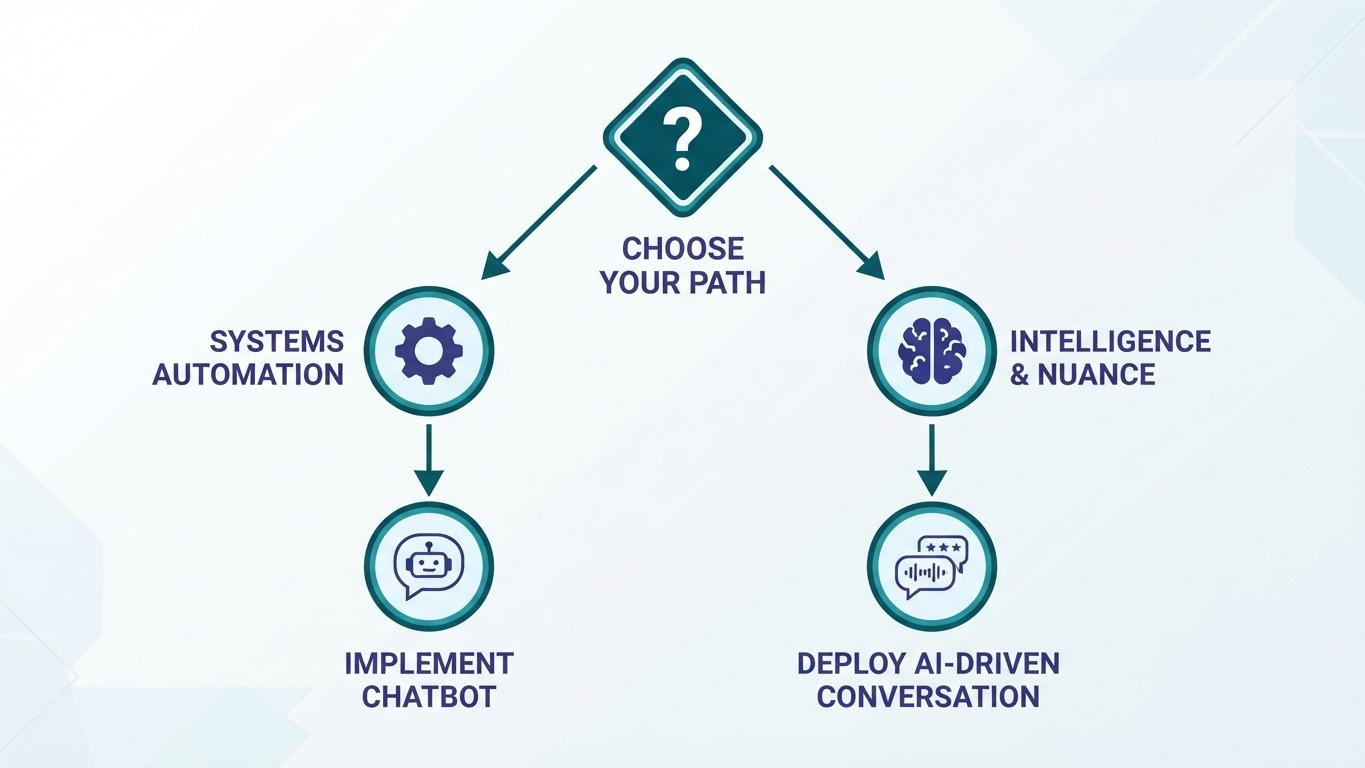
The chatbot vs conversational AI debate matters more than most real estate agents realize. Real estate agents shopping for automation tools run into a confusing landscape: vendors use “chatbot” and “conversational AI” interchangeably, but the two are fundamentally different technologies with very different capabilities and price points. Buying the wrong one — or more commonly, buying a chatbot when you need conversational AI (or vice versa) — leads to wasted budget and a tool that never gets used.
This guide cuts through the marketing language and explains the chatbot vs conversational AI divide — what each technology actually does, where the line between them sits, and which one makes sense for your real estate business right now.
What Is a Chatbot?

A chatbot is a software program that simulates conversation by following predefined rules or decision trees. When a user sends a message, the chatbot matches it against a set of expected inputs and returns a scripted response. Early chatbots were purely keyword-based — if you typed “schedule a showing,” it looked for the word “schedule” and triggered a booking flow. More modern chatbots use basic Natural Language Processing (NLP) to understand variations in phrasing, but they still operate within fixed conversation flows that a human has designed in advance.
Think of a chatbot as a very sophisticated FAQ page. It can handle the questions you anticipated when you built it — property availability, process questions, contact capture, appointment booking — and handle them reliably and at scale. What it cannot do is handle questions you didn’t anticipate, maintain context across a complex multi-turn conversation, or adapt its approach based on what it has learned about a specific lead.
Rule-based chatbots and basic NLP chatbots are what most real estate agents encounter when they use tools like ManyChat for Instagram DMs, Chatbot.com for website widgets, or simple lead capture flows on landing pages. They are affordable, easy to set up, and effective for the specific use cases they were designed for.
What Is Conversational AI?

Conversational AI is a broader category of technology that enables computers to understand, process, and respond to human language in a natural, context-aware way. Modern conversational AI is powered by Large Language Models (LLMs) — the same technology behind ChatGPT — which are trained on vast amounts of text and can generate dynamic, contextually appropriate responses rather than selecting from a predefined list.
The key distinction is intelligence and adaptability. A conversational AI system understands intent rather than just keywords, maintains context across an entire conversation (so it remembers what a lead said five messages ago), handles unexpected questions gracefully, and improves over time through ongoing training. It can hold an open-ended conversation about a lead’s housing needs, adjust its qualification questions based on the answers it receives, and respond differently to a first-time buyer than it does to an investor — all without a human scripting those specific scenarios.
In real estate, purpose-built conversational AI platforms like Structurely and Ylopo’s rAIya fall into this category. They are not following a chatbot script — they are generating contextually appropriate responses based on the full history of a conversation and real estate-specific training data.
Chatbot vs Conversational AI: The Key Differences
| Feature | Chatbot | Conversational AI |
|---|---|---|
| How it works | Predefined rules and scripts | LLM-generated dynamic responses |
| Language understanding | Keyword matching / basic NLP | Deep intent understanding |
| Context retention | Limited (within one flow) | Full conversation history |
| Handles unexpected questions | Often fails or gives generic reply | Handles naturally |
| Personalization | Minimal | High — adapts to each user |
| Setup complexity | Low — drag-and-drop builders | Medium to high |
| Cost | $0–$100/month | $150–$500+/month |
| Best for | Structured tasks, social media, forms | Lead qualification, nurturing, complex Q&A |
Where Chatbots Excel in Real Estate

Chatbots are not inferior to conversational AI — they are purpose-built for a different set of tasks, and in those tasks they often outperform more expensive platforms because of their simplicity and reliability.
Social media lead capture is where chatbots shine brightest for real estate. When a prospect comments on an Instagram listing post or clicks a Facebook ad, a tool like ManyChat triggers immediately, captures the lead’s contact information through a scripted flow, and syncs it to your CRM — all within seconds. The conversation is short, structured, and the chatbot handles it perfectly. Conversational AI is overkill here.
Website FAQ automation is another strong use case. If 80% of your website visitors ask the same five questions — about your commission structure, your service area, how to schedule a consultation — a chatbot can handle those automatically and consistently. You build the flows once, and the chatbot answers the same questions identically for every visitor, around the clock.
Appointment booking works well with chatbots too. When the conversation path is predictable — check availability, offer times, confirm — a chatbot handles it flawlessly and doesn’t require the linguistic sophistication of a conversational AI to do so.
Where Conversational AI Is Essential for Real Estate

The limitations of rule-based chatbots become apparent the moment a lead goes off-script. “I’m interested in this property but I’m not sure if I should sell my current home first — what would you recommend?” A chatbot either fails to parse this or returns a generic “I’ll have an agent contact you” response. Conversational AI can actually engage with the question, ask follow-up questions about the lead’s timeline and equity, and have a meaningful dialogue that moves the lead toward a decision.
Long-term lead nurturing over months is where conversational AI creates the most value in real estate. Most leads are not ready to buy or sell immediately — they are 6, 12, or 18 months away from a transaction. A chatbot can send scheduled follow-up messages, but it cannot have a genuine re-engagement conversation when a lead responds. Conversational AI like Ylopo’s rAIya can pick up a thread after months of silence, reference what the lead previously said, and continue the relationship naturally.
Lead qualification at depth requires conversational AI. Determining whether a lead is pre-approved, their true timeline, their motivation for buying or selling, and their price sensitivity requires a multi-turn conversation with adaptive follow-up questions. Chatbots can collect this information if a lead answers every question linearly, but conversational AI handles the messy reality of how people actually communicate.
Inbound phone and voice inquiries require conversational AI by definition. Handling a live phone call — with all its ambiguity, interruptions, and non-linear flow — is beyond any rule-based chatbot. Platforms like Crescendo that use conversational AI to handle inbound calls are doing something categorically different from a chatbot.
The Emerging Middle Ground: AI-Powered Chatbot Builders
The line between chatbot and conversational AI is blurring. Modern chatbot builders like Tidio now include LLM-powered AI layers (Lyro) that can handle questions outside the scripted flows. Intercom’s Fin AI agent uses a conversational AI core but is deployed through what most people would call a “chatbot” interface. Even ManyChat is adding AI features that allow for more flexible responses within its Messenger flows.
The practical implication for real estate agents: you no longer have to choose between a cheap-but-rigid chatbot and an expensive-but-flexible conversational AI platform. Many mid-range tools now offer a hybrid approach — structured flows for common tasks, AI fallback for edge cases — that delivers most of the benefit of conversational AI at a fraction of the cost.
For real estate teams still unsure about the chatbot vs conversational AI choice, the hybrid platforms listed above offer a practical middle path — start with chatbot functionality, then upgrade to conversational AI when your lead volume demands it.
Which Does Your Real Estate Business Actually Need?
The chatbot vs conversational AI question is ultimately a budget and complexity question. For most independent agents, the chatbot vs conversational AI decision comes down to one factor: how complex are the conversations your leads actually have? If they are short, structured, and predictable, a chatbot handles them perfectly. If they require nuance, memory, and adaptive responses, conversational AI is worth the investment. Understanding chatbot vs conversational AI differences before you buy saves you from paying for capabilities you do not need — or settling for a tool that cannot do the job.
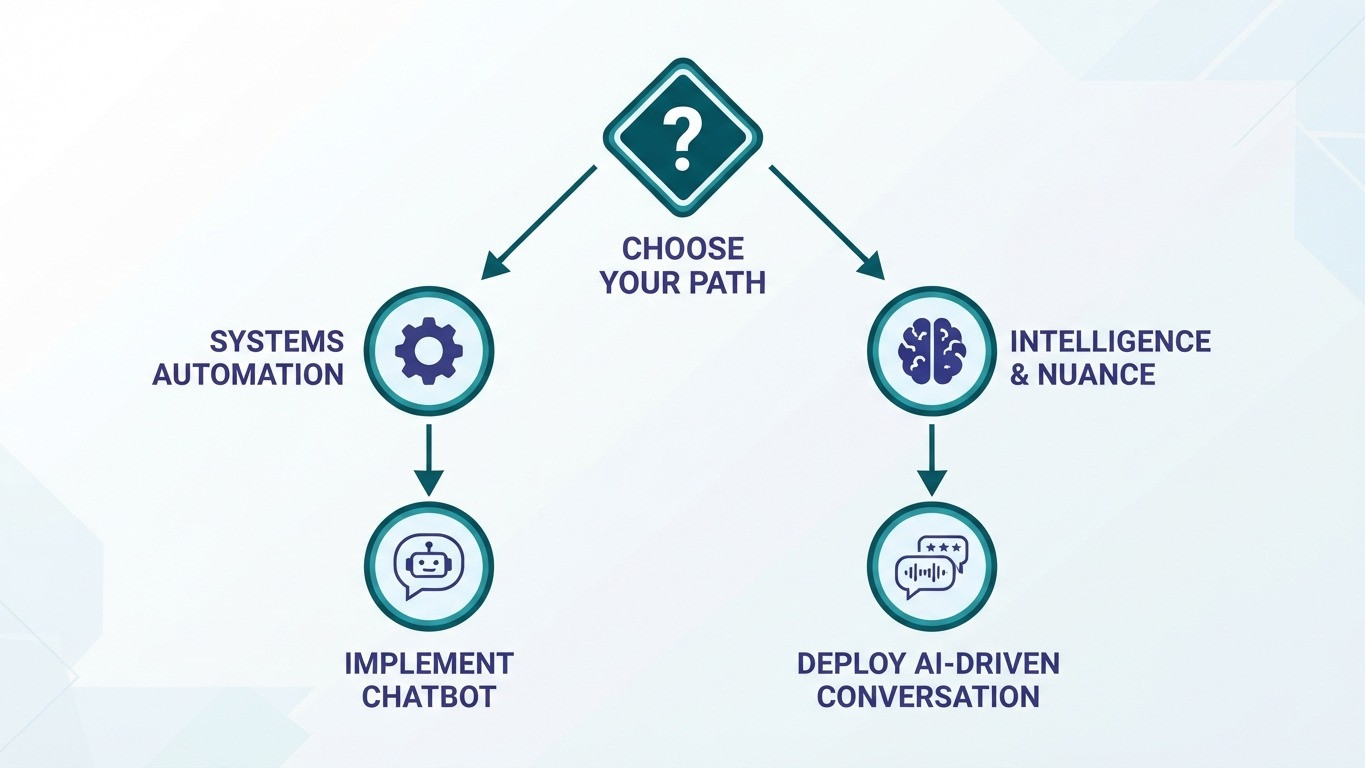
The answer depends on where your biggest lead conversion gap is and what your budget allows.
Start with a chatbot if: you are primarily generating leads from social media, your website traffic is modest, your leads mostly ask the same predictable questions, and you want to get something live quickly without significant investment. A well-built chatbot that captures leads on your website and Instagram will deliver a strong ROI for most independent agents and small teams.
Upgrade to conversational AI if: you are handling significant lead volume and losing deals because follow-up isn’t fast or sustained enough, your leads require complex qualification before agent handoff, you have a large database of cold leads that need re-engagement, or you want to automate phone qualification and not just text-based chat. At this stage, the cost of conversational AI is easily justified by the incremental conversions it drives.
The honest answer for most agents: start with a chatbot, measure results for 90 days, then evaluate whether the leads slipping through the gaps justify the upgrade to conversational AI. For high-volume teams and brokerages, conversational AI is almost always worth it from day one — the ROI on even one additional closing per month covers a year of platform costs.
Related reading: Best Chatbot Customer Service Tools for Real Estate Teams, Best Chatbot Builders for Real Estate Agents, and AI Voice Assistants Compared.
Final Thoughts
The chatbot vs conversational AI distinction is not a question of which technology is better — it is a question of which is appropriate for your current situation. A chatbot is a reliable, affordable automation layer for structured tasks. Conversational AI is a more expensive but dramatically more capable system for the complex, open-ended conversations that drive real estate transactions.
Most real estate businesses will benefit from starting with a chatbot and adding conversational AI as their lead volume and sophistication grow. The important thing is to understand what you are buying before you buy it — so you set the right expectations, configure it correctly, and actually get the ROI the vendor promises.
Related: See our full roundup of Conversational AI Chatbots Ranked for Agents.
