
The central decision in web design for real estate agents is not which color palette to use or whether to include a video header – it is whether to build your own website using a real estate website platform or to hire a designer to build something custom. Both approaches can produce excellent results. Both can produce expensive mistakes. The right choice depends on your budget, your technical comfort level, how differentiated your brand needs to be, and how much lead generation pressure you expect your website to carry. This guide covers what web design for real estate agents actually costs across both paths, and what you get for your money.

DIY Web Design for Real Estate Agents: Platforms and Costs
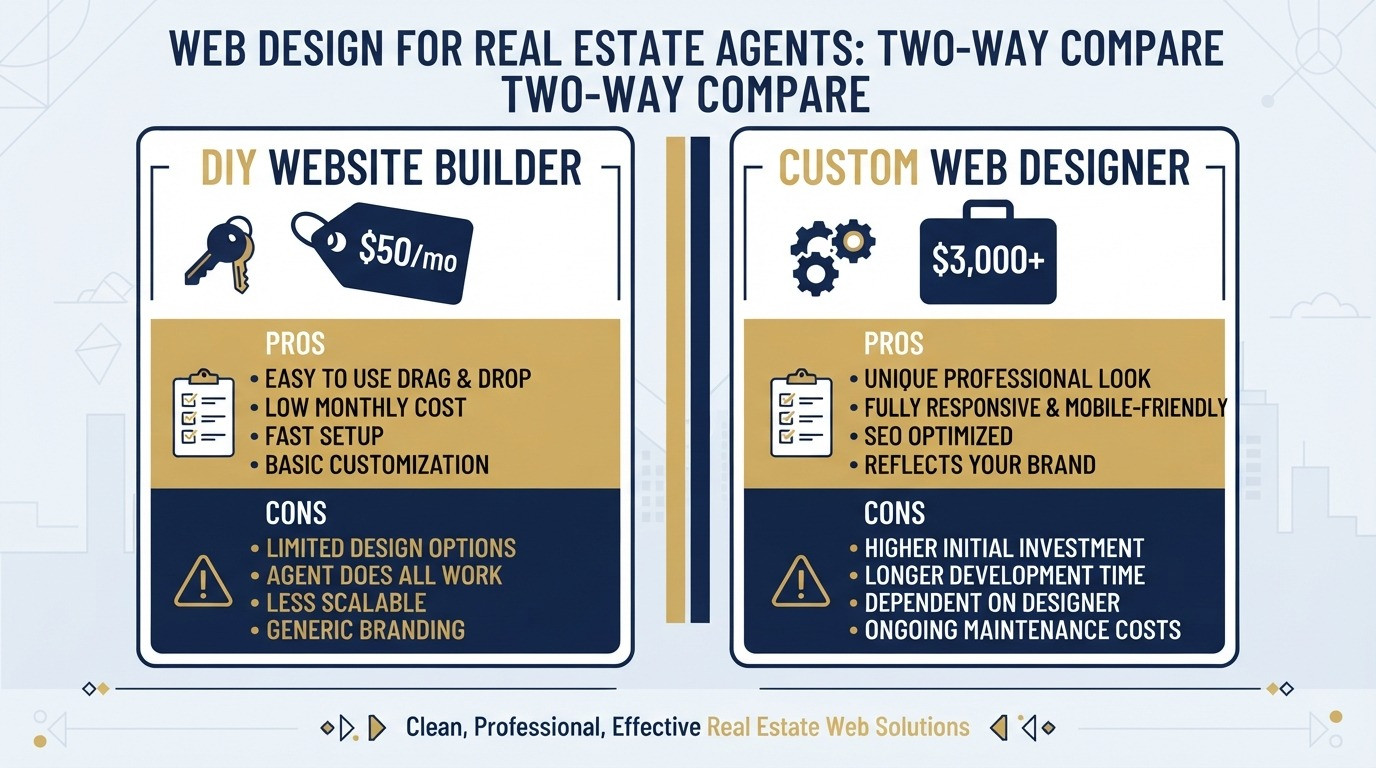
The DIY path for web design for real estate agents means using a real estate website platform that provides templates, IDX integration, and hosting in a single subscription. These platforms handle the technical infrastructure – hosting, security, IDX data feeds, mobile responsiveness – while you control the content, imagery, and basic customization within the template constraints.
Real Geeks ($299/month) provides lead-generation-optimized templates with strong IDX integration and a built-in CRM. The design options are limited but the conversion performance is consistently high. For agents who want results without design decisions, Real Geeks is the most straightforward DIY option.
AgentFire ($149-$399/month) offers more design customization than most IDX platforms – custom color schemes, typography, and homepage layouts – while still providing IDX integration and real estate-specific features. AgentFire sits in the middle of the DIY-to-custom spectrum: more flexibility than generic templates, less than a fully custom build.
Placester ($99/month) is the most affordable full-featured option for web design for real estate agents on the DIY path. Design options are template-based with limited differentiation, but the platform is clean, mobile-responsive, and includes IDX integration that meets most agents’ needs.

Hiring a Designer for Real Estate Agent Web Design
Custom web design for real estate agents through a specialized agency or freelancer produces something no platform template can replicate: a website that is genuinely unique to the agent’s brand, market, and positioning. This matters most for luxury agents, team leaders, and brokers whose brand distinction is a meaningful competitive advantage.
The cost range for custom real estate web design varies significantly. A freelance designer building a WordPress site with IDX integration typically costs $2,000 to $6,000 for design and development, plus ongoing hosting and IDX subscription fees. A specialized real estate web design agency like Luxury Presence charges $5,000 to $15,000+ for fully custom builds with ongoing management fees. The investment is justified when the website needs to signal premium positioning that template sites cannot achieve.
The risk with custom design is the opposite of the risk with platform templates: custom sites may look excellent but lack the real estate-specific functionality – IDX integration, lead capture optimization, CRM connectivity – that platforms build in by default. Vetting a web designer’s real estate experience and their IDX integration partners before signing any contract is essential.
What Good Web Design for Real Estate Agents Requires Regardless of Path
IDX property search. Whether you build DIY or hire a designer, your website needs IDX integration to give buyers a reason to register and return. This is non-negotiable for agents investing in online lead generation. Confirm IDX data agreements are in place for your specific MLS before committing to any platform or agency.
Mobile performance under 3 seconds. Over 60% of real estate website traffic is mobile. Both DIY platforms and custom designers vary significantly in mobile performance. Test on Google’s PageSpeed Insights before selecting a platform or approving a custom build.
Local content architecture. Neighborhood pages, local market data, and location-specific landing pages are the content that drives organic search traffic for real estate agents. The best web design for real estate agents builds this content structure into the site architecture from the start, rather than adding it as an afterthought.
Lead capture at every high-intent moment. Registration prompts when saving listings, home valuation offers on seller-focused pages, and neighborhood market report downloads all convert traffic into leads. Effective web design for real estate agents places these capture points at the moments when visitor intent is highest.
Which Path Is Right for You?
DIY platform design is the right choice if you are within the first three years of your career, if you need to control monthly costs carefully, or if lead generation volume matters more to you than brand distinction. The platform handles the technical complexity and the lead capture optimization – you focus on content and client relationships.
Custom design is the right choice if you are a luxury agent where design quality signals market positioning, if you lead a team or brokerage with serious brand identity investment, or if you have specific functionality requirements that platform templates cannot accommodate. The investment is meaningful – plan for $5,000 to $15,000 for a genuinely custom build – but the result is a website that no template site can replicate.
For a full overview of the design decisions that affect performance most directly, see our guide to what actually makes a site convert. For platform comparisons that include pricing, IDX quality, and design flexibility, our platform-by-platform breakdown covers every major option.
Final Thoughts
The best web design for real estate agents is the one you can actually execute well within your budget and maintain over time. A $15,000 custom site that never gets updated outperforms an expensive template that is actively managed with fresh content and consistent lead follow-up. Start with the platform that fits your current stage, invest in the content and lead capture strategy, and upgrade the design when the business justifies it.
