
Real estate farming means choosing one small, defined area and marketing to the same homes every month until you are the agent people think of when someone there decides to sell. It is slow by design, so the work that matters most happens before you send anything: picking a farm that is worth working, then showing up for a full year.
What Is Real Estate Farming and Does It Still Work?
Real estate farming is a long-term lead strategy built on repetition. You pick a neighborhood, a condo building, or a set of streets, then reach the same households on a steady schedule with mail, notes, events, calls and visits. People do not move on your timeline, so the goal is to be familiar and useful when they do.
It still works for a plain reason: most homeowners will not sell this year, and the ones who will often have no agent in mind. A farm lets you be the name already on their fridge. It does not work as a quick fix. If you need closings in the next 60 days, put your effort into your referral and past client work first and treat a farm as the slow engine you start alongside it.

Farming also fits into the bigger picture in our guide to the full marketing strategy, where it sits with the channels you build over time rather than the ones you switch on and off.
How Do You Choose a Farm for Real Estate Farming?
Choose a farm with data, not with a feeling for a pretty street. The Pennsylvania Association of Realtors, in its guide to geographic farming, lists five checks: average price, farm size, turnover rate, months of inventory and competition. Your MLS can answer most of them.
| Check | How to measure it | Rule of thumb |
|---|---|---|
| Turnover rate | Homes sold in the last 12 months divided by total homes, times 100 | About 6 to 7 percent or higher |
| Average price | Sold prices over the last two years, and what a commission on one sale would be | High enough that a few listings justify the year |
| Farm size | Count of homes, or contacts you can reach | 250 to 500 homes for a first farm |
| Months of inventory | Active listings divided by average monthly sales over 12 months | 5 to 6 months is a balanced market |
| Competition | Who has signs, mailers and the most recent listings in the area | Look elsewhere if one agent dominates |
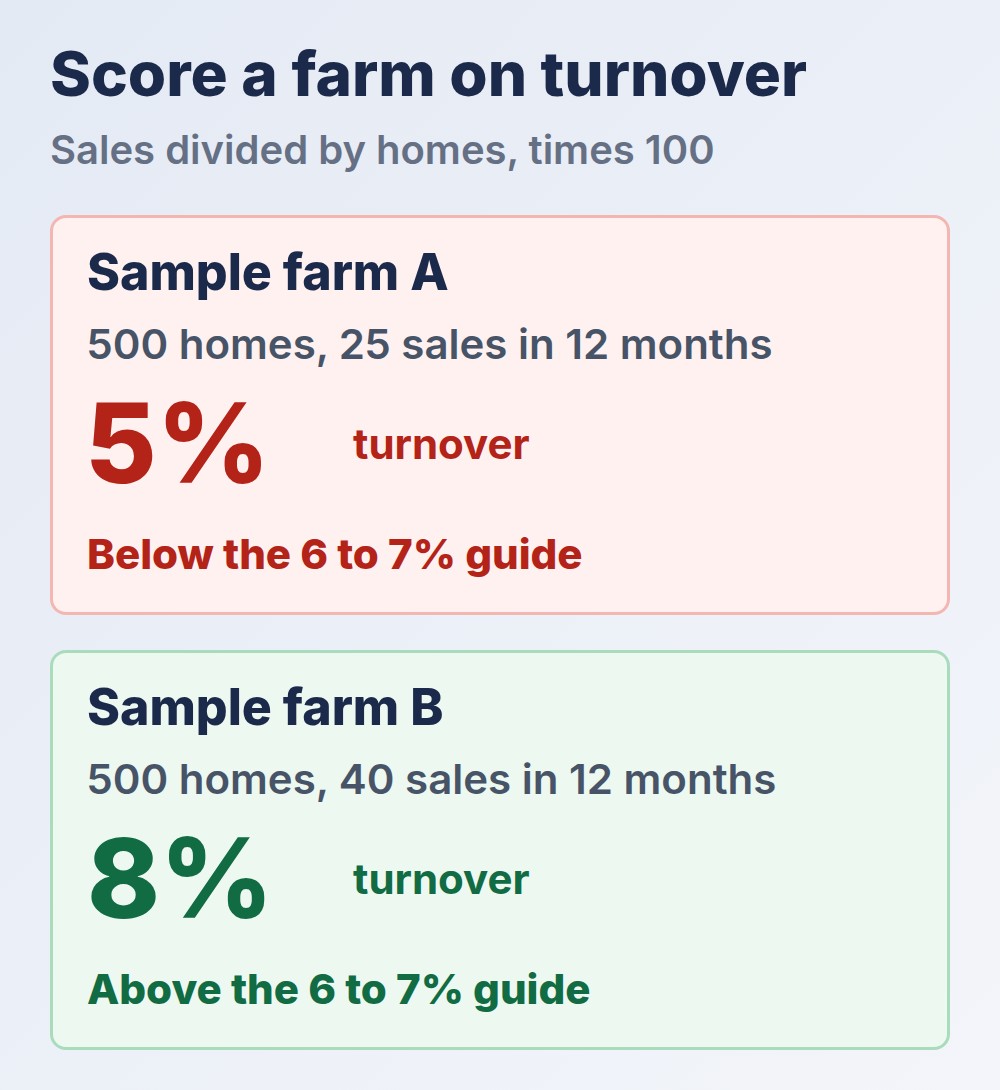
Turnover is the number to protect. A farm of 500 homes with 25 sales in a year has a 5 percent turnover, which falls under the thresholds above. Another farm of 500 homes with 40 sales has 8 percent and gives you more chances to talk to a seller each year. Sources disagree on the exact floor, so treat 6 to 7 percent as a guideline and compare candidate areas against each other rather than against a magic number. NowBam’s farm selection guide cites Tom Ferry at 6 percent or more and suggests checking the last five years, not just one.
How Big Should a Real Estate Farm Be?
Smaller than you think. The Pennsylvania Association of Realtors suggests a new agent start with up to 500 homes and says not to spread yourself too thin. NowBam, summarizing a guideline from Gary Keller, says a farm should give you at least 250 contacts you can reach consistently.
Farm size should follow budget, because every touch repeats for every home. If you can afford a monthly mailer to 300 homes but not to 1,000, choose 300. A small farm you cover well beats a large one you reach twice. Start with a defined boundary, such as one subdivision or a few streets, so you can say exactly who is in it and who is not.
How Do You Check the Competition Before You Commit?
Search your MLS for the last 12 months of listings in the farm and note which agents and brokerages appear. Then look at the area itself: yard signs, mail that has landed in a neighbor’s hands, and how often one name repeats. If a single agent holds most of the listings and shows up everywhere, you will spend a year fighting for second place.
That does not rule an area out forever. A competitor who dominates sold signs may be weak on follow-up, or may have lost steam. Still, a first farm should be one where you can become visible quickly, so a second choice with open space is better than a first choice you cannot move into.
What Does a 12-Month Real Estate Farming Plan Look Like?
A real estate farming plan needs a calendar, because the point is consistency. The plan below is our suggested shape, not a fixed formula. Adjust the touches to what you can keep up, and do not start something you cannot repeat for 12 months.
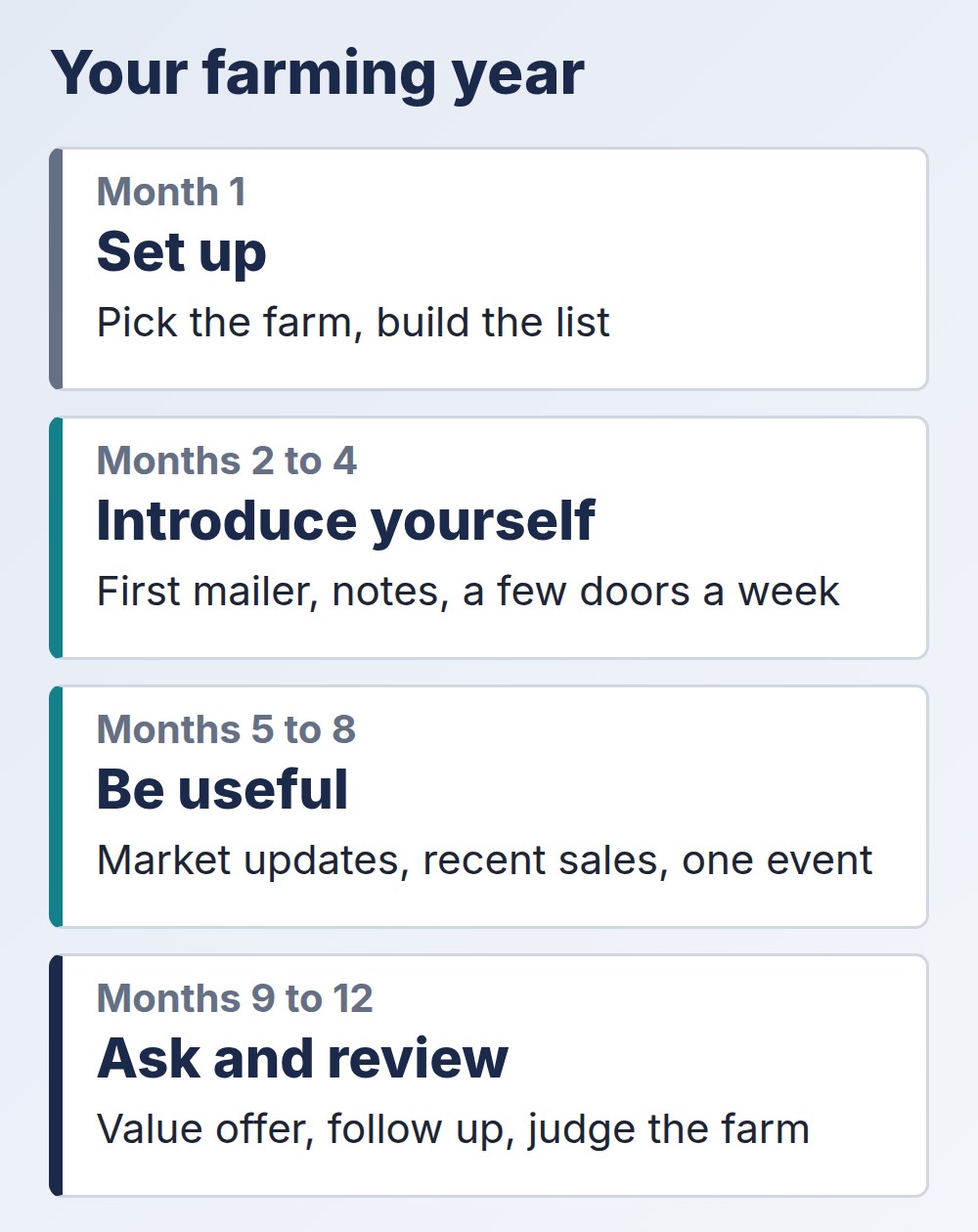
- Month 1: set up. Choose the farm, pull the sold data, build the address list, and set tags in your CRM so every contact has a farm label. Our guide to CRM marketing for real estate covers the follow-up side.
- Months 2 to 4: introduce yourself. Send a first mailer, drop a short note, and knock on a handful of doors a week. Our guide to real estate postcards and mailers covers what to put on the card.
- Months 5 to 8: be useful. Share local market updates, recent sales and one event, such as a neighborhood cleanup or a seasonal gathering. A real estate flyer works well for the event.
- Months 9 to 12: ask and review. Offer a home value conversation, follow up on every response, and review what the farm produced before you renew it for a second year.
Keep a mix. A mailer every month with nothing else becomes wallpaper. Alternate a mailed piece, a hand-written or hand-delivered touch, and a conversation, so the household sees you in more than one way.
How Much Does Real Estate Farming Cost?
The cost is mostly postage, printing and your time, and the mail part is easy to calculate. USPS describes Every Door Direct Mail as a way to reach every address on selected routes without a mailing list. EDDM Retail needs no permit and allows from 200 to 5,000 pieces per day per ZIP Code, with flat pieces up to 3.3 ounces priced at $0.26 each when we checked the USPS page. Postage rates change, so confirm the current price before you budget.
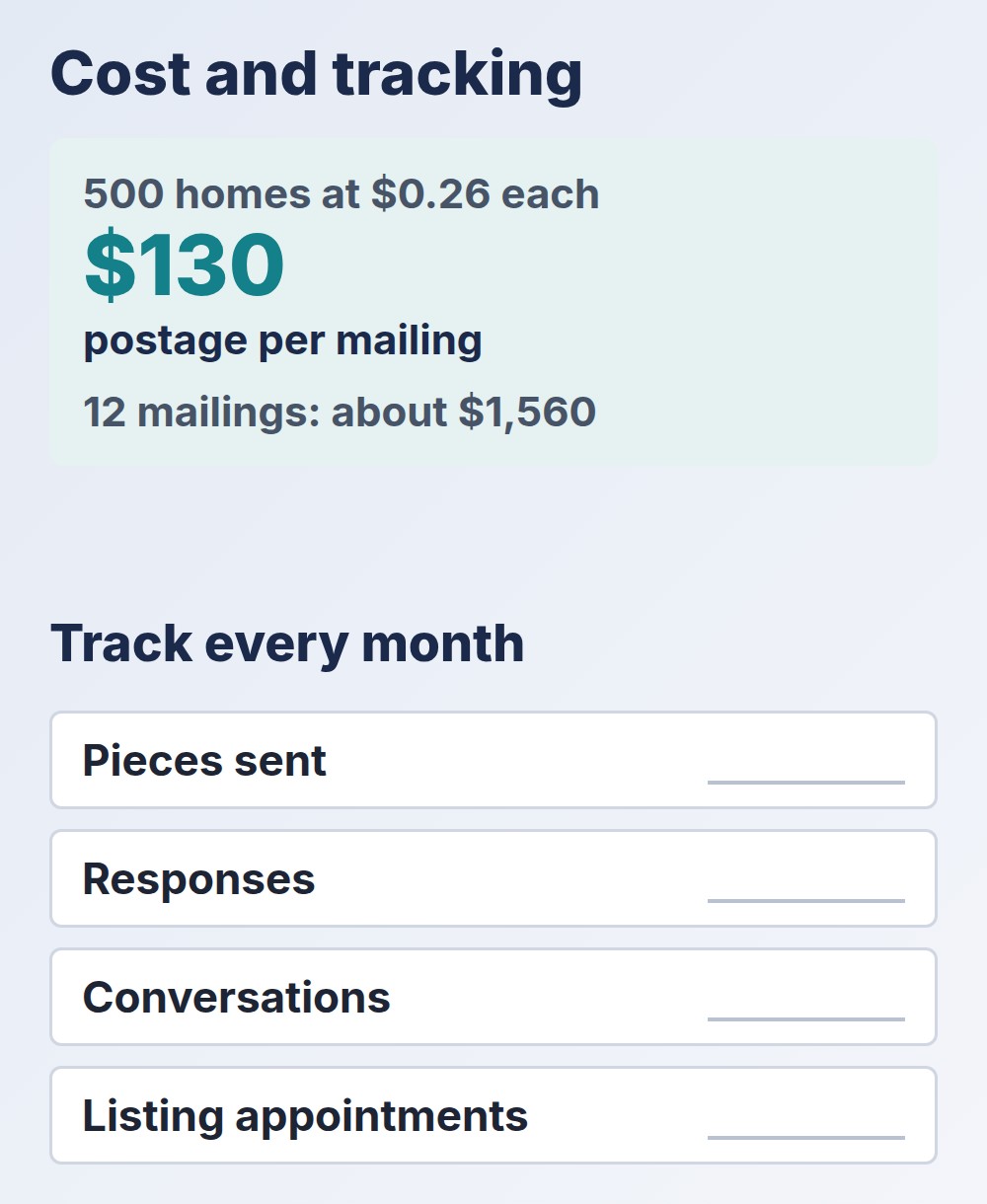
Here is the arithmetic for a 500-home farm using that rate. One mailing costs about $130 in postage ($0.26 times 500). Twelve monthly mailings cost about $1,560 in postage, before design and printing. A 300-home farm brings the same year of postage to about $936. These are postage-only figures to plan with, not a prediction of what you will earn.
Plan real estate farming inside your whole budget rather than on top of it. Our marketing plan template shows how to split spend across channels, so the farm does not quietly eat everything else.
How Do You Measure Whether Real Estate Farming Is Working?
Track the farm like any other lead source. Count what you sent, who responded, how many real conversations you had, how many listing appointments came from it, and what it cost. Farming is slow, so judge it at 12 months and look for direction at six, not for a payoff at month two.
Use the yardsticks in the sources as rough guides. NowBam, again citing Gary Keller, describes a target of about one transaction a year for every 50 homes in the farm. Compare that with your own results and with the turnover you measured at the start. If turnover was 7 percent but you captured no listings, the area is fine and the work needs to change. When your touches were consistent and the area quietly dried up, move to a different farm in year two.
One practical habit pays off most. Every response, whether a call, a reply card or a chat at the door, goes into your CRM the same day with a date to follow up. Infina AI, our own product, is an AI assistant for real estate agents built to help with the follow-up and listing-question side, so a response from the farm does not sit unanswered for a week.
Fair Housing and Contact Rules for Real Estate Farming
Farm by market data, not by who lives there. Federal rules on housing advertising, summarized in 24 CFR 100.75, prohibit ads, statements and notices about a dwelling that show bias based on protected classes. Keep mailer wording and targeting neutral, and have your broker review anything that describes a neighborhood’s residents.
If your plan adds phone calls or texts, the rules change. Check the National Do Not Call Registry and your consent records before you dial, and read our guide to TCPA compliance for real estate agents first. Mail and a knock at the door fall under different rules, and local solicitation laws vary, so ask your broker and check city or county rules before you go door to door.
Common Real Estate Farming Mistakes
- Picking a farm by looks. A pretty street with low turnover leaves you few sellers to talk to.
- Making it too big. Reaching 1,000 homes twice is worse than 300 homes twelve times.
- Quitting at month four. Farming rewards repetition, so stopping early wastes what you already spent.
- Sending only one kind of touch. Mix mail, a note and a face.
- Not tracking responses. A farm without records cannot be judged or improved.
- Ignoring the rules. Fair housing, do not call and local solicitation rules apply to the farm too.
Final Thoughts
Real estate farming rewards patience and a good first decision. Choose an area with enough turnover and little competition, keep it small enough to cover well, follow a calendar you can repeat for a year, and track what comes back. Judge it at 12 months, then renew, resize or move. A modest farm worked steadily will do more for you than a big one you abandon in spring.
