
Real estate marketing is everything you do to be seen and remembered by people who might hire you, and it is the part of the job that decides whether you spend next year chasing leads or answering calls. This guide covers marketing for real estate agents at every stage: where business actually comes from, the real estate marketing strategies worth your time, how to build a plan and a budget, and how to measure whether any of it works.

What Real Estate Marketing Is, and What It Is Not
Real estate marketing covers every way you make your name, your market knowledge, and your results visible to buyers, sellers, and the people who refer them. That includes a postcard, a Google Business Profile, an Instagram post, a yard sign, a logo, a listing presentation, and a closing gift. Each one does a different job, but all of them answer the same question: when someone in your area thinks about buying or selling, will they think of you?
It helps to draw a line between two stages. Marketing gets attention and builds familiarity. Lead follow-up starts after someone raises a hand: a call, a form, a text. The two feed each other, but they fail differently. Weak marketing leaves you with an empty pipeline. Weak follow-up leaves you with a full pipeline and no closings. This guide stays on the first stage, and when you reach the handoff, our complete lead follow-up automation guide picks up where this one stops.
Where Real Estate Business Actually Comes From
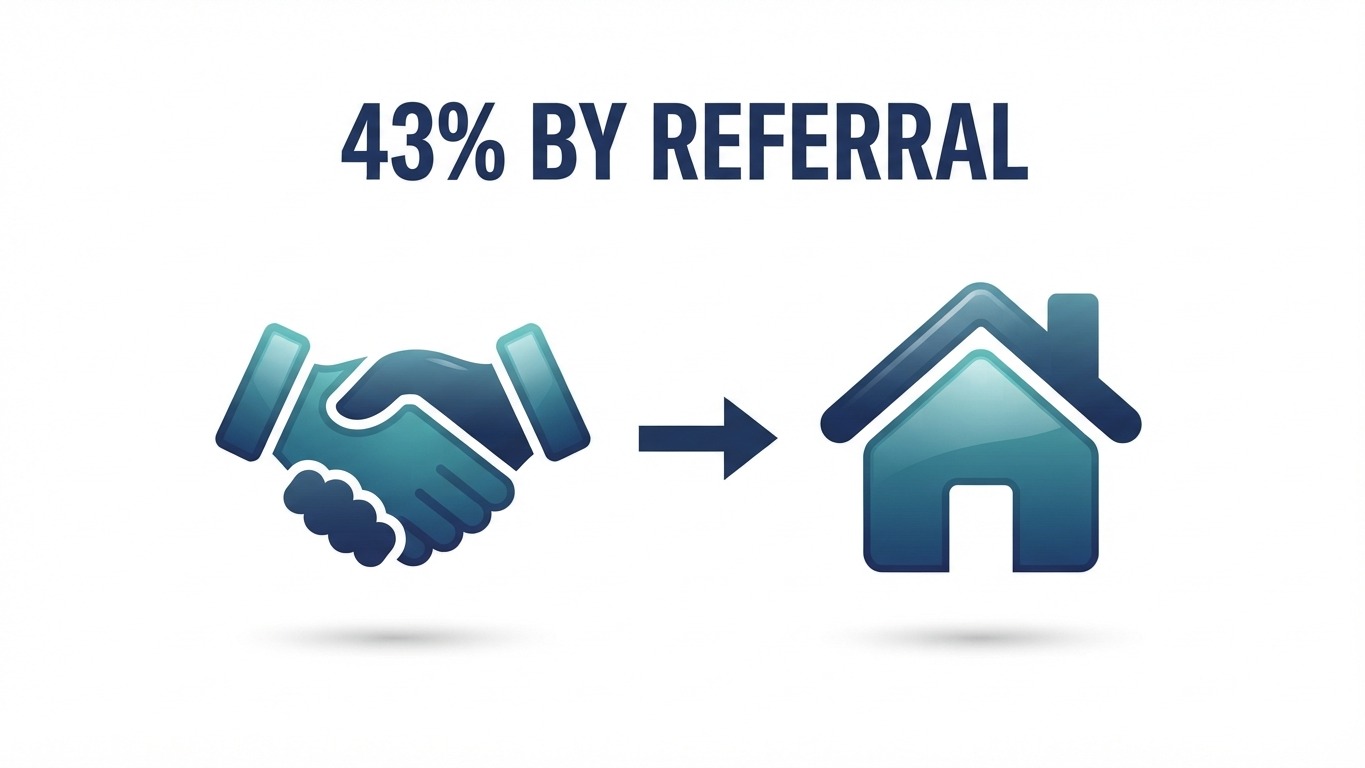
Before you spend a dollar, look at how clients really choose an agent. NAR’s 2025 Profile of Home Buyers and Sellers surveyed people who completed a transaction between July 2024 and June 2025. As summarized by Virginia REALTORS’ key takeaways from the NAR profile, 88% of buyers purchased through an agent or broker, and 43% of buyers used an agent they found through a referral. Another 18% bought through an agent they had worked with before. On the sell side, 66% of sellers found their agent through a referral or used an agent they had worked with in the past.
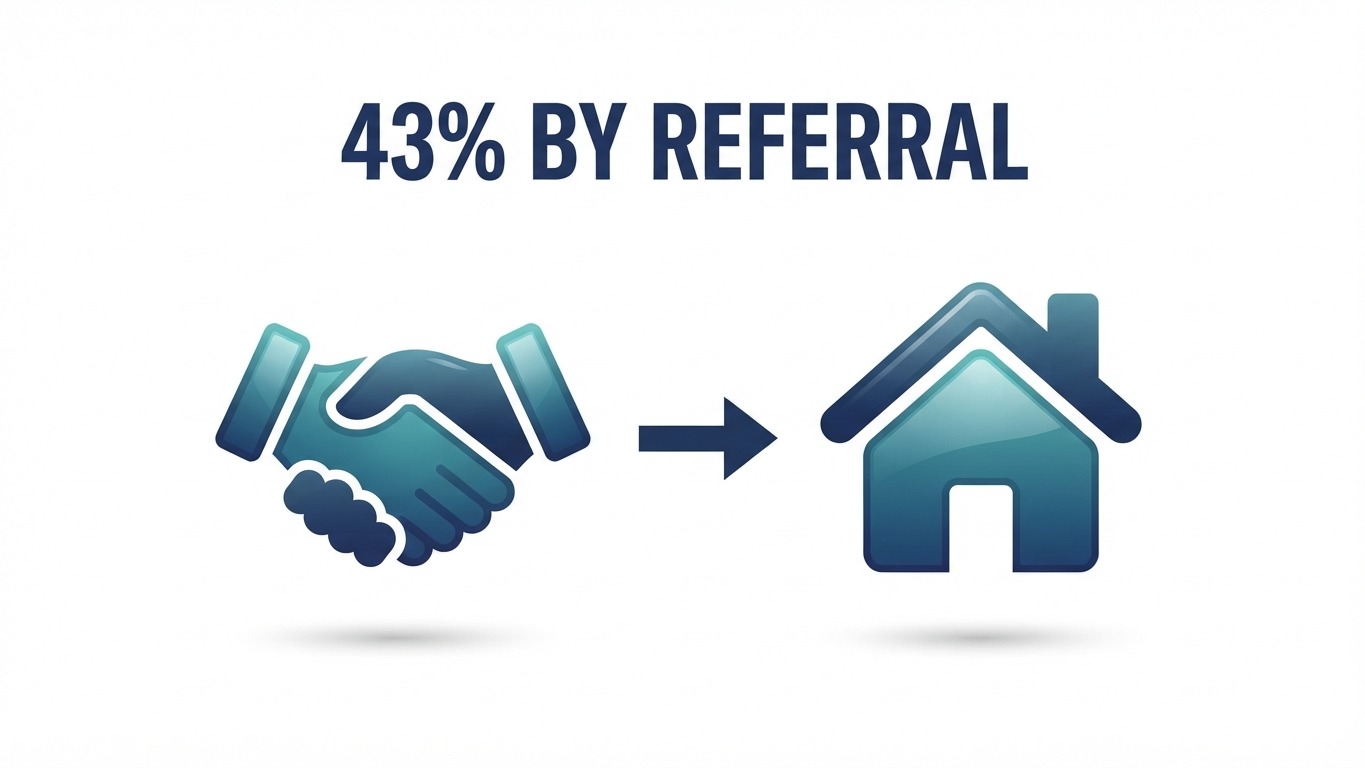
Read that as a statement about memory, not about advertising. Add the two buyer figures and about 61% of buyers came through a referral or a past agent, and two in three sellers did the same. Paid ads, portals, and social media can introduce you to strangers, but the largest single source of business is people who already have your name in their heads. Good real estate marketing is mostly the discipline of staying in front of those people while also adding new ones.
That has a practical consequence for how you spend. A mailer to your own past clients and neighbors, a quarterly update to your contact list, and a clear request for introductions tend to cost less per closing than buying cold leads. Keep that in mind as you compare channels in the next section.
Build a Sphere and Referral System First
Because referrals are the largest source of clients, the first piece of real estate marketing to build is a simple system for your sphere: past clients, friends, family, neighbors, and local contacts. The system has three parts.
- A clean list. Gather every name, address, email, and phone number in one place, with a note on how you know each person.
- A steady rhythm. Contact the list on a schedule: a quarterly market update, a yearly home anniversary note, a seasonal card. Value comes from regular, useful contact, not a pitch.
- A direct ask. Tell people what kind of client you want and ask them to introduce you. Most people are glad to help, but they rarely think of it unless you say it.
A list only works if it is kept current, and the rhythm only works if it does not depend on remembering. That is where a CRM earns its place, as the measuring section below explains.
Real Estate Marketing Strategies Compared
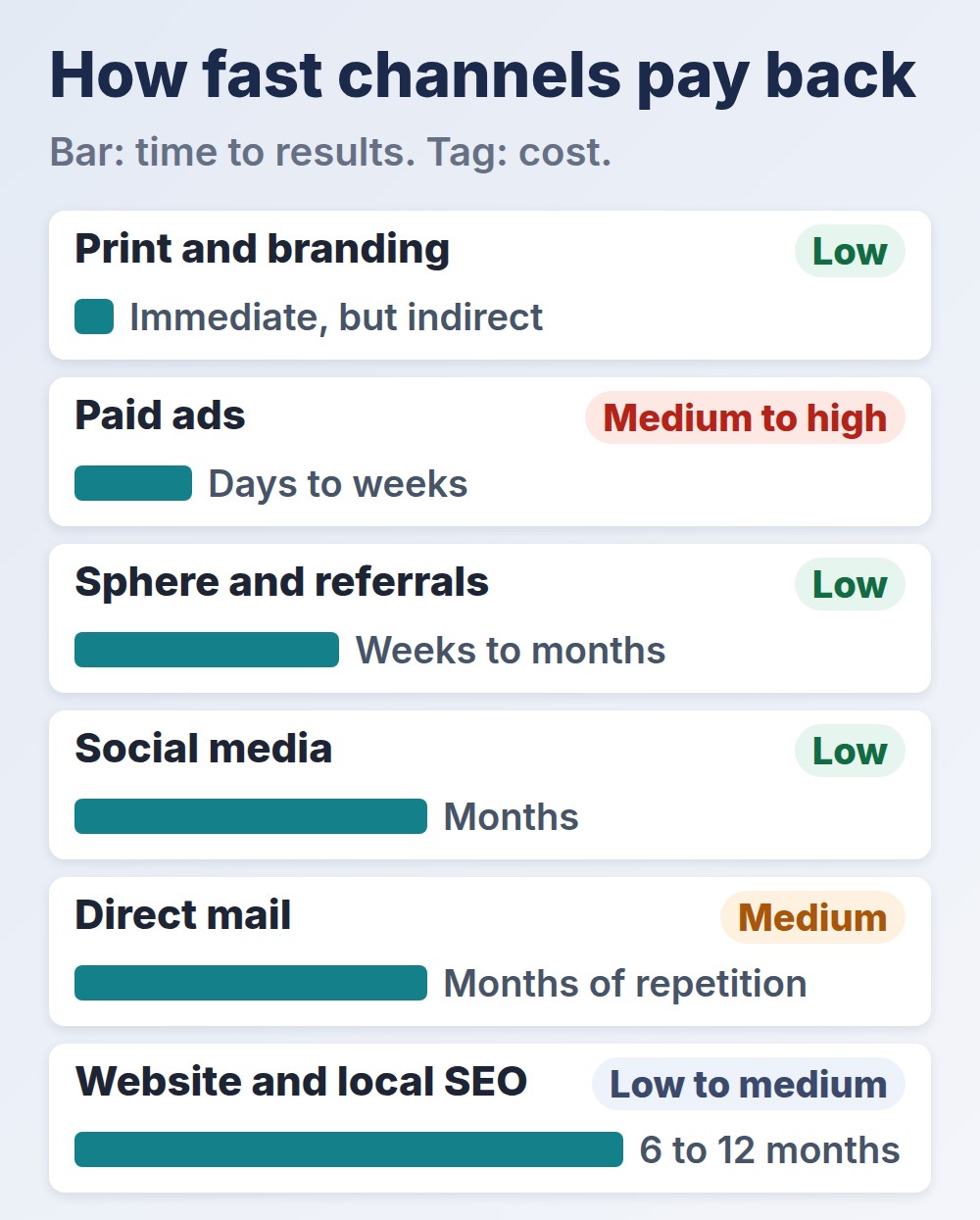
Most real estate marketing strategies fall into six channels. The table below compares them on what they do best, how fast they pay back, and where they tend to go wrong. Cost levels are relative, because your market, your brand, and your volume change the real numbers.
| Channel | Best For | Cost Level | Time to Results | Common Failure |
|---|---|---|---|---|
| Sphere and referrals | Repeat and referred business | Low | Weeks to months | Contacting people only when you need a listing |
| Social media | Staying visible, showing local knowledge | Low (time-heavy) | Months | Posting listings and nothing else |
| Website and local SEO | Searchers who already want an agent | Low to medium | 6 to 12 months | A site with no clear next step |
| Paid ads | Fast lead flow, testing a market | Medium to high | Days to weeks | Leads arrive and nobody follows up fast |
| Direct mail | Farming a neighborhood, past clients | Medium | Months of repetition | One mailing, then nothing |
| Print and branding | First impressions, credibility | Low | Immediate, but indirect | Inconsistent look across every piece |
No agent needs all six at full strength. The usual mistake is spreading a small budget thinly across five channels, then concluding that marketing does not work. Pick two or three, run them long enough to read the result, and add more only when the first ones are working.
Marketing for Real Estate Agents by Career Stage
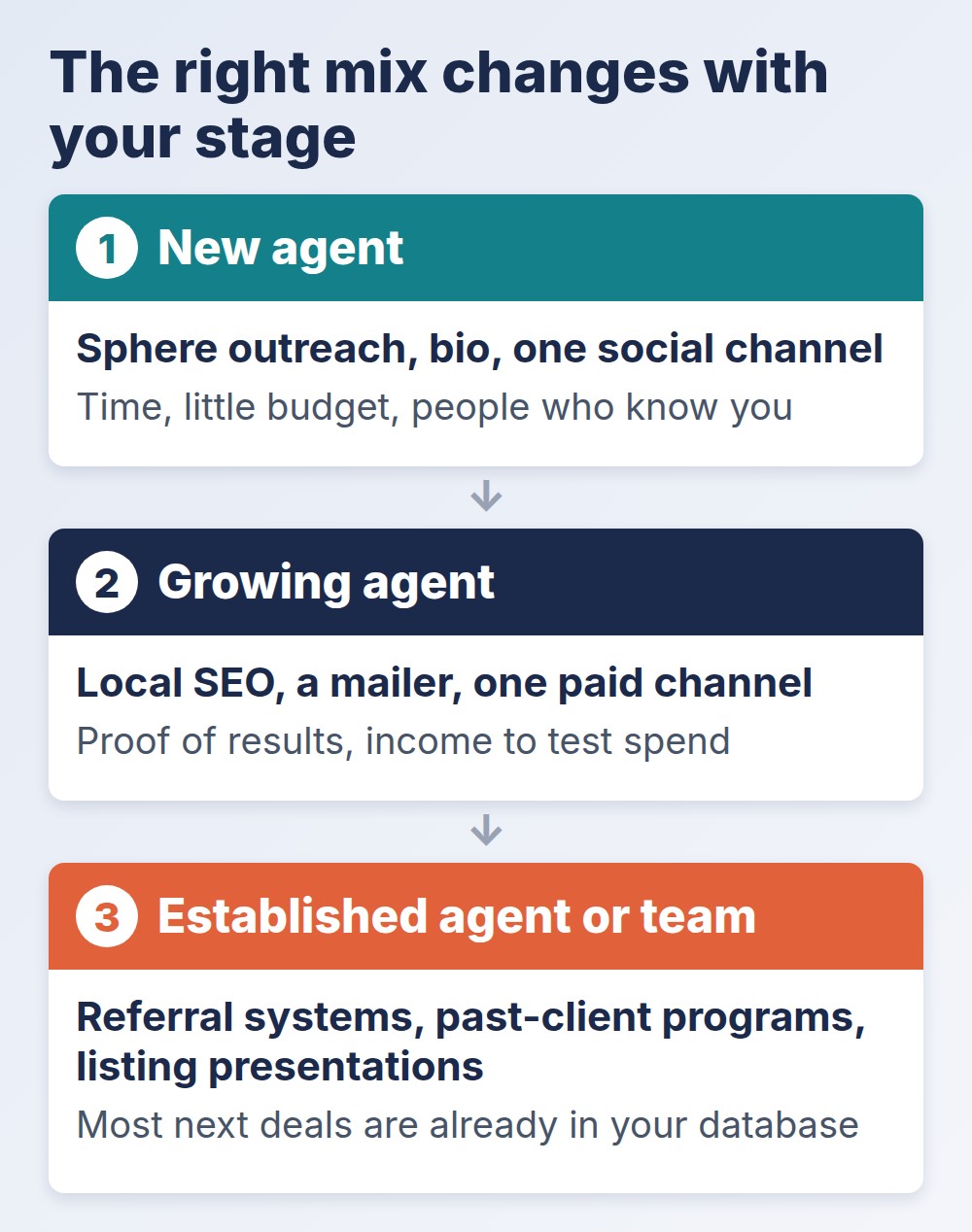
The right mix depends on where you are. A first-year agent and a ten-year agent should not run the same plan.
| Stage | Priority | Why |
|---|---|---|
| New agent | Sphere outreach, a simple profile and bio, one social channel | You have time but little budget, and people who know you are the fastest first clients |
| Growing agent | Add local SEO, a consistent mailer, and one paid channel | You have proof of results to show, and enough income to test spend |
| Established agent or team | Referral systems, past-client programs, listing presentations | Most of your next deals are already in your database |
For marketing for realtors who are just starting, the biggest advantage is speed of action rather than polish. A plain, honest message to everyone you know beats a perfect brand launched six months from now. Established agents face the opposite risk: coasting on referrals without a system, so that business depends on who happened to call this month.
How to Build a Real Estate Marketing Plan in Five Steps
A real estate marketing plan does not need to be long. It needs to answer five questions in writing, so you can look at it three months later and know whether it worked.
- Set one number. Choose a goal such as closed transactions or listings taken this year, then work backward to how many conversations, appointments, and leads that requires.
- Name your audience. Be specific: first-time buyers in two zip codes, downsizing sellers in one neighborhood, or past clients from the last five years. “Everyone” produces generic marketing.
- Choose two or three channels. Use the table above and match them to your stage, your time, and your budget.
- Set the budget before you shop. Decide what share of expected commission income you will reinvest, split it across your channels, and keep a small reserve for testing something new.
- Put it on a calendar. Assign a weekly routine and a monthly mailing or update, so marketing happens when you are busy with clients.
Review the plan every quarter. Drop what produced nothing, double down on what produced conversations, and write down what you learned. Over a year, that review is worth more than any single tactic. For a worksheet with budget shares and a copyable table, use our real estate marketing plan template, which includes a free Excel download.
Social Media, SEO, and Your Website: Being Found Online
Online marketing works in two modes. Social media is for staying visible to people who already know you, while search and your website are for being found by people who do not. Both need a place to land.
For social media, the pattern that holds up is a short weekly routine: one post about your local market, one about a recent client outcome or a neighborhood, and a few real replies to other people’s posts. Listings alone are a weak reason to follow an agent. Local knowledge is a better one.
For search, local SEO starts with a complete Google Business Profile, consistent contact details everywhere you appear, and pages that match what buyers and sellers type, such as neighborhood guides and home valuation requests. Rankings take months, so treat SEO as an asset you build rather than a switch you flip.
Your website is the destination for both. A site that lists homes but gives no reason to contact you wastes the traffic you earn. Our guide to what works in agent website design covers layout, speed, and calls to action, and the real estate landing page guide shows how a single-purpose page can turn a visitor into a contact.
Paid Advertising: Fast, but Only as Good as Your Follow-Up
Paid advertising is the quickest way to get lead flow, and the quickest way to waste money. Facebook and Instagram ads, Google search ads, and portal leads all buy attention at a price that changes with your market and the season. Our look at average cost per lead for agents shows why the headline price of a lead is only part of the story: what matters is cost per closing.
Three rules keep ad spend from running away. First, start with a small test budget on one offer, such as a home valuation or a buyer guide. Second, make sure someone responds quickly, because a paid lead that waits for a day is usually money lost. Third, follow housing ad rules on targeting and wording; for a walk-through of the Facebook side, see turning Facebook ad leads into showings.
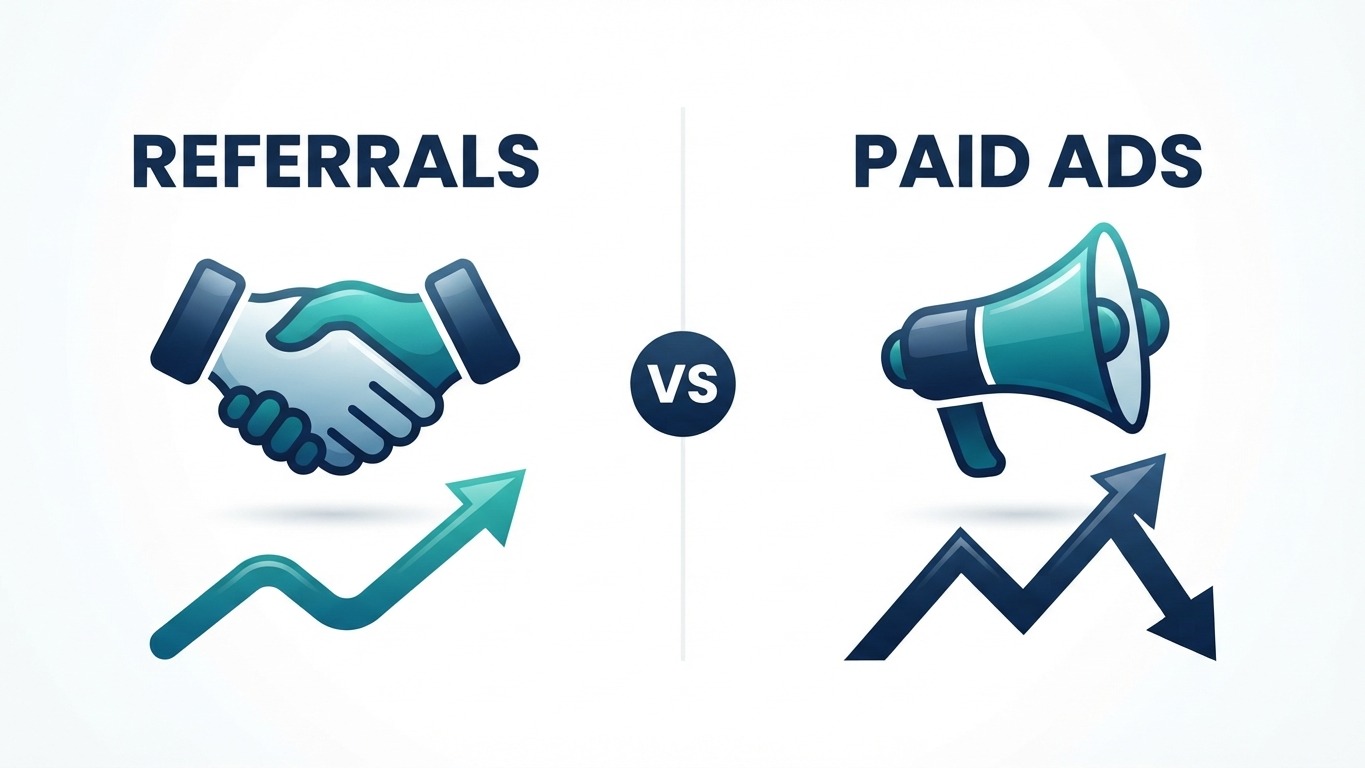
Notice the contrast in the image above. Referral and sphere work builds slowly and compounds. Paid ads start fast and stop the moment you stop paying. Neither is wrong, but a plan that relies only on paid ads has no memory built into it, while a plan that relies only on your sphere has no growth beyond the people you already know. Infina AI, our own product, is an AI assistant for real estate agents for the follow-up and listing-question side of this plan.
Proof Sells: Testimonials, Your Bio, and Listing Presentations
Whatever channel brings someone to you, they will check whether you can be trusted before they call. Three pieces of proof do most of that work. A short bio that says who you help and where gives a stranger a reason to choose you. A handful of specific testimonials, each naming the situation and the result, beat a long list of vague praise. And a listing presentation that shows your pricing logic, marketing plan, and recent results turns a seller conversation into a decision.
Ask for testimonials at the moment a client is happiest, usually right after closing, and make it easy by sending two or three short questions rather than a blank page. Reuse the best lines on your website, your social profiles, and your listing presentation, so the same proof works in every channel at once.
Direct Mail, Print, and Branding Basics
Direct mail still works for one reason: it lands in a physical mailbox, repeatedly, in a neighborhood you want to own. The common failure is sending one postcard and judging the result. Agents who farm an area send to the same addresses every month for a year or more, with a message that changes but a look that stays recognizable.
That recognizable look is branding, and our practical real estate branding guide covers it in full. A logo, a color, a headshot, a short bio, and a business card should all feel like they came from the same person. You do not need an expensive identity. You need consistency, so that a postcard, a sign, and a social profile read as one agent. Keep your bio specific: who you help, in which area, and one result you can point to.
Print is the cheapest part of the plan to fix. If your card, sign, and flyer carry three different fonts and two phone numbers, that is a free improvement to make this week.
Measure What Works With a Simple Lead Source Field
Many agents cannot say which marketing produced their last three closings. That is fixable with one habit: record a lead source for every new contact, and update it when a deal closes. Do it in your CRM rather than in a notebook, so the data survives a busy season.
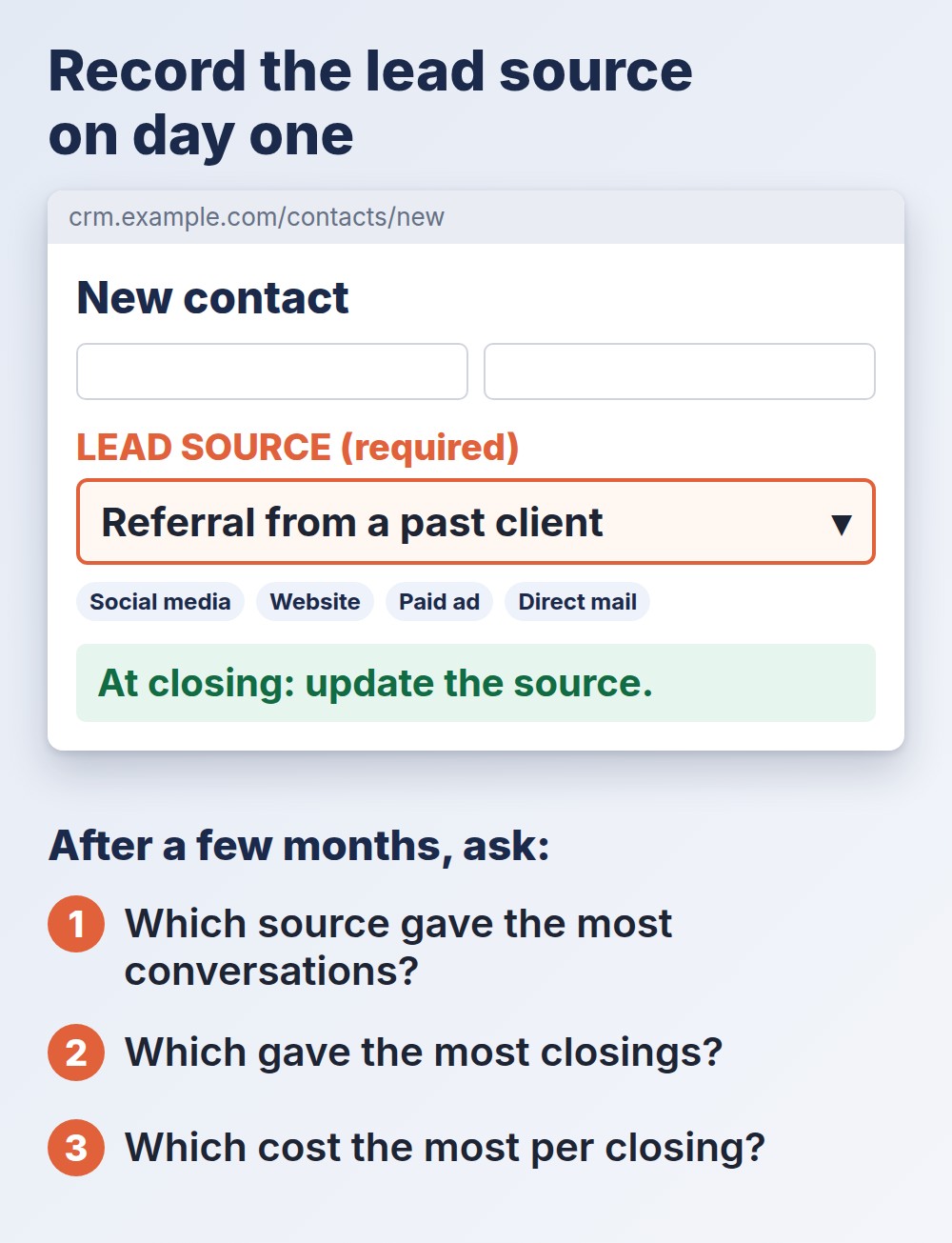
Once you have a few months of data, ask three questions. Which source produced the most conversations? Which produced the most closings? Which cost the most per closing? Those answers often differ, and the second and third matter more than the first. If you need a CRM that tracks sources and past clients, our guide to using your CRM database for marketing explains how to turn contacts into repeat business.
Common Real Estate Marketing Mistakes
- Quitting too early. Mail, SEO, and social media all need months of repetition before they pay back. Stopping at week six guarantees a zero.
- Marketing only when you need a listing. People notice agents who disappear between transactions, and they remember the ones who stay in touch.
- Copying a competitor’s plan. Their market, budget, and strengths are not yours.
- Buying leads with no follow-up plan. Without a quick response, paid lead flow just raises your cost per closing.
- Never asking for referrals. The biggest source of business is also the one most agents never request out loud.
Final Thoughts
Real estate marketing works best as a small set of habits repeated for a long time: stay in touch with the people who already know you, add a couple of channels that fit your stage and budget, keep your look consistent, and track the source of every lead. The agents who win are rarely the ones with the biggest budget. They are the ones whose name comes up when a friend asks, “Do you know a good agent?” Build your plan around that moment, and measure it every quarter.
