

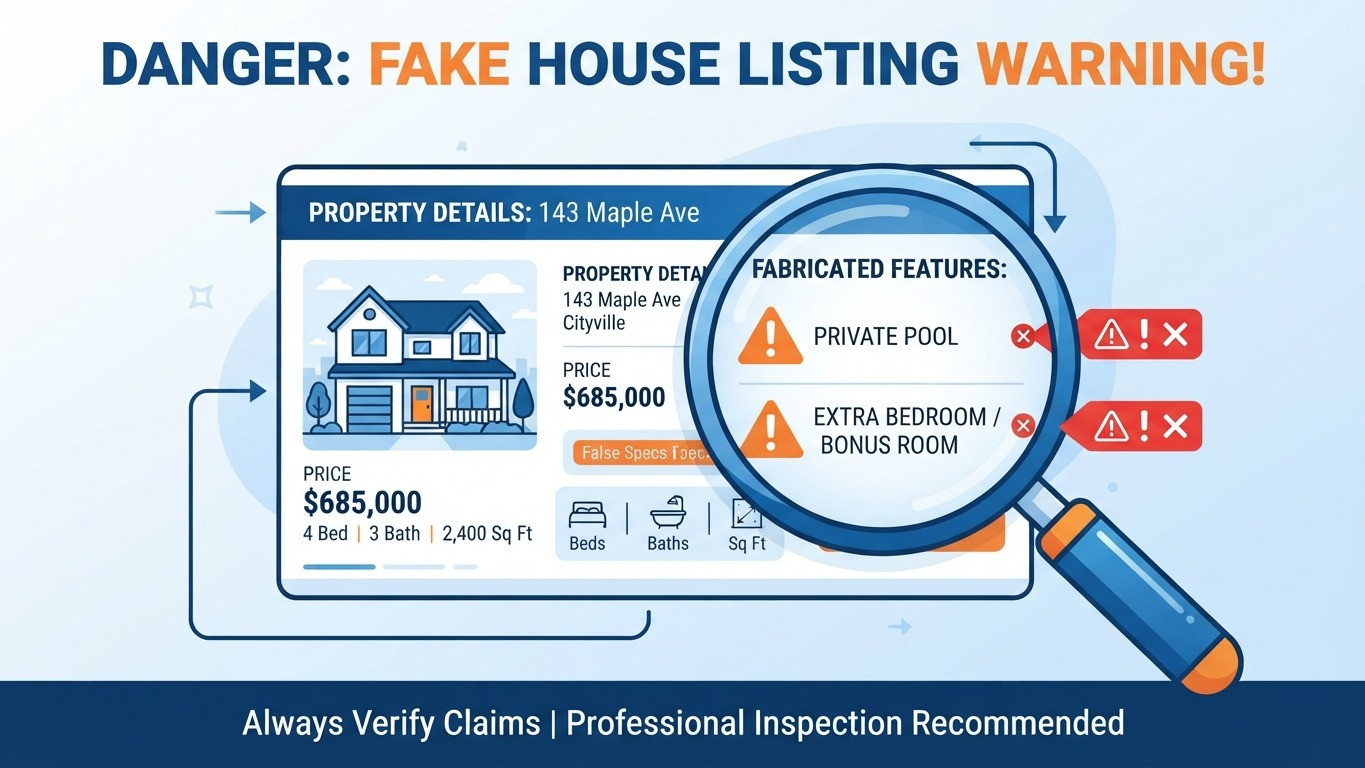
The ai hallucination risk real estate listings now carry isn’t hypothetical anymore. It’s showing up in MLS remarks, flyers, and Facebook ads faster than most brokerages can catch it. AI tools writing listing copy can invent a pool that doesn’t exist, describe a “master bedroom” that isn’t there, or fabricate a nearby school zone, and once that language goes live, the agent who published it is the one legally responsible for it.

How the Hallucinations Actually Happen
Generative AI writes confidently whether or not it has the facts, and listing descriptions are a near-perfect setup for it to guess wrong. Recent reporting on AI hallucination sanctions points to the same pattern across commercial and residential real estate: models infer details from a handful of listing photos or a thin data feed, then fill gaps with plausible-sounding but invented specifics: granite countertops that are actually laminate, a finished basement that’s unfinished, a “top-rated school district” the AI never verified.
The ai hallucination risk real estate listings pose is compounded by exactly what makes AI content tools appealing in the first place: speed. A tool that writes a full listing description in seconds is also generating unverified claims in seconds, and without a human checking each fact against the actual property, that risk moves straight into public-facing marketing.
Why This Is a Fair Housing Problem, Not Just an Accuracy Problem
Two different failures get blurred together here, and keeping them apart changes what you have to do about them.
Accuracy failures are the hallucinations: a pool that does not exist, a finished basement that is not finished. Those are misrepresentation problems, and fact-checking against the property file genuinely solves them.
Fair housing failures are different, and fact-checking does not solve them. The Fair Housing Act is about discrimination, not accuracy, so language about neighborhood character, school quality, or who a home would “suit” can steer buyers whether or not every detail in it is true. An AI that correctly reports a school rating and wraps it in language implying what kind of family belongs there has produced a fair housing problem out of accurate facts. Fair housing analysis of AI listing content covers the phrasing patterns that get flagged.
The penalties attach to the discrimination, not to the error. Under 24 C.F.R. 180.671, HUD civil penalties for a discriminatory housing practice run to $26,262 where the respondent has no prior adjudication, $65,653 with one prior inside five years, and $131,308 with two or more inside seven. Those amounts were last adjusted in June 2025 and HUD made no inflation adjustment for 2026, so they are current. And agents cannot point at the AI tool as the responsible party: if the content appears under an agent’s name, the agent owns it.
That liability doesn’t disappear because a brokerage didn’t know the AI was inventing details. Model drift and confident-sounding hallucinations are exactly why regulators and fair housing advocates are treating AI-generated real estate content as a compliance issue now, not a future one.

Reducing the AI Hallucination Risk Real Estate Listings Create
None of this means abandoning AI-assisted listing copy. It means treating AI output the way you’d treat a draft from a junior assistant, not a finished product:
- Verify every property fact against a source. Square footage, bedroom/bathroom counts, school zones, and amenities should be checked against MLS data or a walkthrough, not accepted from the AI’s output.
- Ground the tool in your own verified data. Retrieval-augmented tools that pull from your actual listing sheet produce far fewer invented details than tools generating from a prompt alone.
- Flag anything that sounds too specific. A hallucination often reads as confidently precise: “top-rated elementary school half a mile away” is exactly the kind of detail worth double-checking before it ships.
- Keep a human sign-off step. One person reviewing the final copy against the property file catches most hallucinations before they reach MLS or an ad platform.
- Read the same draft a second time for steering, not for errors. This is a separate pass with a separate question: does any sentence describe the neighbors, the community, or who would fit here, rather than the property? Accuracy review will not catch that, because the sentence can be perfectly true.
Part of avoiding this risk is understanding what kind of AI tool you’re actually using and what it’s built to do. A general-purpose content generator behaves very differently from a purpose-built conversational AI tool designed around your actual property and lead data rather than an open-ended prompt.
Related Reading
If your team is choosing AI tools for client-facing content or conversations, the first step is to separate general-purpose content generators from tools grounded in your actual data instead of guessing. It’s also worth reading about why the right AI tool beats the cheapest before standardizing on any single AI vendor across your listing and marketing workflow. And since AI content risk and AI outreach risk are governed by overlapping rules, see our guide to TCPA compliance for real estate agents for the consent and disclosure side of the same compliance picture.
Final Thoughts
The ai hallucination risk real estate listings carry today is a direct result of how convincingly AI can write about things it doesn’t actually know. Agents don’t need to stop using AI for listing descriptions, but the output needs two review passes rather than one: a fact check against the property file, and a separate read for language that describes people rather than the property.
The first pass protects you from a misrepresentation claim. The second protects you from a fair housing one, which is the expensive half. In both cases “the AI wrote it” is not a defense: if it went out under your name, it is yours.
