
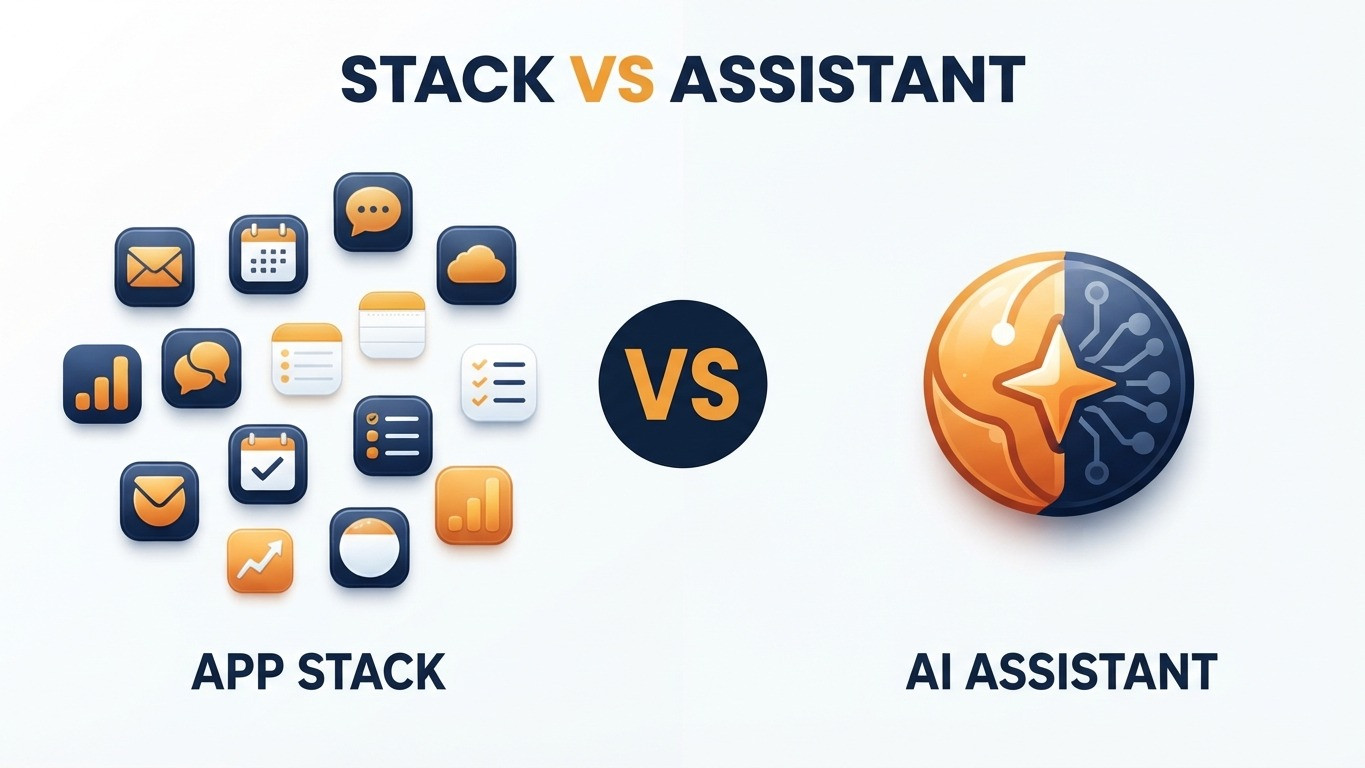
Real estate coaches Tim and Julie Harris published a piece yesterday with a blunt title: agents are using AI wrong, and the fix is to build an assistant instead of buying another app. Their argument is simple. Most agents have spent years stacking software on top of software, each new platform arriving with its own login, its own monthly fee, and its own workflow that somehow still has to connect to everything else. An ai assistant instead of software stack real estate agents approach flips the default question from “which tool should I buy” to “can AI already do this.”

The Real Cost of Stacking Software
According to Tim and Julie Harris’s coaching column, the fix is not to stop buying software altogether. It is to research what a piece of software actually does before buying it, decide whether that function actually matters to the business, and then ask an existing AI platform how much of that process it can already recreate or automate. A surprising amount of what gets sold as a standalone product turns out to be a workflow an AI assistant already connected to a CRM can handle without a new subscription.
The habit worth breaking is treating every new pain point as a reason to add a fourteenth login. Each additional tool is not just a monthly fee. It is another place data has to be re-entered, another dashboard to check, and another workflow that breaks when one piece updates and the others do not.
Where an AI Assistant Instead of Software Stack Real Estate Agents Rely On Actually Helps
The Harris column makes an important distinction that is easy to miss: technology creates leverage, but training determines what gets leveraged. An AI assistant sitting on top of a disorganized process just automates the disorganization faster. The agents getting real value are the ones who already have clear scripts, presentations, and systems, and are using AI to run those systems consistently rather than inventing new ones from scratch.
That means the highest-value place to start is not the flashiest new AI feature. It is the task an agent already does every single day: qualifying a lead, scheduling a follow-up, updating a contact record after a call. If an AI assistant embedded in an existing CRM can already do that reliably, a separate app promising the same thing is redundant by definition.
A Simple Test Before the Next Software Purchase
Before adding another line item to the stack, three questions are worth asking. First, does this tool do something an AI assistant already connected to my CRM cannot do today. Second, if the answer is no, would asking my AI to replicate that workflow actually take less time than onboarding a new platform. Third, if the answer is yes and it genuinely fills a gap, does it integrate with what already exists or does it become yet another disconnected island of data.
None of this means avoiding new tools forever. It means treating “can AI already do this” as the first question rather than the last one, which is the exact reversal the Harris column is pushing agents toward. Running an ai assistant instead of software stack real estate agents test before every purchase is the whole habit change in one sentence.

Consolidation Is the Pattern Across Real Estate AI This Year
This fits a pattern showing up across real estate tech coverage all year: platforms building AI that acts inside an existing system rather than asking agents to open one more tab. Whether that is an AI agent updating records directly inside a CRM or a coaching column telling agents to stop buying redundant software, the direction is the same. Fewer logins, more leverage out of the tools already in place. This is the idea behind Infina AI, our own product: an AI assistant for real estate agents that handles listing questions instead of adding another tool to the stack.
Related Reading
If you are trying to decide whether your current platform can absorb tasks you are paying separate tools for, our CRM buying guide for real estate agents breaks down which features actually justify a new subscription versus which ones your existing CRM’s AI can already handle. It pairs well with our look at embedded AI real estate brokerage platforms, since embedded and standalone are really the same choice this article is describing, just at the platform level instead of the individual tool level.
Final Thoughts
The agents who benefit most from AI in 2026 will not be the ones who bought the most tools. They will be the ones who asked, before every purchase, whether an ai assistant instead of software stack real estate agents could already do the job. Software fatigue is a real cost, and the fix has been sitting inside most agents’ existing CRM the whole time.
