
Broker IDX is the system that allows licensed real estate brokers and agents to display active MLS listings on their own websites. Without IDX, a real estate website can only show properties the broker has personally listed. With IDX, the site can display every active listing in the MLS database – giving visitors the same search capability they get on Zillow or Realtor.com, powered directly from your website.
This guide explains exactly how broker IDX works, what it costs, which providers deliver the best results, and how to set it up on your real estate website.

What Is Broker IDX?
Broker IDX stands for Internet Data Exchange. It is a policy created by the National Association of Realtors (NAR) that allows MLS participants – licensed brokers and agents – to display each other’s listings on their websites through a shared data feed. When a broker activates IDX for their website, they get access to a real-time feed of all active listings in their MLS board, which they can display through a property search interface.
Before IDX existed, only the listing agent’s brokerage could display a property on its own website. Buyers who wanted to search for homes had to visit each brokerage’s site separately or rely on printed MLS books. IDX changed this by creating a cooperative data-sharing framework that lets every participating broker display every listing – making individual brokerage websites genuinely useful for property search.
The result is that a solo agent or small brokerage can build a website with the same listing search depth as Zillow or Realtor.com, completely independent of those third-party platforms.
How Broker IDX Works
Broker IDX operates through a data feed that runs between the MLS database and your website. Here is how the process works from end to end:
Step 1 – MLS data feed. Your local MLS board maintains a database of all active listings submitted by participating brokers and agents. When you activate IDX participation, the MLS grants your website access to this database through an RETS (Real Estate Transaction Standard) or RESO Web API data feed. The feed updates continuously – typically every 15 minutes to 2 hours depending on the MLS board – keeping your website listings current.
Step 2 – IDX provider middleware. Between the MLS data feed and your website sits an IDX provider (also called an IDX vendor). The provider handles the technical complexity of receiving the MLS data, parsing it into a consistent format, and delivering a search interface you can embed on your website. You do not connect directly to the MLS feed yourself – the IDX provider does this on your behalf and delivers a finished search tool.
Step 3 – Your website displays listings. The IDX search interface appears on your website either as an embedded widget (iFrame) or as natively integrated pages that share your site’s design. Visitors can search by location, price, bedrooms, and other criteria. Results show all active MLS listings, not just your own.
Step 4 – Lead capture. When a visitor saves a listing or sets up a search alert, the IDX system prompts them to register with their name and email. This registration creates a lead record that flows into your CRM or lead management system for follow-up.
IDX vs. MLS: What Is the Difference?
The MLS (Multiple Listing Service) is the database. Broker IDX is the policy and technology that allows portions of that database to be displayed publicly on broker and agent websites.
The MLS itself is not a consumer-facing website – it is a database system accessible only to licensed members. NAR’s IDX policy specifies which fields from the MLS database can be displayed publicly (active listings, key property details, photos) and which cannot (listing agent contact information beyond MLS attribution requirements, pending contract details, off-market data).
Think of the MLS as a warehouse and IDX as the storefront window. IDX gives the public a view into the warehouse – but only the view that brokers and the MLS board have agreed to share.
Broker IDX Compliance Rules
Broker IDX display is governed by NAR’s IDX policy, which every MLS board adopts with local variations. The core compliance requirements that apply to virtually every IDX website are:
Required attribution fields. Every listing displayed through IDX must show the listing firm name (the brokerage that holds the listing), the listing agent name, the MLS logo or disclaimer language, and a statement that the data is deemed reliable but not guaranteed. These fields must be visible on every listing display – not just on an About page or footer.
Data currency disclosure. Your IDX display must show when the data was last updated. Most IDX providers include an automatic timestamp. You cannot display IDX data that is more than 12 hours stale without disclosing the delay.
No co-mingling without disclosure. If you display both IDX listings and non-IDX listings (such as listings from outside your MLS board or manually entered listings) on the same search page, you must clearly distinguish between them. Co-mingling IDX and non-IDX data without disclosure is a compliance violation.
Opt-out compliance. Listing agents and brokers can opt their listings out of IDX display. Your IDX provider must honor these opt-outs in real time. If a listing agent opts out and their listing continues to appear on your site, your brokerage is in violation.
No framing of other sites. You cannot display another brokerage’s website inside a frame on your site and present it as your IDX search. You must have your own IDX license through an approved provider.
Best Broker IDX Providers (2026)
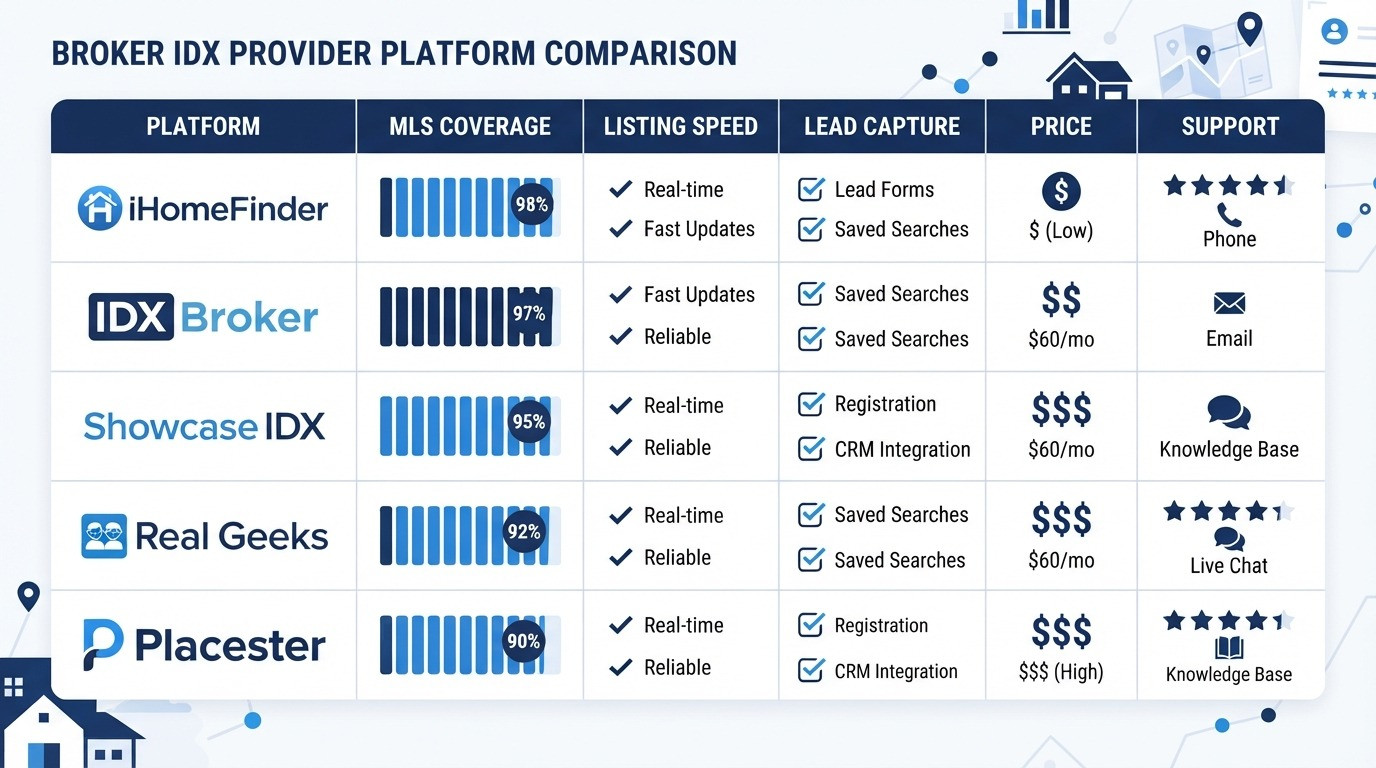
iHomeFinder – Best broker IDX provider for independent agents and small brokerages. iHomeFinder has been one of the most widely used broker IDX providers for over two decades. It connects to most MLS boards across the United States and Canada, delivers a clean and mobile-responsive search interface, and integrates with most website platforms including WordPress, Squarespace, and Wix. The lead capture system is solid – registration walls trigger at key moments and leads sync to major CRM platforms. Pricing starts around $60 per month. For agents who want a standalone IDX plugin they can add to an existing website, iHomeFinder is the most straightforward option.
IDX Broker – Best broker IDX provider for MLS coverage breadth. IDX Broker covers more MLS boards than any other provider – over 650 boards across the US and Canada. For agents in markets with smaller or regional MLS boards, IDX Broker is often the only provider with an established data connection. The search interface is functional and mobile-responsive, with map search, saved searches, and listing alerts included. The lead capture module integrates with major CRM platforms. Pricing starts around $55 per month for a single agent license.
Showcase IDX – Best broker IDX provider for SEO performance. Showcase IDX is the best choice for agents focused on organic search traffic. Its listings are indexed by Google as native pages rather than iFrame embeds, which means individual property pages can rank in search results. Neighborhood and market statistics pages are generated automatically with current MLS data, giving agents scalable content for local search terms. The search interface is modern and fast. Pricing starts around $59 per month. For agents investing in SEO as their primary lead generation channel, Showcase IDX delivers more organic visibility than other providers.
Real Geeks IDX – Best broker IDX provider bundled with website and CRM. Real Geeks includes broker IDX as part of an all-in-one platform that also includes a conversion-optimized website and built-in CRM. For agents who do not already have a website platform and CRM, Real Geeks is the most cost-effective way to get all three at once. The IDX search experience is fast and mobile-first. Lead capture and CRM automation are deeply integrated – when a lead registers, they immediately enter an automated follow-up sequence without any manual setup. The trade-off is that you cannot use Real Geeks IDX on a separate website – it is bundled with the Real Geeks site platform.

How Much Does Broker IDX Cost?
Broker IDX costs vary by provider and MLS board. Here are the primary cost components:
MLS IDX participation fee. Most MLS boards charge a one-time setup fee ($25 to $100) and an annual IDX participation fee ($50 to $200 per year). This fee is paid directly to your MLS board and is separate from what you pay to your IDX provider.
IDX provider monthly fee. Standalone IDX providers like iHomeFinder and IDX Broker charge $55 to $100 per month for a single agent license. Broker licenses covering multiple agents start around $150 per month. All-in-one platforms that bundle IDX with a website and CRM (Real Geeks, AgentFire, kvCORE) range from $100 to $500+ per month depending on plan tier and team size.
Total monthly cost for a solo agent using a standalone IDX provider on an existing website: approximately $55 to $100 per month for the IDX provider, plus whatever you pay for your website hosting and platform. Total all-in for most solo agents: $100 to $200 per month.
How to Set Up Broker IDX on Your Website
Setting up broker IDX on your website involves four steps:
Step 1 – Verify MLS IDX participation. Contact your MLS board to confirm you are enrolled in IDX participation. Most boards require a separate enrollment form and charge a participation fee. If you are a salesperson (not the broker of record), your managing broker typically needs to authorize IDX participation.
Step 2 – Choose an IDX provider. Select a provider based on your MLS board’s approved vendor list. Not all IDX providers have data agreements with every MLS board – your MLS board’s website will list approved IDX vendors. Sign up with the provider and complete their MLS authorization form.
Step 3 – Install the IDX on your website. Depending on your website platform and IDX provider, installation involves adding a plugin (WordPress), embedding an iFrame code snippet, or connecting via API. Most providers include setup documentation and support. Setup typically takes one to three business days after MLS authorization is confirmed.
Step 4 – Configure lead capture and CRM sync. Set up your registration wall triggers, connect the IDX to your CRM, and test that lead data is flowing correctly. Verify that attribution fields (listing firm name, agent name, MLS logo) are displaying correctly on every listing page before going live.
Using Broker IDX for Lead Capture
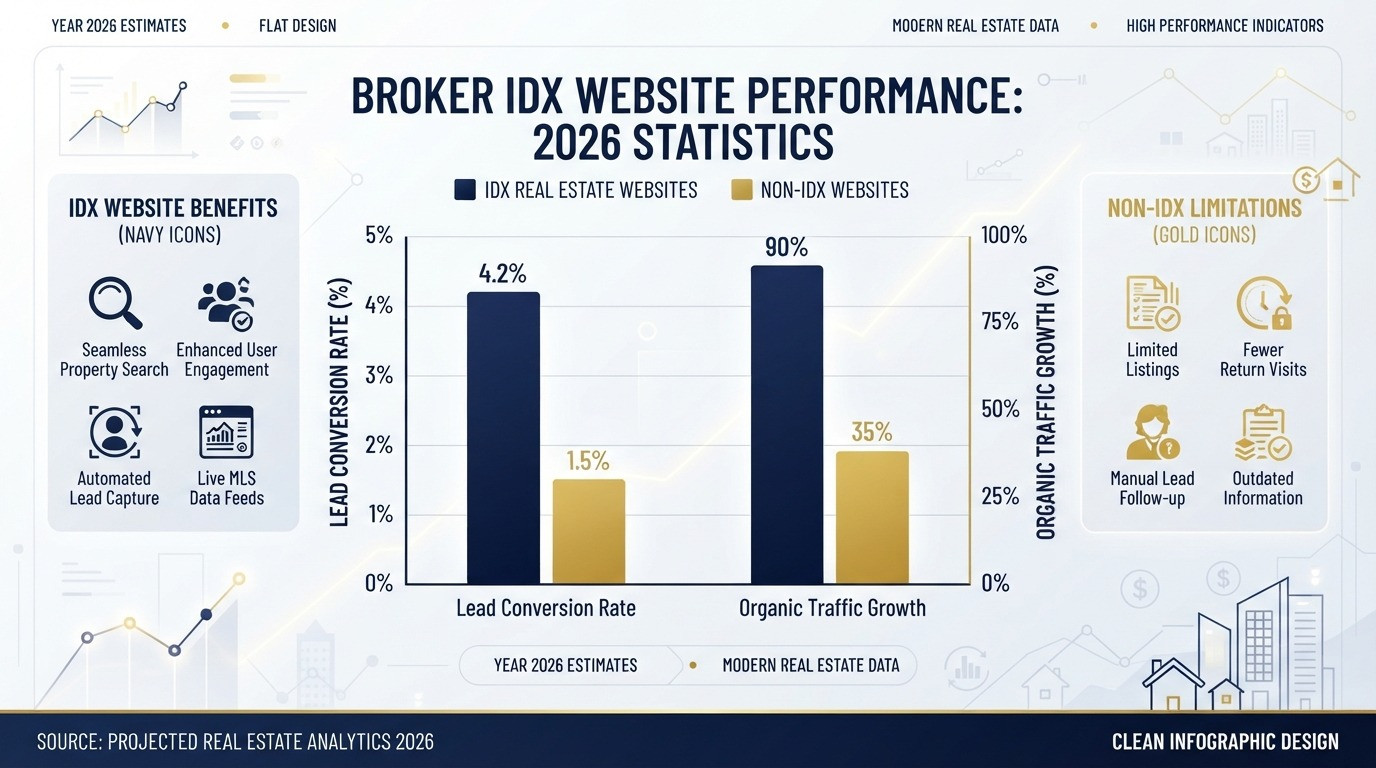
The primary business value of broker IDX is lead capture. A visitor who searches for homes on your IDX site, saves a listing, and registers their contact information is a fundamentally warmer lead than one who fills out a generic contact form. They have told you exactly what they are looking for through their search behavior.
To maximize lead capture from your IDX site, configure your registration wall to trigger at high-intent moments: when a visitor saves a listing, sets up a price drop alert, or tries to access detailed listing information (room dimensions, tax history, neighborhood data). Requiring registration immediately on site arrival reduces engagement – most visitors will leave rather than register before they have seen any value.
Connect your IDX lead capture to an automated CRM follow-up sequence that sends relevant listing alerts based on the lead’s search criteria. A lead who searched for 3-bedroom homes under $450,000 in a specific zip code should receive automated alerts for new listings that match that criteria. This behavioral follow-up consistently outperforms generic email drip campaigns for IDX leads.
For more on building a complete website and IDX system, see our guide to the best real estate website builder options for agents and brokerages. For the CRM side of the equation, our CRM overview for brokerages covers platforms with strong IDX lead integration.
Broker IDX FAQs
Do I need to be a broker to have IDX on my website? No. Licensed real estate salespersons can also participate in IDX, but participation must be authorized by their managing broker. The data feed is technically issued to the brokerage, and individual agents use it under the broker’s authorization.
Can I use IDX data from multiple MLS boards on one website? Yes, but it requires separate IDX agreements with each MLS board and a provider that supports multi-MLS feeds. This is common for agents who work across county or state lines where multiple MLS boards cover their market area.
How often does broker IDX data update? Update frequency varies by MLS board and IDX provider. Most modern systems update every 15 to 30 minutes. Some boards update every few hours. Your IDX provider will specify the update frequency for your board.
Can buyers save searches and get listing alerts through IDX? Yes. Most IDX providers include a saved search and listing alert feature that sends buyers automatic email notifications when new listings matching their criteria are added to the MLS. This feature requires the buyer to register, which makes it one of the best lead capture mechanisms on an IDX site.
What happens if I cancel my IDX subscription? If you cancel your IDX provider subscription, the listing search on your website will stop functioning. The MLS data feed access ends, and any IDX pages or embedded searches will return errors. Leads who have registered and saved searches will stop receiving alerts. Always transition to a new provider before canceling the existing subscription to avoid downtime.
Is broker IDX the same as Zillow or Realtor.com? No. Zillow, Realtor.com, and similar portals are third-party aggregators that have their own data agreements with MLS boards. Broker IDX gives individual agents and brokers their own MLS search capability on their own websites – independent of third-party portals. The key difference is ownership: leads generated on your IDX site belong to you. Leads who contact you through Zillow belong to Zillow first.
