
The best CRM for real estate agents does more than store contacts — it qualifies leads, automates follow-up, and books appointments without any manual effort. In a market where 78% of buyers choose the first agent to respond, your CRM is the difference between winning and losing the lead.
This guide compares the top real estate CRM platforms available in 2026, with honest assessments of who each tool is best for, what it costs, and what sets it apart from the competition.

What Is a Real Estate CRM?
A real estate CRM (Customer Relationship Management) platform is software built to manage every contact, lead, and client relationship in your pipeline. The category itself is not real estate specific, and our guide to what CRM software is covers the general version. What changes in this industry is the shape of the data. A real estate record carries a lead source, a price range, saved searches, showing history, and a transaction stage, none of which a generic CRM has a field for out of the box.
That difference is why a tool like Salesforce or HubSpot rarely survives contact with an agent’s day. Our plain-English breakdown of what CRM means in real estate goes through the fields and workflows that only exist here: IDX portal capture, listing alerts, showing schedules, and transaction milestones that fire their own task lists.
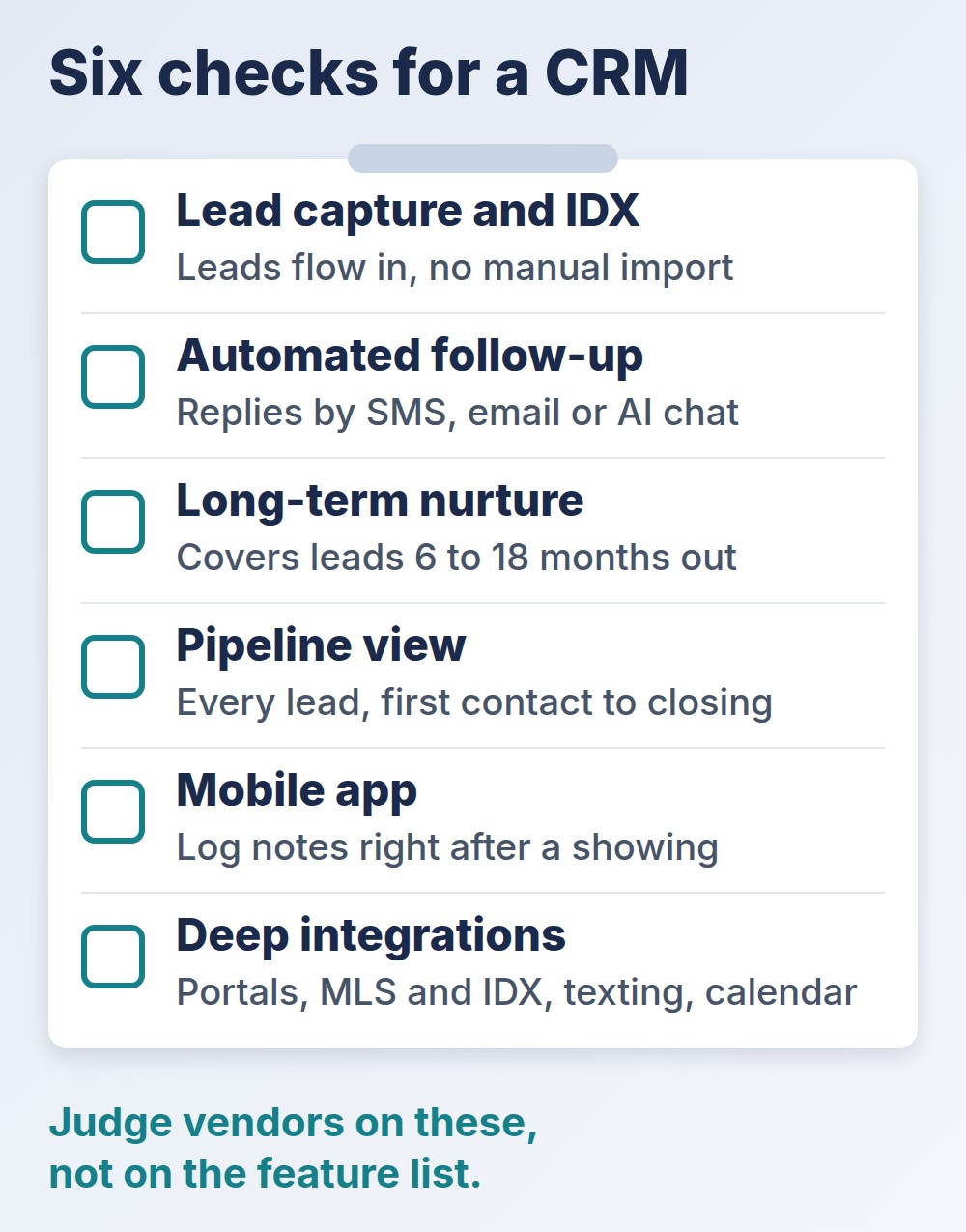
The best CRM for real estate centralizes the database, automates the repetitive touchpoints, and surfaces the leads most likely to transact, so your time goes to conversations that close rather than data entry. Judge any platform on those three jobs before you look at the feature list.
Do You Actually Need One Yet?
Not every agent does, and buying too early is a common waste. The honest threshold is database size and lead volume rather than years in the business. Below roughly 200 contacts and a handful of new leads a month, a disciplined spreadsheet plus calendar reminders genuinely covers it, and the time you would spend configuring a CRM is better spent on the pipeline itself.
Past that point the manual version starts dropping things, and it drops them silently. The symptom to watch for is not feeling busy, it is discovering that a lead you spoke to in March bought through someone else in September. If you are at that stage and setting up a system for the first time, our beginner guide to CRM management walks through pipeline stages, tagging, and the daily habits that decide whether the tool gets used after week three.
Budget should not be the blocker either. Several platforms run a usable free tier, and our roundup of the best free CRM for real estate agents covers what you actually get and where the ceiling sits. Starting free and migrating later costs less than guessing wrong on an annual contract.
What to Look for in the Best CRM for Real Estate

Lead capture and IDX integration. The best CRM for real estate connects directly to your IDX website and captures buyer and seller leads automatically. Every form submission, property inquiry, and saved search should flow in without a manual import step.
Automated follow-up. Speed to lead decides most outcomes. The best CRM for real estate triggers a response the moment a lead submits, by SMS, email, or AI chat, so the lead is not sitting in an inbox while a faster competitor answers.
Long-term nurture sequences. Most real estate leads are 6 to 18 months from transacting. A CRM that only handles the first week leaves the majority of the database untouched for the period when the decision actually gets made.
Pipeline and transaction management. Track every lead from first contact through closing in a visual pipeline that shows where each contact stands without anyone opening a report.
Mobile access. Agents work in the field. A full-featured mobile app is the difference between notes logged after a showing and notes never logged at all.
Integrations that are deeper than they look. Four separate the tools that get used from the ones that create extra work: Zillow and Realtor.com lead import by direct API rather than email parsing, MLS and IDX data sync so property activity sits next to the contact record, texting and calling built in rather than bolted on through a separate dialer, and Google or Outlook calendar sync. Every platform below supports the basics, but depth varies sharply. Follow Up Boss and Lofty have the most mature portal integrations, while LionDesk has the most complete built-in communication stack.
Best CRM for Real Estate Agents in 2026
Each platform below is ranked for a specific situation rather than on a single overall score, because the best CRM for real estate for a solo agent with 40 leads a month and the right answer for a 60-agent brokerage are rarely the same product. For each one you get what it does better than the rest, who it suits, what it costs, and the limitation that shows up in month three rather than in the demo. Pricing is list pricing as of early 2026 and moves, so treat it as a starting point for your own quote.
1. Follow Up Boss — Best Overall CRM for Real Estate Teams
Follow Up Boss is consistently ranked the best CRM for real estate teams managing significant lead volume. Its automated lead routing, action plans, and two-way texting make it the go-to platform for ISA-driven brokerages and high-volume teams. Follow Up Boss integrates with over 200 real estate lead sources — Zillow, Realtor.com, Facebook, and most IDX platforms — routing every lead to the right agent instantly.
Best for: High-volume teams and brokerages with ISAs.
Pricing: From $69/month (solo) to $1,000+/month (enterprise).
The limitation: Follow Up Boss is a CRM and nothing else. There is no IDX website, no built-in lead generation, and no landing page builder, so the real monthly cost is the subscription plus whatever you already pay for a site and for leads. Pricing is also per user, which makes it the most expensive option on this list once a team passes about eight agents. Teams that want calling and the full reporting suite need the higher tier, not the $69 entry plan. Our full Follow Up Boss review goes through where the follow-up still breaks down even on the top plan.
2. Wise Agent — Best Value CRM for Real Estate
Wise Agent delivers the most features per dollar of any real estate CRM on the market. Its all-in-one platform covers contact management, transaction management, landing pages, email marketing, and AI-powered lead follow-up — all for $49/month flat, regardless of team size. For solo agents and small teams who want a capable real estate CRM without enterprise pricing, Wise Agent is the best CRM for real estate on a budget.
Best for: Solo agents and small teams wanting maximum features at low cost.
Pricing: $49/month flat (unlimited contacts, unlimited users).
The limitation: the flat price is real, and so is the trade-off that pays for it. The interface looks its age next to kvCORE or Lofty, reporting is basic enough that a team lead will end up exporting to a spreadsheet, and there is no paid lead generation attached. Wise Agent is the right call when you already have a lead source and want somewhere disciplined to put those leads. It is the wrong call if you were hoping one subscription would also solve where the leads come from.
3. LionDesk — Best CRM for Real Estate Video and AI Follow-Up
LionDesk stands out as the best CRM for real estate agents who want AI-powered texting and video messaging built into their follow-up workflows. Its AI assistant handles inbound lead conversations via SMS automatically, qualifying buyers and sellers before a human agent engages. LionDesk’s video texting feature lets agents send personalized video messages directly from the CRM — a proven way to increase response rates.
Best for: Agents who want AI SMS follow-up and video messaging.
Pricing: From $39/month.
The limitation: the AI texting assistant runs on a credit system billed on top of the subscription, so the real cost tracks lead volume rather than the headline $39. LionDesk is also now part of a larger transaction-software group rather than an independent product, and the pace of feature releases has slowed since that change. The communication stack is still the most complete at this price, but buy it for what ships today rather than for a roadmap.
4. kvCORE — Best CRM for Real Estate Brokerages
kvCORE is the best CRM for real estate brokerages that want an all-in-one platform covering IDX website, CRM, lead generation, and AI-driven follow-up under one roof. Its Smart CRM automatically prioritizes leads based on behavioral signals — when a lead revisits listings, changes search criteria, or re-engages with email content, kvCORE flags them and triggers an automated outreach sequence.
Best for: Brokerages wanting an all-in-one IDX + CRM platform.
Pricing: Custom — typically $500–$1,500/month for brokerages.
The limitation: kvCORE is sold to the brokerage, not to the agent, normally on an annual contract. That shapes two things worth knowing before signing. Setup is a project rather than an afternoon, since smart campaigns, routing rules, and the IDX site all need configuring before the platform earns its price. And when an agent leaves the brokerage, the database and the campaign history stay with the brokerage. For a brokerage that is the point. For an agent planning to move, it is a reason to keep a personal CRM alongside it.
5. Lofty (formerly Chime) — Best CRM for Real Estate with AI Built In
Lofty (the platform formerly known as Chime) combines a real estate CRM with built-in lead generation and the most AI-forward feature set on this list — an AI sales assistant that drafts follow-up messages, an AI content generator that produces social posts from listing data, and AI-powered IDX recommendations that resurface listings a lead is most likely to engage with. For agents and teams specifically shopping for the best real estate CRM with AI rather than a CRM that has an AI feature bolted on, Lofty is built around that use case from the ground up.
Best for: Teams wanting the most AI-native CRM, plus built-in paid lead generation.
Pricing: From $499/month (includes ad management).
The limitation: the $499 is not comparable to a $69 CRM subscription, because it bundles managed ad campaign services into the platform fee, and the ad budget itself sits on top of that. Lofty makes sense when you were going to buy paid leads anyway and want the generation and the follow-up in one system. If you already have a steady referral or sphere pipeline, you are paying for the half of the product you will not use. The AI drafts are also drafts, good starting points that still want an agent to edit before sending.
6. Real Geeks — Best CRM for Real Estate IDX Websites
Real Geeks is the best CRM for real estate agents who prioritize IDX website quality alongside CRM functionality. Its IDX websites consistently outperform the competition for lead capture rate, and the integrated CRM routes, nurtures, and tracks every lead from the site automatically. Real Geeks also includes AI-powered SMS follow-up (Geek AI) that handles initial lead conversations without any human involvement.
Best for: Agents wanting a high-converting IDX website with integrated CRM.
Pricing: From $299/month.
The limitation: the website is the strongest part of the product and the CRM is the supporting act. Pipeline views, reporting, and team management are thinner than Follow Up Boss, and large teams tend to outgrow them. Read Real Geeks as an IDX lead-capture platform that includes a competent CRM, not as a CRM that happens to include a site. For a solo agent or a small team running their own traffic, that is a good trade.
7. IXACT Contact — Best CRM for Real Estate Relationship Management
IXACT Contact is the best CRM for real estate agents focused on long-term relationship management and repeat/referral business. Its “Keep in Touch” coach prompts agents to follow up with past clients on key dates — birthdays, home anniversaries, market milestones — and its drip campaigns maintain consistent communication over years, not just months.
Best for: Agents building a referral-based business.
Pricing: From $46/month.
The limitation: IXACT Contact is built for the long tail of a database rather than for the first five minutes after a lead arrives. There is no AI SMS responder, so a portal lead at 9pm waits until an agent opens the app. If most of your business comes from past clients and referrals, that gap costs you very little. If you buy Zillow or Realtor.com leads, it costs you the lead, and you want one of the AI-first platforms above instead.
8. GoHighLevel — Best CRM for Real Estate Agencies and Tech-Savvy Teams
For real estate agencies and tech-forward teams, GoHighLevel is the best CRM for real estate that wants full control over their automation stack. Its white-label capabilities, built-in funnel builder, AI chat and voice agents, and two-way SMS make it the most customizable option on this list. Teams already running GoHighLevel as their marketing platform get a real estate CRM built into an ecosystem they already know.
Best for: Tech-savvy teams and agencies wanting full customization.
Pricing: From $97/month.
The limitation: GoHighLevel is not a real estate product. There is no native MLS or IDX connection, no listing fields, and no transaction pipeline until someone builds them, usually through Zapier and custom fields. The flexibility is genuine and so is the setup cost, measured in days of configuration rather than hours. Choose it when you have someone who enjoys building systems. Avoid it when you need the CRM working by Monday.
Best CRM for Real Estate: Quick Comparison
| CRM | Best For | AI Follow-Up | IDX Integration | Starting Price |
|---|---|---|---|---|
| Follow Up Boss | High-volume teams | ✓ | 200+ sources | $69/mo |
| Wise Agent | Budget-conscious agents | ✓ | ✓ | $49/mo flat |
| LionDesk | AI SMS + video | ✓✓ | ✓ | $39/mo |
| kvCORE | Brokerages | ✓✓ | Native | Custom |
| Lofty (formerly Chime) | AI-native + lead gen | ✓✓✓ | Native | $499/mo |
| Real Geeks | IDX website + CRM | ✓ | Native | $299/mo |
| IXACT Contact | Referral business | ✗ | ✓ | $46/mo |
| GoHighLevel | Agencies + tech teams | ✓✓ | Via Zapier | $97/mo |
Read the table by column rather than by row. If speed to lead is the problem you are solving, the AI follow-up column is the one that matters and the price column barely moves the decision. If you are replacing a website at the same time, the IDX column narrows the list to three. Nobody wins on every column, and a platform that did would cost more than the deals it saved.
How to Choose the Best CRM for Real Estate
The best CRM for real estate depends on three factors: your lead volume, your team size, and your existing tech stack.
If you are a solo agent handling fewer than 50 leads per month, Wise Agent or LionDesk give you the best CRM for real estate at the lowest cost — both include AI follow-up and contact management without enterprise pricing. If you are a growing team with an ISA model, Follow Up Boss is the industry standard — its lead routing and action plan system is purpose-built for the ISA-driven brokerage workflow.
For brokerages wanting an all-in-one platform that covers IDX website, lead generation, CRM, and AI nurture, kvCORE and Lofty are the top contenders. Both deliver the best CRM for real estate when the brokerage wants to own the full lead lifecycle in a single system — and Lofty is the stronger pick specifically for brokerages prioritizing AI.
For more on AI-powered follow-up tools that complement your CRM, read our guides: Customer Service Chatbots for Brokerage Teams, What Is a Conversational Chatbot for Real Estate, and GoHighLevel Chatbot vs Dedicated Real Estate Chatbots.
Choosing by Role: Solo Agent, Team Lead, Broker
The same shortlist reads differently depending on who is signing. Volume and budget are the obvious filters, but the one that decides whether a platform survives the first quarter is who has to maintain it and who owns the data when someone leaves.
Solo agent. You are the admin, the user, and the person who forgets to log the call. That makes setup time a real cost, not a footnote, and it is the reason a $49 platform you configured in an afternoon beats a $499 platform you half configured in March. Prioritize mobile app quality and a single automation that fires the moment a lead arrives. Ignore team reporting entirely. If you are still weighing categories rather than products, our CRM buying guide for real estate agents lays out the questions worth answering before you book a demo.
Team lead. The problem shifts from logging activity to distributing it. Lead routing rules, accountability dashboards, and a shared inbox stop mattering as nice-to-haves and start deciding whether leads get worked at all. Per-user pricing starts to bite here, and so does the question of whether an agent who leaves takes their contacts with them. Our breakdown of the best CRM for real estate teams compares the routing and ISA features specifically, which is where the agent-focused reviews tend to stop short.
Broker or brokerage owner. You are buying a system of record, not a productivity tool, and the evaluation criteria barely overlap with the agent version: recruiting and retention reporting, compliance trails, commission and transaction data, and whether the platform can be administered across dozens of agents without a full-time operations hire. A CRM that delights one agent can be unmanageable at forty. Our guide to what brokerages need that agent CRMs miss goes through the gaps that only appear at that scale.
What a CRM Does After the Lead Arrives
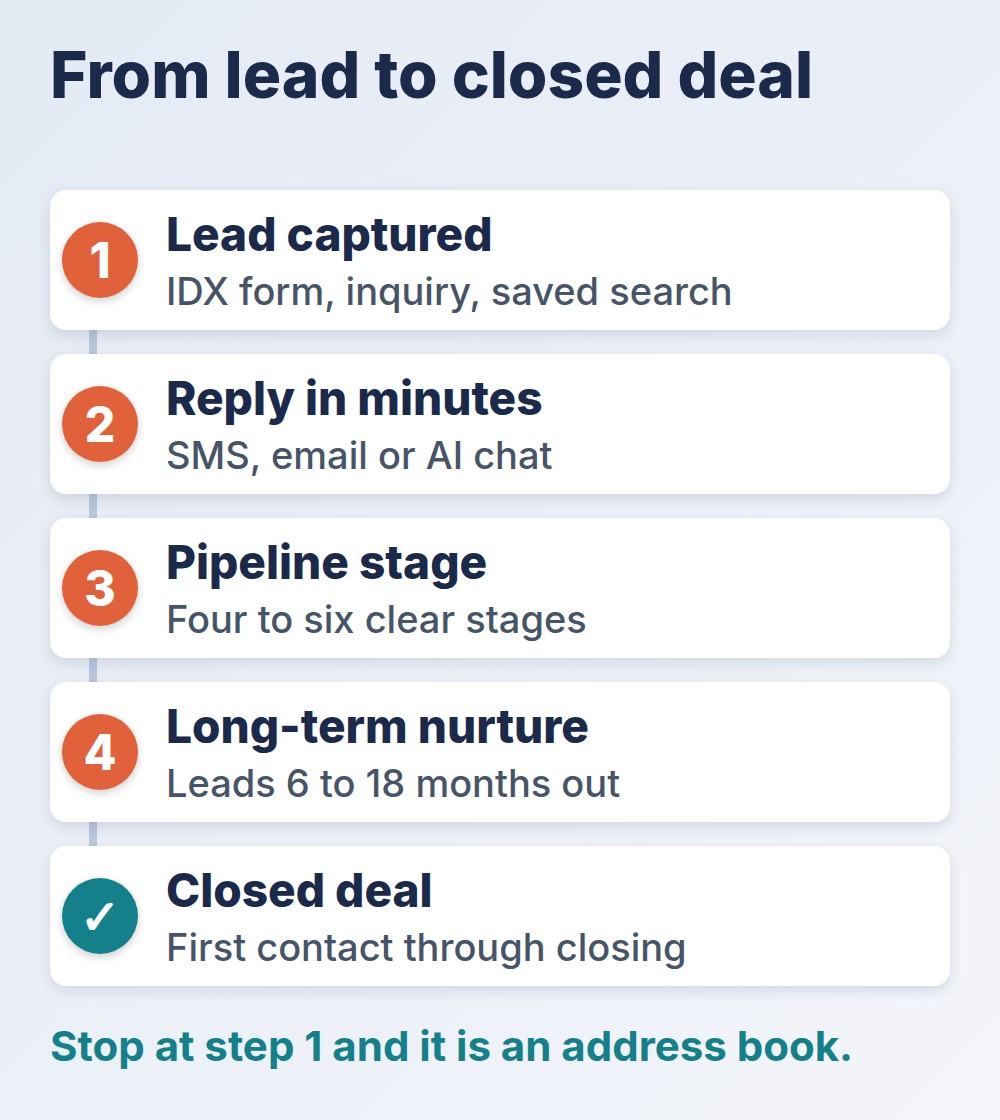
Most comparison articles stop at lead capture, which is the easy half. The platforms above are separated by what happens in the hours, weeks, and months after the form submit, and that is where the best CRM for real estate earns the subscription.
The first five minutes. Response time is the single biggest controllable variable in conversion, and the gap between a five-minute reply and a next-morning reply is not marginal. This is the one job to automate before anything else, because no amount of nurture compensates for being second. Our piece on closing the speed-to-lead gap covers what the automation has to do, and what it should never try to do on an agent’s behalf.
The pipeline. Once a lead is engaged it needs a stage, and the stage needs to mean something. Pipelines fail in two directions: too many stages, so nobody updates them, or too few, so the dashboard says nothing. Four to six stages with a clear exit condition on each is the version that survives contact with a working week. Our guide to CRM pipeline management walks through the stage design and the weekly review that keeps it honest.
The long middle. Most of your database is not transacting this quarter, and the automated marketing layer is what keeps you present until it is. Market updates, home valuation touches, and anniversary notes do the work that neither a hot-lead sequence nor a cold email blast can. We cover the strategy side in CRM marketing for real estate and the tooling side in what CRM marketing software actually does.
Judge a platform on all three, not just the first. A CRM that nails capture and automates nothing after it is an address book with better branding.
Where the CRM Meets Your Website and IDX
The CRM question and the website question are usually asked separately and answered together, because the website is where most of your owned leads are born. A buyer who finds a listing on your IDX site, saves a search, and comes back twice is generating exactly the behavioral data the CRM needs, and that data only arrives if the two systems are genuinely joined rather than linked by a nightly export.
That argues for one of two shapes. Either you take a platform where site and CRM ship together, as kvCORE, Lofty, and Real Geeks do, and accept less choice on each half. Or you keep a best-of-breed CRM and connect a separate site, which gives better tools at the cost of owning the integration yourself. Our comparison of CRM platforms with a website builder included covers the first route, and real estate CRM with IDX integration covers what to check on the second before you assume the sync does what the sales page implies.
Where the Category Is Moving
Two things are changing the shortlist above faster than feature releases usually do, and both are worth factoring into a decision you will live with for three years.
The first is that AI has stopped being a differentiator and started being a baseline. In 2024 an AI SMS responder was a reason to pick a platform. By 2026 every vendor on this list ships one, and the question has moved to what the model is allowed to decide on its own: whether it only drafts, whether it sends, whether it qualifies, and what happens when it gets a compliance-sensitive question wrong. Our overview of AI CRM for real estate covers how to evaluate that layer rather than take the feature list at face value.
The second is consolidation on price. Brokerages that were paying for a CRM, an IDX site, a dialer, and a transaction platform separately are collapsing that stack, and the vendors are responding by bundling. eXp’s move to a single platform is the clearest example of the pattern, and our look at what that consolidation does to per-agent software cost covers what it means for agents who did not choose the stack themselves.
Underneath both sits a quieter shift in what the CRM is expected to watch. The useful signals are increasingly outside the conversation history: rate moves against a past client’s loan, a saved search that suddenly gets revisited, a valuation request from someone who bought four years ago. Our piece on tracking ARM borrowers inside an agent CRM is one concrete version of that, and it is the same idea the next section is about.
None of These Ship a True Intent Layer
Follow Up Boss, kvCORE, and the rest of the platforms above are excellent at capturing leads, routing them, and logging communication history — what has already happened. None of them, out of the box, score real-time buyer behavior (a property click, a second visit to the same listing, a saved search) into a threshold that automatically tells an agent this specific lead is ready to call right now. That is a different, narrower problem than what a CRM is built to solve — see our AI intent layer for real estate CRM breakdown for what closing that gap actually looks like on top of a CRM you already have.
The distinction is worth being precise about, because every vendor on this list will tell you their platform does lead scoring. Most of what ships under that name is a static model: points for a source, points for a form field, points for opening an email, totaled into a number that gets stale the moment a lead’s situation changes. It ranks a list. It does not tell you that this particular contact crossed a threshold forty minutes ago and should be called before lunch.
An intent layer is the second thing, and it needs three pieces a CRM does not have by default: behavioral events streaming in continuously rather than at import time, a threshold that is tuned to your own conversion data rather than a vendor default, and an alert that lands where the agent already works instead of in a dashboard nobody opens. That is a narrow problem, and narrow problems are usually solved better by something sitting on top of the CRM than by waiting for the CRM to grow into it.
None of this is an argument against the platforms above. Pick the best CRM for real estate for your situation from this list, get it running, and treat the intent question as the layer you add once the basics are in place and the follow-up is actually happening.
One more category gets confused with this one. Customer engagement platforms sit close enough to CRM on a feature list that teams assume buying one replaces the other, and the two are built for different jobs. Our comparison of customer engagement platform vs CRM covers where each stops, which is worth reading before you add a second subscription to solve something your CRM was never going to do.
Final Thoughts
The best CRM for real estate is the one your team actually uses — consistently, across every lead and every follow-up. A sophisticated platform sitting unused is worth less than a simple CRM used religiously every day.
Start with the platform that matches your current workflow and lead volume. Follow Up Boss for teams, Wise Agent for solo agents on a budget, kvCORE for brokerages wanting an all-in-one solution. All three are proven platforms trusted by thousands of real estate professionals — and all three will make you faster, more consistent, and more effective at converting leads into closed deals.
One practical note on how to run the decision. Take the two platforms that fit your role and lead volume, import the same 50 real contacts into both trials, and build one automation in each: the reply that fires when a new lead arrives. That single test tells you more about which tool you will actually use than a month of feature comparison, because it exposes the setup friction that decides whether the system is still running in month six.
And set a review date. The right answer at 40 leads a month is rarely the right answer at 200, and the cost of switching early is far lower than the cost of a database nobody has touched since onboarding.
