
A listing presentation is the meeting, and the document that goes with it, where you show a homeowner why they should hire you to sell their home. It covers your pricing opinion, your marketing plan, your terms, and your proof. This guide explains what a listing presentation should contain, gives a section-by-section template and a sample script, shows examples of different formats, and covers the compensation conversation that changed in 2024.

What Sellers Decide On in a Listing Presentation
Sellers compare you with other agents on a few things. NAR’s 2025 Profile of Home Buyers and Sellers, as summarized by Virginia REALTORS’ key takeaways, reports that sellers focused most on marketing the home, pricing it competitively, and selling within a specific period. It also found that 35% said the agent’s reputation was a deciding factor, and that 66% found their agent through a referral or used an agent they had worked with before.
Read that as a checklist for the meeting. Show how you will market the home, how you reached your price, and how long you expect it to take, and back each point with proof that the seller can check. The rest of the presentation exists to support those three answers.
The Parts of a Listing Presentation
Most strong presentations use the same sections in roughly this order. You do not need every slide, but you should be able to answer each question.
| Section | The Question It Answers | What to Include |
|---|---|---|
| About you | Who is this agent? | A short bio, your area, and one result you can prove |
| Their goals | What does the seller want? | Their timeline, price hopes, and concerns, in their words |
| Market snapshot | What is the market doing now? | Local activity in plain terms, with sources named |
| Pricing opinion | What should we list at, and why? | Three to five comparable sales and your reasoning |
| Marketing plan | How will buyers find this home? | What you do, in what order, and by when |
| Process and timeline | What happens next? | Steps from listing agreement to closing |
| Terms | What does it cost and what do we agree? | Compensation, listing period, and what you provide |
| Proof | Why believe you? | Real testimonials and results you can document |
The Pricing Section of a Listing Presentation
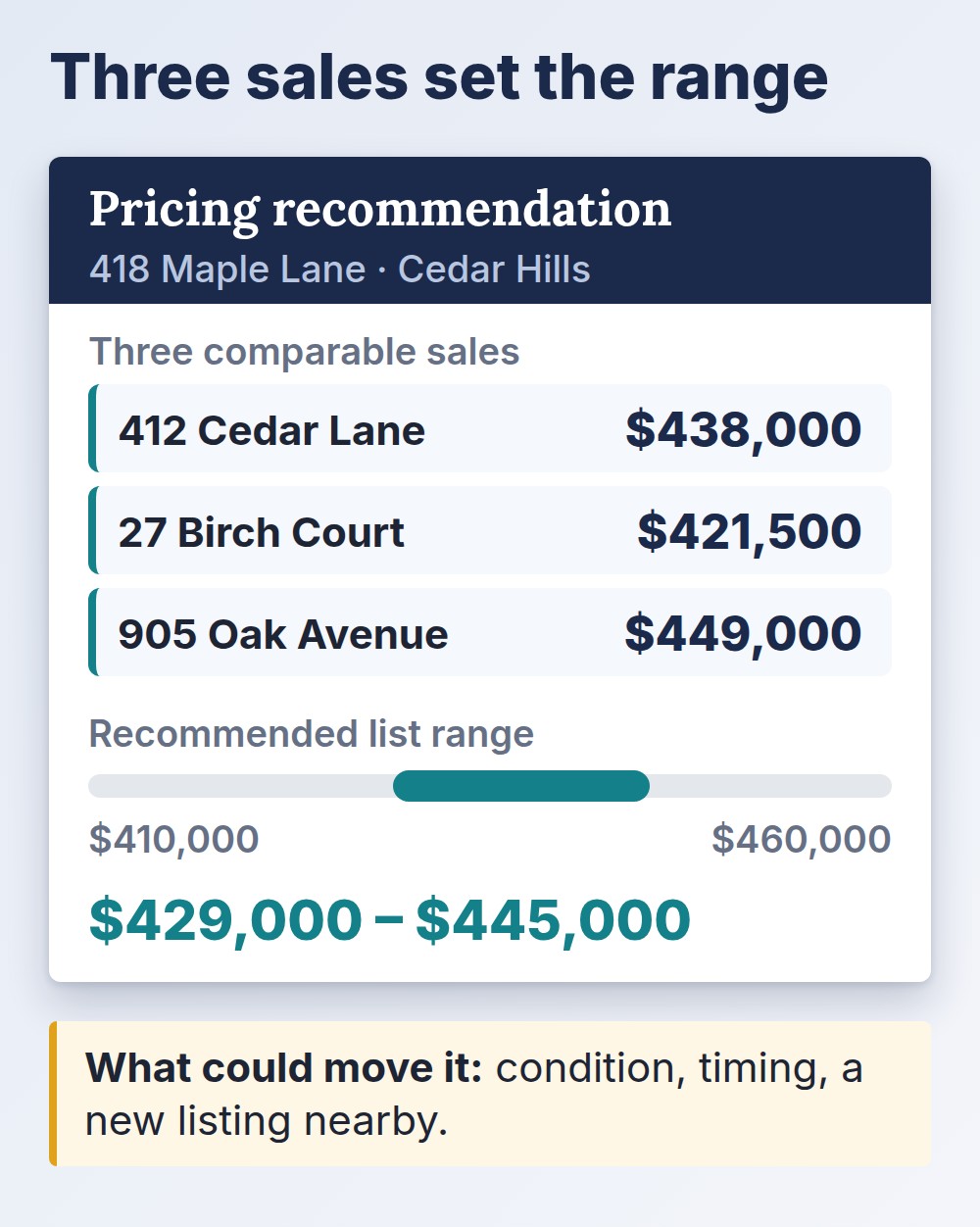
Pricing is where sellers decide whether to trust you. Show three to five comparable sales near the home, explain how each differs from it, and give a recommended price or a narrow range with your reasoning. Be honest about uncertainty: say what could move the number, such as condition, timing, or a new listing nearby. A price you cannot explain looks like a guess, and a price chosen only to win the listing can cost the seller time later.
Prepare this before the meeting. Walk the property if you can, gather the comparables, and write down the two or three points you most want the seller to understand. Bring the numbers on paper or a tablet, not only in your head.
The Marketing Plan Slide
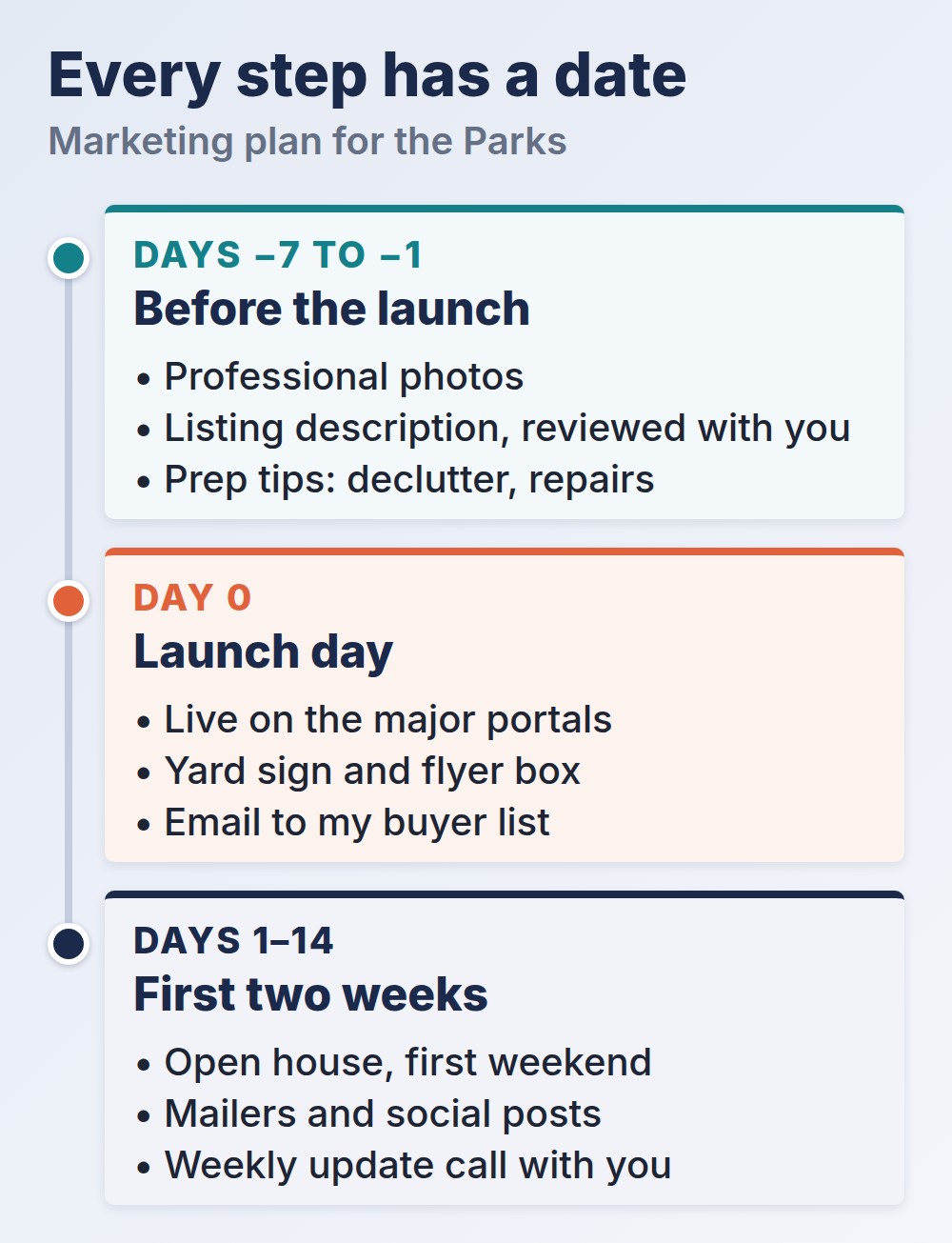
Sellers hire you to market the home, so show the plan as a sequence with dates. List what happens before the home goes live, such as photos, a description, and preparation tips, then what happens on launch day and in the first two weeks. Include online listing exposure, signage, an open house if you plan one, and the mail and social media you will use. Our guides to postcards and mailers that get opened and the full guide to marketing for agents can help you choose which pieces to include.
Keep the language honest and compliant. Describe the home and the plan, not the kind of buyer who should want it, and follow 24 CFR 100.75 on discriminatory advertisements in any sample ad you show.
Compensation and Terms After the 2024 Changes
The compensation conversation is different since the NAR settlement practice changes took effect on August 17, 2024. NAR’s settlement FAQs describe a ban on publishing offers of compensation on an MLS and a written agreement requirement for buyers before they tour homes, and they refer to a disclosure stating that compensation is not set by law and is fully negotiable. For a listing presentation, that means you should be ready to explain your fee clearly, say what the seller gets for it, and explain how any compensation to a buyer’s agent would be handled, in line with your brokerage’s policy and your state’s rules.
Do not leave this for the end of the meeting. Sellers ask about it early, and a clear answer builds trust. Put the terms in writing, and ask your broker to review the language before you use it.
Proof: Results and Testimonials
Show results you can document, such as homes sold, days on market, and sale price compared with list price, and name the time period. Use client words only with permission, as our guide to real estate testimonials and how to ask explains. Pair one specific quote with each result, so the number has a person behind it. If you are new, show your process and your references instead of inventing numbers.
Listing Presentation Template: A 12-Slide Outline
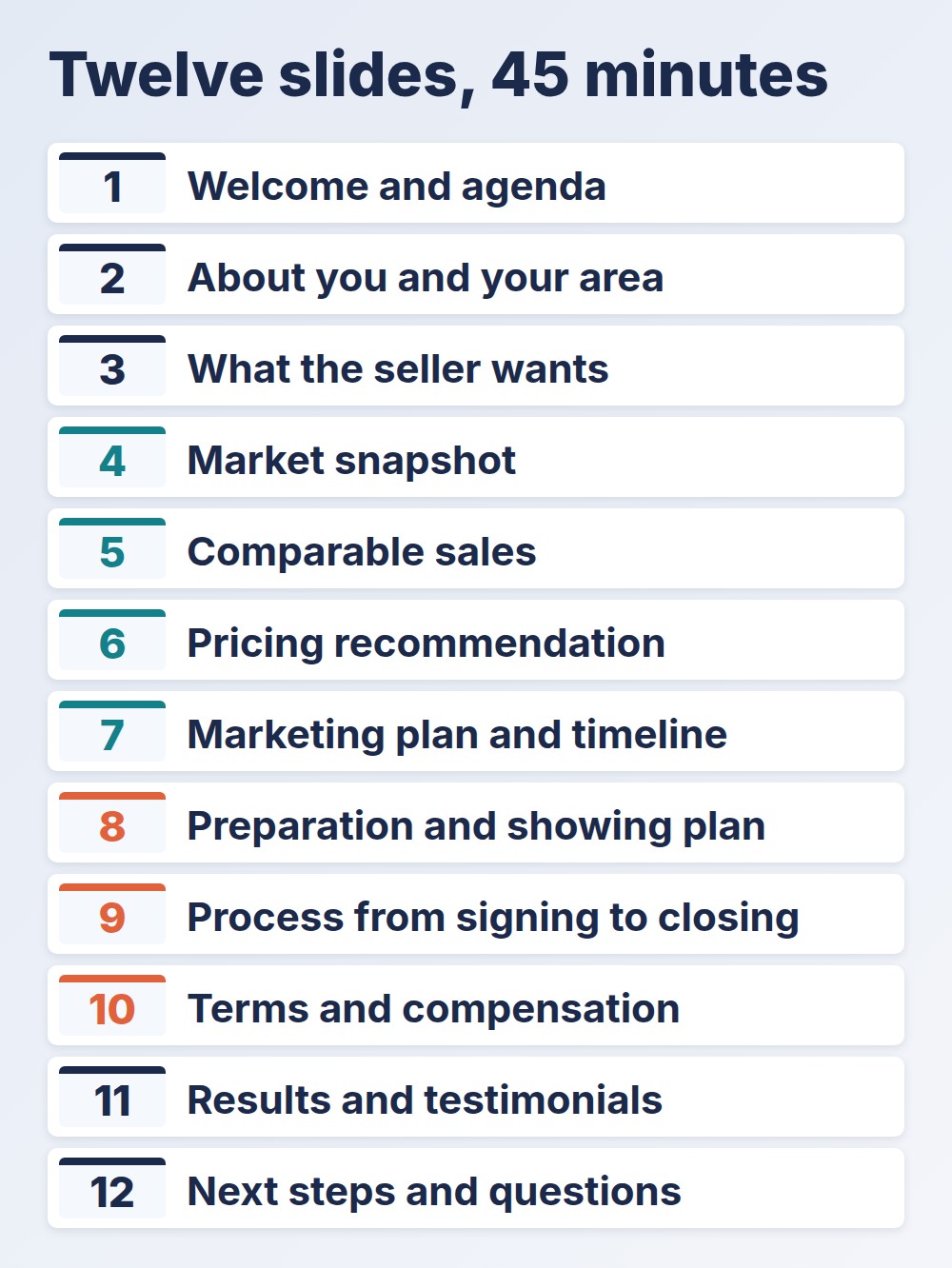
- Welcome and agenda
- About you and your area
- What the seller wants, in their words
- Market snapshot
- Comparable sales
- Pricing recommendation and range
- Marketing plan and timeline
- Preparation and showing plan
- Process from signing to closing
- Terms and compensation
- Results and testimonials
- Next steps and questions
Keep it to a number of slides you can discuss in about forty-five minutes. A longer deck usually means you are reading, not talking.
Listing Presentation Examples by Situation
- The short meeting. Ten to fifteen minutes on the seller’s goals, a one-page pricing summary, and a one-page marketing plan. It suits a referral who already trusts you.
- The standard meeting. The twelve-slide outline above, delivered in about forty-five minutes after a walkthrough of the home.
- The virtual meeting. The same content shared on screen, with the comparables sent in advance so the seller can read them first.
- The competitive meeting. A shorter deck with a stronger proof section, used when the seller is interviewing several agents.
A Sample Listing Presentation Script
The wording below is a sample opening, a pricing line, and a close. Change it to sound like you.
- Opening. “Before I show you anything, I want to ask a few questions so I can focus on what matters to you. When would you like to be moved, and what is most important about the sale?”
- Pricing. “These are the three sales I weighed most, and here is how each differs from your home. Based on them I would start at this range, and here is what could move it.”
- Close. “Here is what I will do in the first two weeks, and here is what I will need from you. What questions do you have, and what would you like to see changed?”
The pattern is to ask questions first and let the seller talk. A presentation where you only read slides tells them what you do. One where you ask questions shows them how you listen.
After the Meeting
Send a short thank-you the same day, with the pricing summary and the marketing plan as a single document. Follow up once within two days. If the seller picks someone else, ask politely what decided it and keep the answer, because it will improve the next presentation. Record the source and result of each meeting in your CRM, as the marketing plan table suggests.
Common Listing Presentation Mistakes
- Talking about yourself for half the meeting. The seller came to hear about their home.
- Quoting a price you cannot explain. Comparables and reasoning matter more than the number.
- A vague marketing plan. “We will market it everywhere” is not a plan.
- Avoiding the compensation question. It builds distrust.
- Using claims you cannot prove. Rankings and sales totals need a source and a year.
- No follow-up. A seller comparing agents may decide after the meeting, so a prompt note keeps you in the running.
Final Thoughts
A good listing presentation answers three questions: how will you market this home, how did you reach this price, and how long will it take. Prepare the pricing, show the plan as a sequence, be clear about compensation, and prove your claims. Use the template as a starting point, practice the script out loud, and ask questions before you present. The agent who listens and explains clearly usually beats the agent with the longest deck.
