
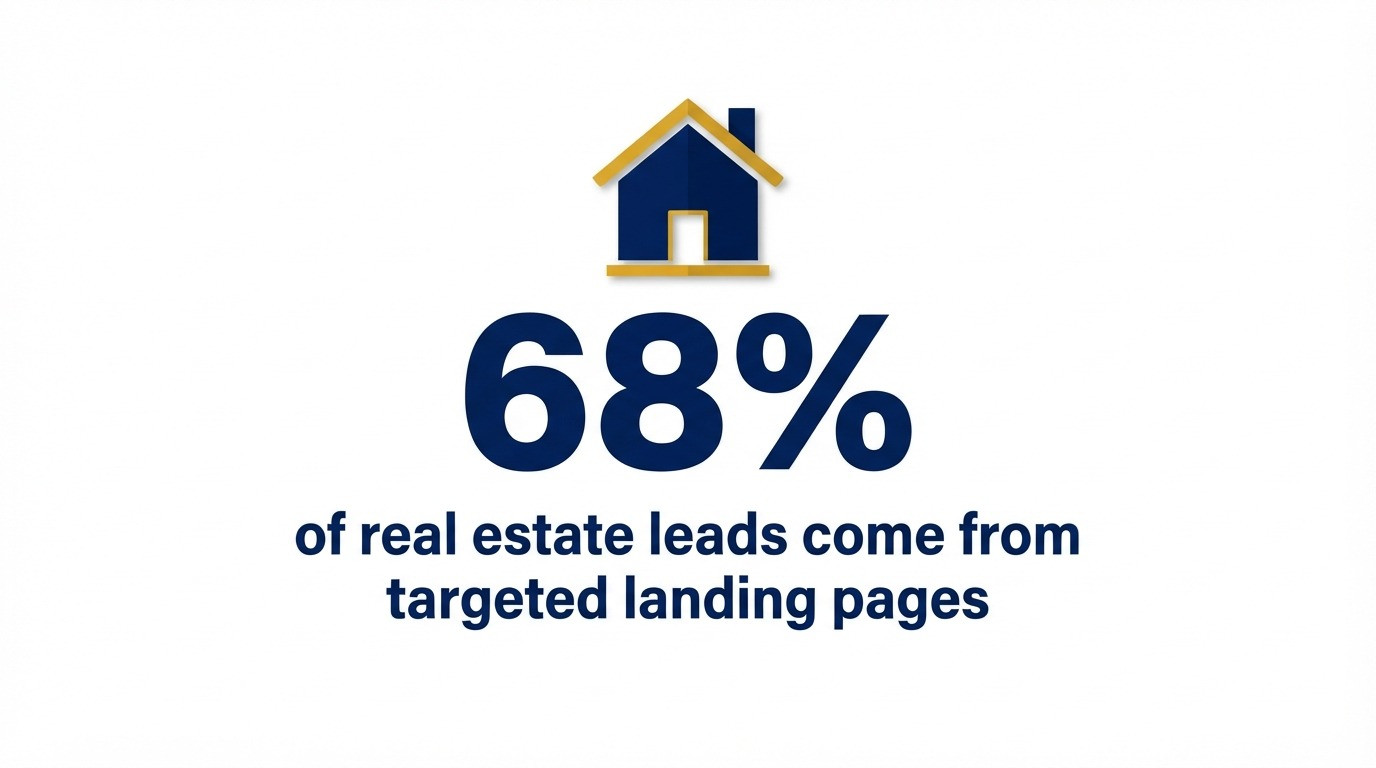
Every dollar you spend on real estate marketing, whether that is Facebook ads, Google PPC, Zillow Premier Agent, social posts, or direct mail carrying a URL, lands somewhere. If it lands on your general website, most visitors leave without converting. If it lands on a dedicated real estate landing page built for a single purpose, a meaningful share of those visitors become registered leads. The real estate landing page is not a nice-to-have in your lead generation system. It decides whether your marketing spend produces contacts or just traffic.
The gap between a good one and an average one is larger than most agents expect. The Unbounce Conversion Benchmark Report, covering 2,877 real estate landing pages and 891,959 conversions, puts the median conversion rate for this industry at 2.2 percent, while pages in the top quartile convert at 20.2 percent. Roughly a tenfold spread, on the same traffic, from page construction alone.
This guide covers the four types worth building first, the elements each one needs, how to build the page, what separates the top quartile from the median, and the failure modes that waste the spend even when the page itself looks fine.

Types of Real Estate Landing Page That Actually Produce Leads
Home valuation landing page. The most effective real estate landing page for seller leads. The offer is simple: enter your address and get an estimated value for your home. It works on cold traffic because homeowners are perpetually curious about their home’s value whether or not they are planning to sell, and because the ask is small while the payoff is immediate. A well-built home valuation landing page is the offer most agents find outperforms everything else they run. It is also the natural first page to build if you want seller leads rather than buyer leads.
Valuation is one of several seller-side offers, and the others suit different stages: a listing consultation page for sellers already decided, an expired listing page for a very specific and very motivated audience, and a market report page for owners who are watching rather than acting. Our breakdown of seller landing page types that convert covers when to use each.
Open house registration page. A dedicated landing page for a specific open house event. Instead of sharing a Zillow listing URL on social media, which sends traffic to Zillow’s platform where other agents capture the leads, you send traffic to your own page where visitors register directly in your database. The page also does a second job that the Zillow link cannot: it collects the registration before the event, which gives you a list to follow up with whether or not those people show up on the day. For more on building this type of page, see our guide to building an open house registration page.
Neighborhood or zip code landing page. Targets buyers searching in a specific area by offering a free neighborhood market report or property alert. A page targeting “homes for sale in [Neighborhood]” that offers a free weekly market update converts search traffic at higher rates than a generic property search page because it delivers something specific the visitor cannot easily get elsewhere.
First-time homebuyer guide landing page. Offers a downloadable guide in exchange for contact information. Effective for capturing buyers early in their decision process, before they have selected an agent, and for building a nurture list you work over months rather than days. Expect a longer gap between registration and transaction here than on any other page type, which makes it the wrong page to judge on 30-day numbers.
Your own agent page. Separate from the four above, and the one most agents skip. It is the page that referral traffic, a business card QR code, and your social bio all point at, and it has a different job: not capturing a cold lead with an offer, but converting someone who already has your name into a conversation. Our guide to the real estate agent landing page covers what belongs on it.
Build in that order rather than all at once. One page running well against one traffic source teaches you more than four half-configured pages splitting the same budget.
The Elements Every Real Estate Landing Page Needs
Message match. The headline on your real estate landing page must match the ad, email, or post that sent the visitor there. If your Facebook ad says “Free Home Value Report for [City],” your landing page headline must say the same thing. Visitors who land on a page that does not match what they expected leave immediately, which drives conversion rates below 1 percent regardless of how good the rest of the page is.
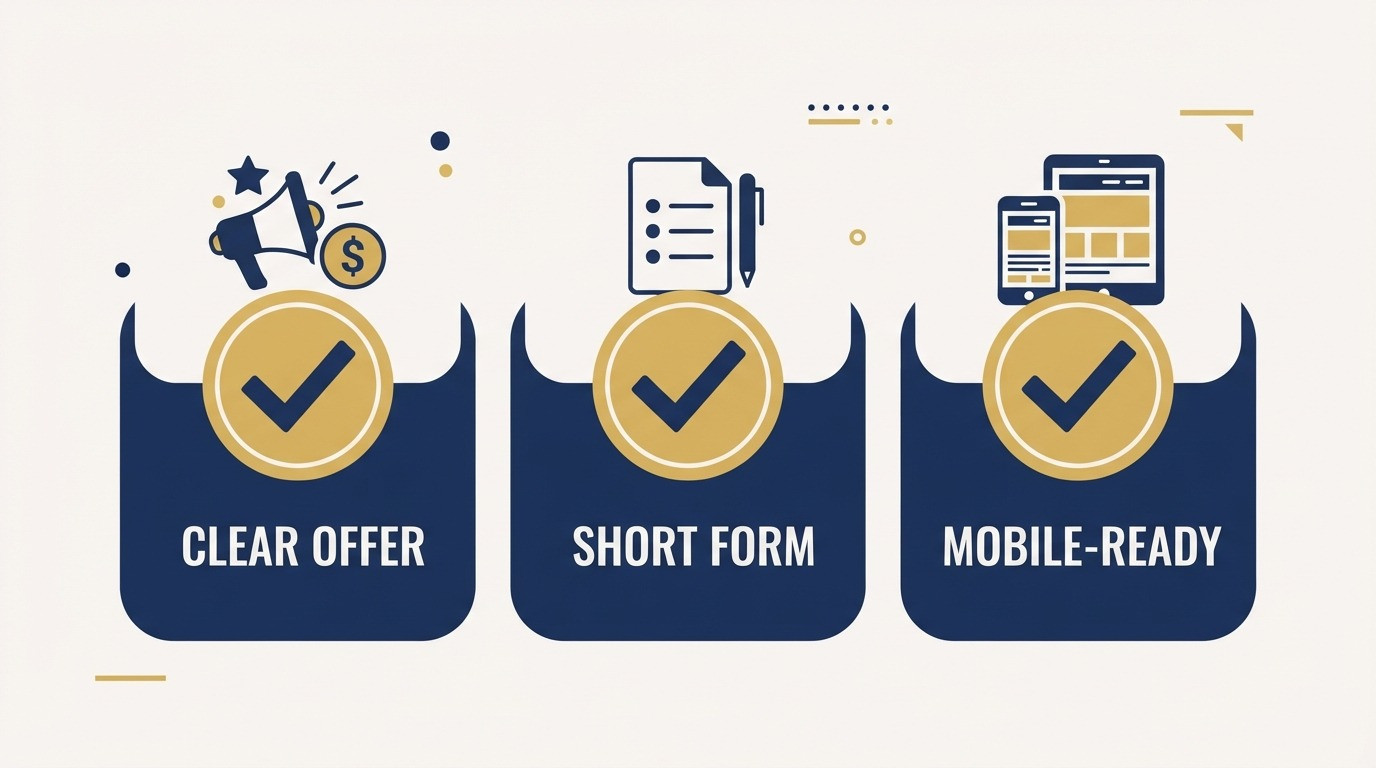
A single, specific offer. The offer is the reason the visitor submits their contact information. It must be specific (“Free market report for zip code 90210, updated monthly”) and immediately valuable (“Get it instantly” or “See results on the next page”). Generic offers (“Learn more about buying a home”) do not convert because they do not give the visitor a concrete reason to share their information.
Short form with three to four fields maximum. Name, email, and phone for most pages. Add property address for home valuation pages. Add price range or neighborhood preference for buyer lead pages. Every field beyond the minimum reduces completion rates. You can collect additional qualifying information in your follow-up sequence once you have the lead’s contact details.
Your credibility. A professional headshot, name, brokerage, and one or two specific accomplishments. Visitors are deciding whether to trust you with their personal information. Generic agent bio copy does not build trust. A specific statement like “I have helped 140 families buy and sell in [City] over the past 8 years” does.
One call to action, repeated. A single action, worded the same way every time it appears. Pages that offer a form, a phone number, a chat widget, and a link to browse listings give the visitor four ways to leave and one way to convert. Remove the site navigation entirely while you are at it, since every menu item is an exit.
Mobile and speed, treated as structural rather than cosmetic. Most paid social traffic arrives on a phone, which means the headline, the offer, and the first form field all have to be visible without scrolling on a small screen. A page that takes several seconds to load loses a meaningful share of visitors before they see any of it, and no amount of copy work recovers them.

Building Your Real Estate Landing Page
Purpose-built platforms are the fastest way to launch a high-performing real estate landing page. Carrot specializes in real estate landing pages and includes pre-built templates for home valuation, open house, and buyer lead campaigns. Templates include all standard elements pre-configured: headline, offer section, agent profile, form, and social proof. A first landing page on Carrot takes 30 to 60 minutes to build from a template.
Agents on all-in-one platforms like Real Geeks, kvCORE, or Sierra Interactive have landing page tools built into their subscription. These integrated options route registrations directly into the CRM, which eliminates the manual work of importing leads from a separate landing page tool. For agents still evaluating which platform to use, our guide to platforms with landing pages built in covers which subscriptions already include the tooling.
For automating follow-up after a lead registers on your landing page, our CRM overview for agent pipelines covers which platforms handle landing page lead intake and automated nurture sequences most effectively.
What Separates High-Converting Real Estate Landing Pages
The difference between a real estate landing page that converts at 2 percent and one that converts at 20 is almost never design. It comes down to a set of structural decisions: message match, offer specificity, form length matched to how cold the traffic is, social proof placement, and mobile and speed execution.
The benchmark data makes the size of that gap concrete. Against a median of 2.2 percent, the top quartile in the Unbounce Conversion Benchmark Report converts at 20.2 percent. That is not a design difference, because the pages at both ends of that range look broadly similar. It is the difference between a page built for one audience arriving from one ad with one offer, and a page built to cover several audiences at once.
The practical reading: if your page converts near 2 percent you are normal, not broken, and the fastest fix is usually narrowing the page rather than redesigning it. For the full breakdown of each factor with the tactics to apply, see our guide to high converting real estate landing pages. Infina AI, our own product, pairs a listing page with a built-in AI expert that answers questions.
What Usually Goes Wrong
Four failure modes account for most of the money wasted in this category, and only one of them is about the page itself.
The page is fine and nothing happens after the form. This is the most common and the most expensive. A registration that sits in a tool nobody checks is worth the same as no registration. Decide what happens in the first five minutes after submission before you spend anything on traffic, because that step, not the page, is where most real estate landing page leads are actually lost. Our guide to real estate lead follow-up automation covers how to wire it up.
One page pointed at every campaign. A single page receiving buyer traffic, seller traffic, and referral traffic cannot match the message for any of them. Message match is the first thing to break when a page is reused, and it is the factor with the largest effect on conversion rate. One page per offer per audience, even when that means four thin pages instead of one polished one.
The offer is really an ask. “Contact me for a free consultation” is not an offer, it is a request for the visitor’s time dressed as a gift. A real offer delivers something immediately and without a conversation: a number, a report, a document. If a visitor would have to speak to you to receive it, it will convert like a contact form, because that is what it is.
Nobody measures it. Conversion rate on a landing page is two numbers divided, and most agents running paid traffic cannot state either one. Without the baseline, every later change is a guess. Record visits and registrations per page from the first day, before testing anything.
Final Thoughts
A real estate landing page is the mechanism that converts your marketing investment into contact information. Without it, your ads and social media posts drive traffic that mostly leaves without converting. With a dedicated landing page for each campaign, matched to the right offer, the right audience, and the right traffic source, the same marketing budget generates significantly more leads.
Start with a home valuation page for seller leads and an open house registration page for buyer leads. Wire the follow-up before you buy traffic. Record the conversion rate from day one, then test one element at a time, starting with the headline and the offer rather than the design.
A real estate landing page converting at the 2.2 percent median is not a failed page. It is an ordinary one, and ordinary is a starting point with a known amount of room above it.
