
Choosing the right CRM for real estate agents is one of the highest-leverage decisions you can make for your business. The wrong CRM adds friction, gets abandoned within weeks, and leaves your leads in the same spreadsheet you started with. The right CRM for real estate agents automates the follow-up you never have time for, surfaces the leads most likely to close, and compounds your productivity every single day.
This guide breaks down exactly what to look for in a CRM for real estate agents, the five questions to ask before you buy, and which platforms are delivering the best results for agents and teams in 2026.

Why Most Agents Choose the Wrong CRM for Real Estate Agents
The most common mistake agents make when selecting a CRM for real estate agents is choosing based on features rather than fit. A CRM with every capability imaginable is worthless if the agent never opens it. A simpler CRM used consistently every day beats a sophisticated platform sitting idle.
The second most common mistake is choosing a generic CRM like Salesforce or HubSpot and trying to adapt it to real estate workflows. Generic CRMs are built for B2B sales cycles, not real estate transactions. They require extensive customization to handle IDX leads, listing alerts, showing schedules, and transaction milestones — work that a purpose-built CRM for real estate agents handles out of the box.
The third mistake is underestimating adoption. A CRM for real estate agents only works if every lead enters it and every follow-up happens through it. If the CRM is hard to use on mobile, agents will stop logging calls. If lead capture requires manual import, leads will pile up in email. The best CRM for real estate agents removes friction from every part of the workflow — capture, follow-up, and tracking — so adoption happens naturally rather than through discipline.
5 Questions to Ask Before Choosing a CRM for Real Estate Agents
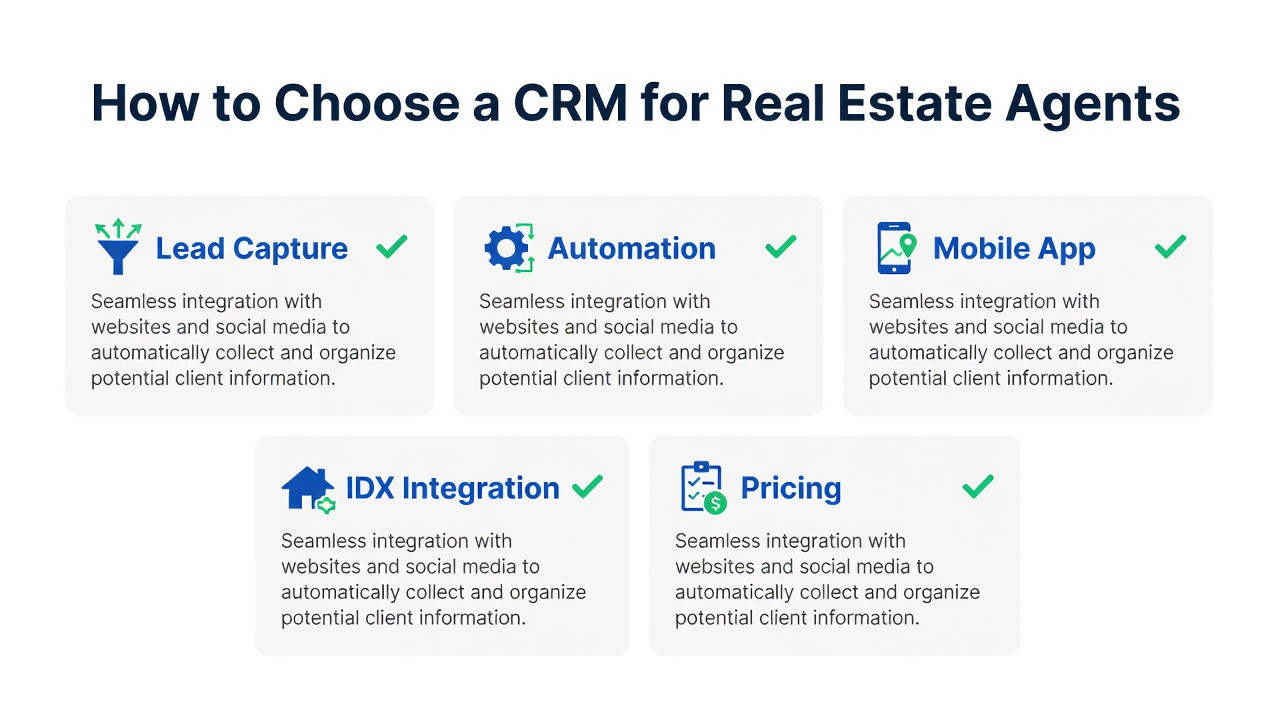
1. Does it capture leads automatically from all your sources?
A CRM for real estate agents should connect directly to every lead source you use — Zillow, Realtor.com, Facebook, your IDX website, and any other portals — and capture every lead the moment it submits. If you have to manually import leads from any source, you will miss leads and create unnecessary work. Confirm that every source you use has a direct integration before you commit.
2. Does it trigger an immediate automated response?
Speed to lead is the single biggest conversion factor in real estate. The best CRM for real estate agents sends an automated SMS or email within seconds of lead capture — not when you check your phone, not when you get back from a showing. Ask every vendor specifically: how fast does the first automated response go out, and can I customize the message?
3. Can it manage long-term nurture automatically?
Most real estate leads are 6 to 18 months from transacting. A strong CRM for real estate agents keeps you in front of those leads through automated drip campaigns, behavioral triggers, and scheduled check-ins — without you having to remember a single follow-up. If the CRM requires manual task creation to stay in touch with long-term leads, it will fail within weeks.
4. Does it have a full-featured mobile app?
Real estate agents work in the field. A CRM for real estate agents with a limited or absent mobile app is not a real option. You need to be able to log calls, update contacts, respond to new leads, and check your pipeline from your phone — in between showings, from the parking lot, at any hour. Test the mobile app before you buy, not after.
5. What does it cost as your team grows?
Many CRM for real estate agents platforms charge per user — what costs $69/month for one agent becomes $500/month for a team of seven. Understand the pricing model before you commit. Some platforms like Wise Agent charge a flat fee regardless of team size, which dramatically changes the economics as you add agents.
CRM for Real Estate Agents: Top Platforms in 2026
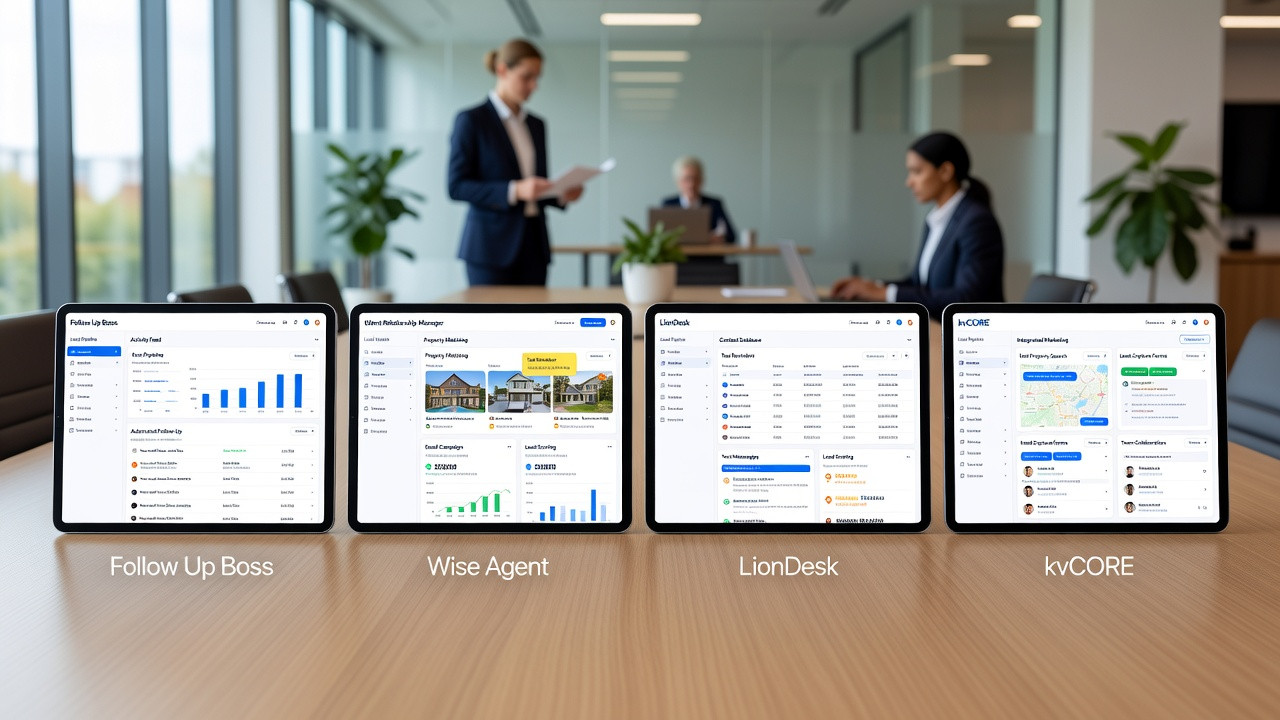
Follow Up Boss — Best CRM for Real Estate Agents on Teams
Follow Up Boss is the most widely used CRM for real estate agents on high-volume teams. Its lead routing, action plans, and two-way texting are built specifically for the ISA-driven brokerage model. Every lead from every source routes to the right agent automatically, and the automated action plans ensure no lead goes more than 24 hours without a touchpoint. Follow Up Boss integrates with over 200 lead sources, making it the most connected CRM for real estate agents on the market.
Best for: Teams with 3+ agents and significant lead volume.
Starting price: $69/month (solo), $499/month (teams).
Wise Agent — Best Value CRM for Real Estate Agents
Wise Agent is the best CRM for real estate agents who want maximum functionality at the lowest price. Its flat $49/month fee covers unlimited contacts, unlimited users, transaction management, landing pages, email marketing, and AI-powered follow-up. For solo agents and small teams who want a full-featured CRM for real estate agents without enterprise pricing, Wise Agent delivers the best return per dollar of any platform on this list.
Best for: Solo agents and small teams on a budget.
Starting price: $49/month flat.
LionDesk — Best CRM for Real Estate Agents Who Rely on SMS
LionDesk stands out as the best CRM for real estate agents who want AI-powered SMS and video messaging built into their follow-up workflows. Its AI assistant responds to inbound lead texts automatically, qualifying buyers and sellers before any human involvement. LionDesk’s video text capability lets agents send personalized video messages directly from the CRM, a feature that consistently outperforms standard text in response rate studies.
Best for: Agents who prioritize SMS-first follow-up and video messaging.
Starting price: $39/month.
kvCORE — Best All-in-One CRM for Real Estate Agents at Brokerages
kvCORE is the best CRM for real estate agents who want a single platform covering IDX website, lead generation, CRM, and AI-powered nurture. Its Smart CRM monitors every contact’s behavioral activity and triggers automated follow-up when signals indicate buying intent, without any agent action required. For agents at brokerages that provide kvCORE as a company tool, it is the most complete ecosystem available.
Best for: Agents at brokerages wanting an all-in-one platform.
Starting price: Custom, typically $500–$1,500/month at brokerage level.
Real Geeks — Best CRM for Real Estate Agents Who Want IDX + CRM Together
Real Geeks combines a high-converting IDX website with a tightly integrated CRM for real estate agents — so every website lead flows directly into the CRM with full behavioral data attached. Its Geek AI handles initial lead conversations via SMS automatically, and the IDX website is consistently among the highest-converting in the industry. For agents who want their website and CRM to work as one system, Real Geeks is the most coherent option available.
Best for: Agents who want website and CRM fully integrated.
Starting price: $299/month.
How to Match a CRM for Real Estate Agents to Your Business Model
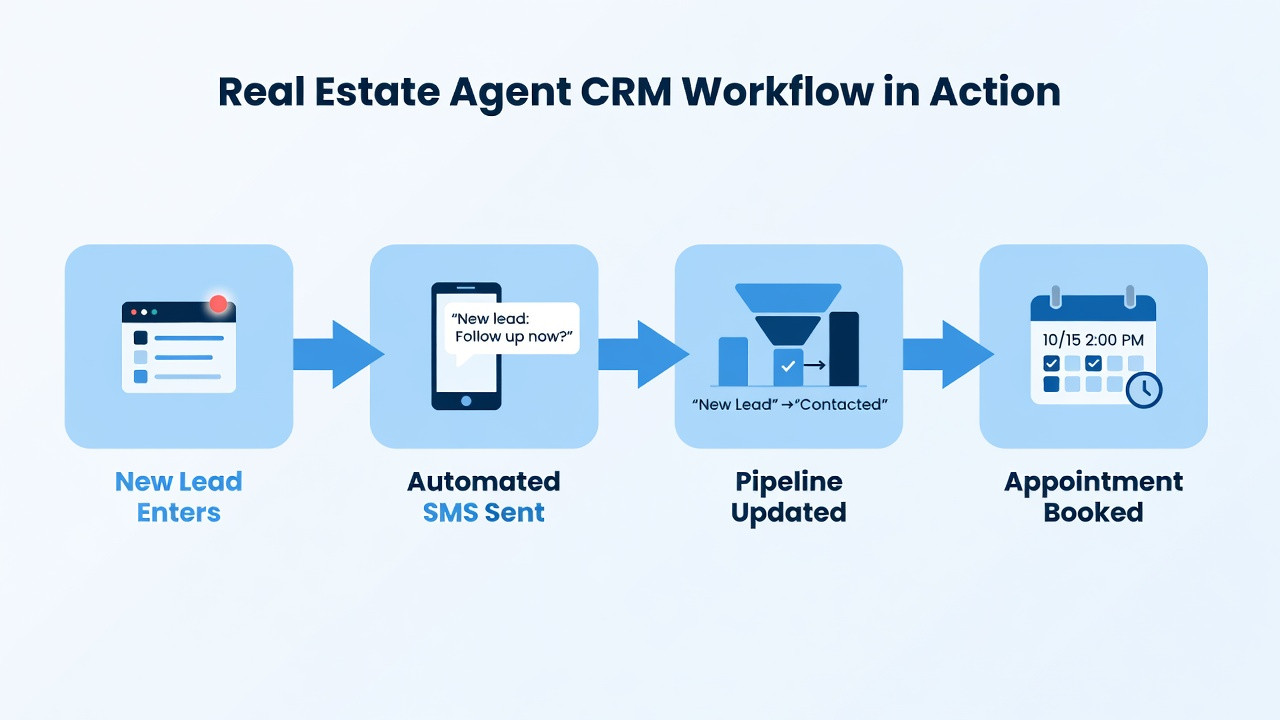
The right CRM for real estate agents depends less on which platform has the most features and more on which one fits your actual business model.
Solo agent, referral-based business: You need a CRM for real estate agents that handles long-term relationship management, birthday and anniversary reminders, and consistent past-client communication. Wise Agent or IXACT Contact are the best fits — both prioritize the relationship-nurture workflows that drive repeat and referral business.
Solo agent, portal lead buyer: You need a CRM for real estate agents with instant automated response and aggressive short-term follow-up sequences. LionDesk or Wise Agent deliver both at a price point that makes sense for solo volume. Speed-to-lead automation is non-negotiable — for more on why, read our guide on how a CRM closes the speed-to-lead gap.
Team with ISAs: You need a CRM for real estate agents built around lead routing and ISA workflow visibility. Follow Up Boss is the industry standard for this model — its routing rules, action plans, and reporting are designed specifically for teams where ISAs handle initial qualification and agents handle appointments and closings.
Brokerage wanting one platform: You need a CRM for real estate agents that scales across multiple agents, tracks individual performance, and integrates with your transaction management system. kvCORE and Chime are the leading options at the brokerage level — both provide the oversight tools brokers need alongside the agent-facing features that drive adoption.
Red Flags When Evaluating a CRM for Real Estate Agents
Not every CRM for real estate agents is worth your time. Watch for these warning signs during the evaluation process.
No native IDX integration — If the CRM cannot connect directly to your IDX provider, you will spend hours manually importing leads. This is a dealbreaker for any agent doing meaningful online lead generation.
No mobile app or a poor one — A desktop-only CRM for real estate agents will be abandoned. Real estate is a mobile profession. If you cannot use the CRM from your phone with full functionality, it will not survive contact with your actual workday.
Pricing that penalizes growth — Per-agent pricing that jumps significantly as you add team members creates a disincentive to grow. Understand the pricing model at two agents, five agents, and ten agents before you commit to any platform.
For a deeper look at how AI is transforming what a CRM for real estate agents can do, read our guide on what an AI-driven CRM actually automates. For the full platform comparison across all use cases, see our Best CRM for Real Estate Agents in 2026 guide.
Final Thoughts
The best CRM for real estate agents is not the one with the most features or the highest price — it is the one your team will actually use every day, consistently, across every lead and every follow-up. Start with your actual workflow, not the vendor’s feature list. Ask the five questions above, test the mobile app, and confirm that every lead source you use connects automatically.
Get those fundamentals right and the CRM for real estate agents becomes the most valuable tool in your business — not because of what it can do in theory, but because of what it does automatically while you are out doing what actually closes deals.
