
Not all CRM tools for real estate are built for the same operation. A solo agent managing 50 active leads has very different needs from a team of ten agents sharing a lead pool and requiring accountability dashboards. The five platforms reviewed here are the ones consistently winning at both ends of that spectrum in 2026 — chosen based on lead automation depth, team management features, ease of adoption, and integration with the portals and tools real estate professionals actually use.
Whether you are a solo agent looking to stop losing leads in a spreadsheet, or a team lead who needs visibility into what every agent is doing with their pipeline, this comparison of crm tools for real estate will help you find the right fit faster than a free trial ever could.

What Separates Good CRM Tools for Real Estate from Generic CRM Software?
Generic CRM platforms — Salesforce, HubSpot, Pipedrive — are built for B2B sales cycles measured in weeks. Real estate operates on a completely different timeline: leads can take 12 to 18 months to convert, and the follow-up cadence that wins deals (text within 5 minutes, call within an hour, automated drip for 90 days) requires integrations that generic CRMs do not have out of the box.
The crm tools for real estate that actually move the needle are built around three capabilities that generic platforms lack: direct API integrations with Zillow, Realtor.com, and other lead portals; automated speed-to-lead response that fires within seconds of a new lead arriving; and pipeline structures designed around property search timelines rather than B2B deal stages. Every platform reviewed here meets all three criteria.
Top CRM Tools for Real Estate: Platform-by-Platform Breakdown
Follow Up Boss is the benchmark CRM tool for real estate teams that need serious accountability and lead routing. Its central inbox consolidates every lead from every source — portals, IDX, referrals, direct — and routes them to the right agent based on rules you define. Team leads get a real-time view of every agent’s follow-up activity, response times, and pipeline movement. For teams of five or more agents, Follow Up Boss is the most widely used CRM tool in real estate for good reason: it makes it impossible to let a lead fall through the cracks without the team lead knowing about it.
Lofty (formerly Chime) is the strongest AI-native CRM tool for real estate agents who want automation to handle lead qualification before a human agent gets involved. Its AI assistant engages new leads via text conversation, asks qualifying questions about timeline, budget, and location preference, and schedules appointments — all without agent input. For high-volume teams receiving more leads than agents can physically call, Lofty’s AI layer acts as a first-response filter that dramatically improves the quality of conversations agents are having.
kvCORE is the CRM tool built for brokerages that need enterprise infrastructure. Each agent gets their own branded IDX website, their own lead pipeline, and their own automated follow-up sequences — while the brokerage admin retains centralized visibility and control over lead distribution, compliance, and team performance. For brokerages managing 20 or more agents, kvCORE’s brokerage-level toolset is unmatched among real estate CRM tools.
Wise Agent is the best-value CRM tool for real estate agents at $49/month — unlimited contacts, transaction management, built-in drip campaigns, and lead routing, all in a platform that new users can operate productively within hours of signing up. For solo agents and small two-to-three person teams who do not need brokerage-scale infrastructure, Wise Agent delivers everything essential without the enterprise price tag.
LionDesk stands apart among CRM tools for real estate through its video email and AI texting features. Its AI texting sends a personalized first-response text within seconds of a new lead arriving, and its video email feature has consistently shown higher open and reply rates than standard email drip in real estate contexts. For agents whose conversion model is relationship-first rather than volume-first, LionDesk’s communication tools are the strongest in the category.

CRM Tools for Real Estate Teams: Feature Comparison
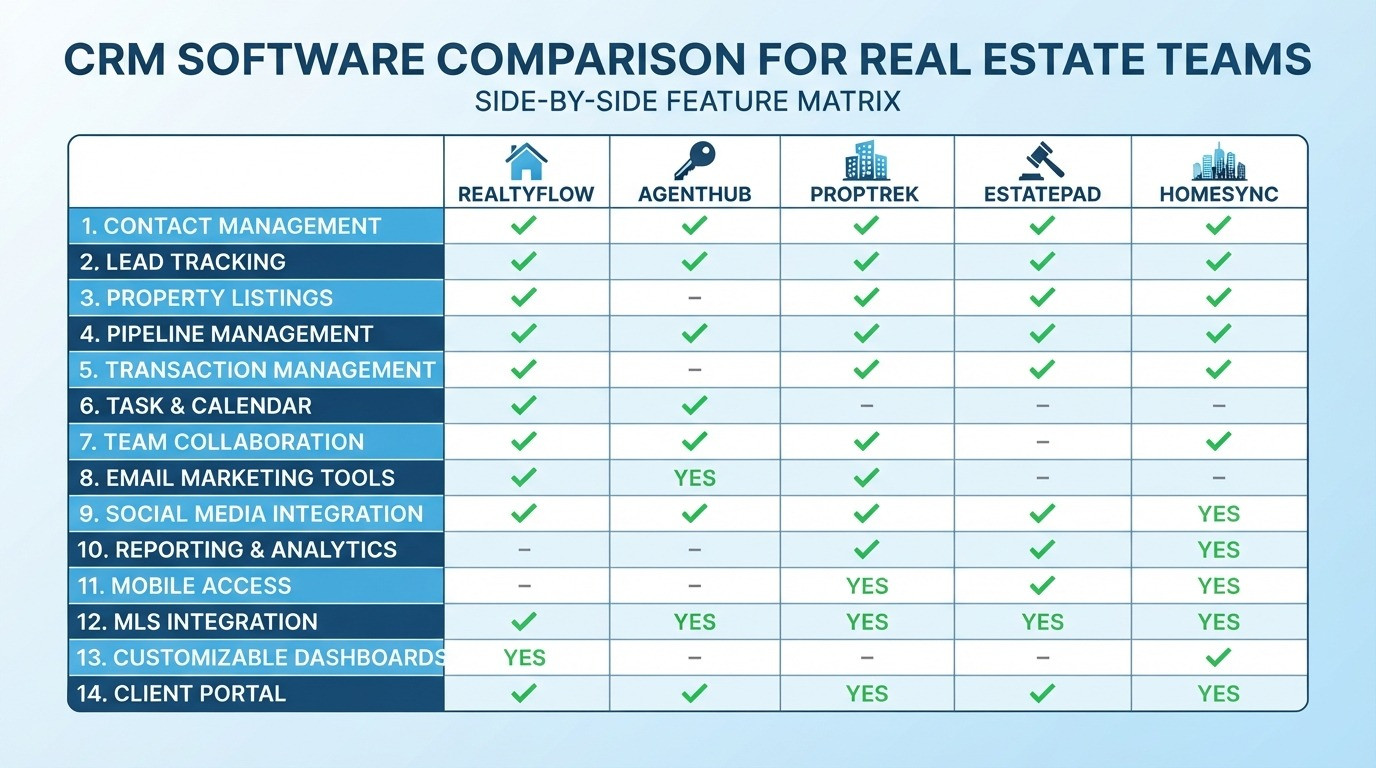
Across all five platforms, the decision typically comes down to team size and automation preference. Follow Up Boss wins on team accountability and lead routing. Lofty wins on AI automation depth. kvCORE wins on brokerage infrastructure. Wise Agent wins on price-to-feature ratio for solos. LionDesk wins on video and text communication quality.
The one factor that matters more than any feature comparison: adoption. A CRM tool that agents actually open every morning outperforms a more sophisticated platform that sits unused. When evaluating crm tools for real estate, always run a two-week trial with the agent who is most resistant to new software — if they can build a daily habit with it, the rest of the team will follow.
Integrations That Matter for Real Estate CRM Tools
The integrations that separate productive CRM tools for real estate from the ones that create extra work are: Zillow and Realtor.com lead import (direct API, not email parsing), MLS/IDX data sync so agents can see property activity alongside contact records, texting and calling built into the CRM rather than requiring a separate dialer, and Google or Outlook calendar sync for appointment scheduling. All five platforms reviewed here support these integrations — but the depth of implementation varies significantly. Follow Up Boss and Lofty have the most mature portal integrations; LionDesk has the most complete built-in communication stack.
Related Reading
For a full platform ranking with pricing, see our guide to the best CRM for real estate agents. If you are evaluating AI-powered options specifically, our AI CRM for real estate guide covers the platforms using machine learning to automate lead qualification and follow-up. New to CRM software entirely? Start with our CRM management beginner’s guide for realtors.
Final Thoughts
The best CRM tools for real estate in 2026 are not the ones with the longest feature list — they are the ones that respond to leads faster than your competition and give your team the structure to follow up consistently over the 12-to-18-month timelines that define residential real estate. Follow Up Boss, Lofty, kvCORE, Wise Agent, and LionDesk each do this at a different price point and scale. The right choice depends on your team size, your volume, and how much you want automation to handle versus how much you want your agents to do manually.
Whatever platform you choose, the most important decision is committing to it fully: importing your existing contacts, configuring your lead sources, and using it every day. A CRM tool only delivers value when it becomes the center of your workflow — not an afterthought.
