

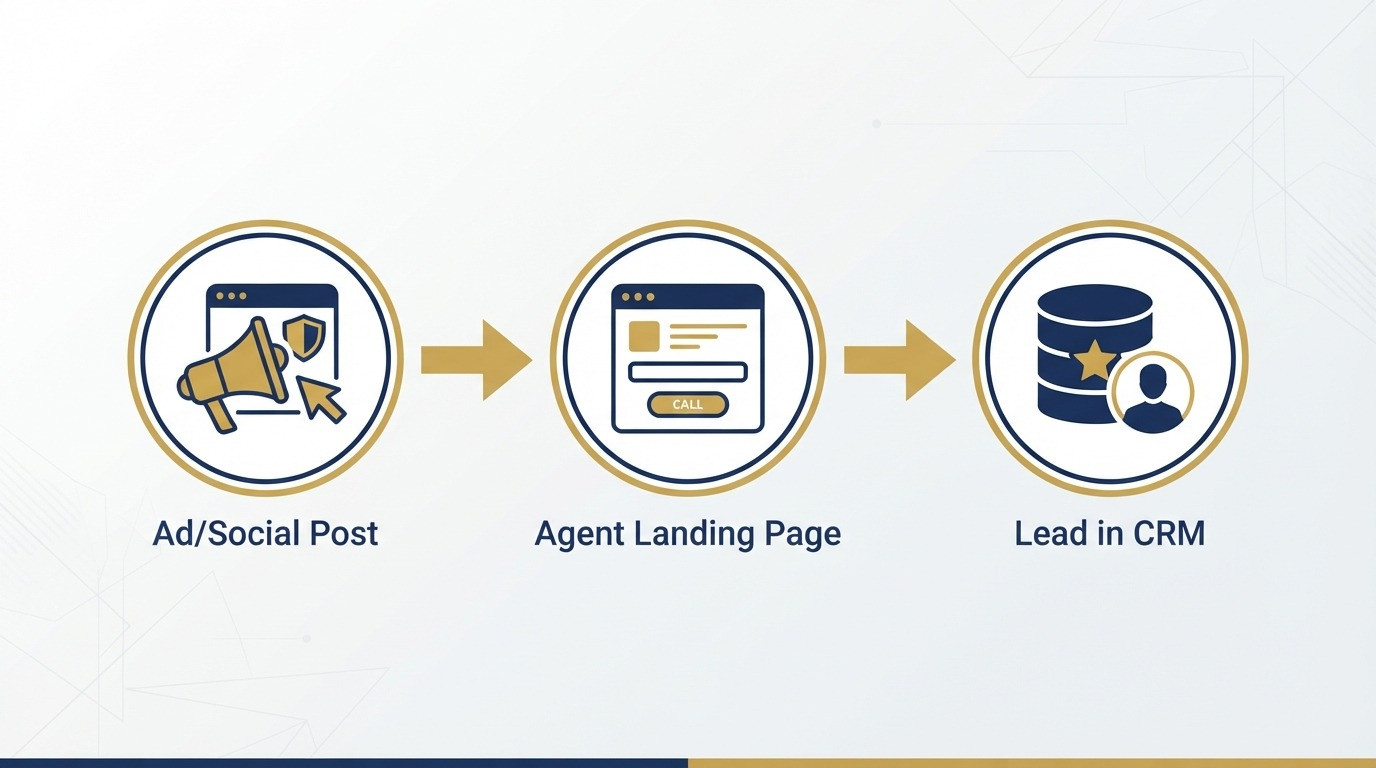
Most real estate agents have a website. Far fewer have a dedicated real estate agent landing page – and that distinction drives most of the difference in online lead generation results. A general website does many things at once: it shows your listings, describes your services, links to your blog, and displays your contact information. A real estate agent landing page does exactly one thing: it converts a specific type of visitor – someone who clicked your Facebook ad, your Google Pay-Per-Click campaign, or your Instagram bio link – into a registered lead.

What Is a Real Estate Agent Landing Page?
A real estate agent landing page is a standalone web page with a single call to action, designed to convert traffic from a specific source into leads. Unlike your main website, a landing page has no navigation menu, no footer links, and no competing calls to action. Every element on the page – your photo, your credentials, your value proposition, your form – exists to move the visitor toward one action: submitting their contact information.
The most common types of real estate agent landing pages are lead magnet pages (offering a free home valuation, market report, or neighborhood guide in exchange for contact information), open house registration pages (promoting a specific event), and seller consultation pages (targeting homeowners who are thinking about selling). Each type targets a specific intent and offers something specific in return for the visitor’s information.
What Every Real Estate Agent Landing Page Needs
A clear headline that matches the ad or link that sent the visitor there. If your Facebook ad says “Get Your Free Home Value Report,” your landing page headline should say the same thing. When the headline does not match what the visitor expected based on the ad or link, they leave immediately – this is called message match, and it is the single biggest factor in landing page conversion rates.
Your photo and credibility indicators. A professional headshot, your name, brokerage affiliation, years of experience, and one or two specific accomplishments (number of homes sold, average days on market, or a client testimonial). Visitors are deciding whether to trust you with their contact information. A generic stock photo or no photo at all significantly reduces trust and conversion rates.
A specific offer. The most effective real estate agent landing pages offer something concrete in exchange for the lead’s information – a free home valuation, a neighborhood price report for a specific zip code, a list of off-market properties, or a first-time homebuyer guide. The offer needs to be specific and immediately valuable. “Contact me to learn more” is not an offer. “Get your free home value report for [City], updated weekly” is an offer.
A short form with the right fields. For most real estate agent landing pages, the optimal form is name, email, and phone number. If you are targeting sellers for home valuation, add a property address field. If you are targeting buyers, ask for a preferred neighborhood or price range. Keep it to three to four fields maximum – every additional field reduces completion rates.
Social proof. One to three short testimonials from past clients, displayed near the form. Video testimonials convert better than text, but even a single text quote with the client’s first name and city significantly increases form completion rates.

Real Estate Agent Landing Page for Different Traffic Sources
The same real estate agent landing page structure works across traffic sources, but the offer and headline should be tailored to the intent of the visitor coming from each source.
Facebook and Instagram ads: Social media visitors are in browse mode, not search mode. They did not search for you – your ad interrupted their feed. The offer needs to be immediate and low-commitment: a free home valuation, a neighborhood market report, or an open house invitation. Keep the form to two fields (name and email) to reduce friction for cold traffic.
Google Pay-Per-Click: Search visitors are in intent mode. Someone searching “sell my home in [City]” or “homes for sale in [Neighborhood]” already knows what they want. Your landing page can ask for more – a property address for valuation, a price range for buyer leads – because the visitor has higher intent and will complete a slightly longer form.
Instagram bio link: Followers who click your bio link are warm – they know who you are. A landing page targeting this audience can lead with a stronger call to action and less introductory credibility-building than a page targeting cold paid traffic.
How to Build a Real Estate Agent Landing Page
Purpose-built platforms are the fastest path to a high-performing real estate agent landing page. Carrot offers real estate-specific landing page templates that include all the standard elements pre-configured: headline, offer section, agent profile, form, and social proof. A first landing page on Carrot takes 30 to 60 minutes to build from a template. Each subsequent one takes 10 to 15 minutes.
Agents who already have a WordPress website can use Elementor or Beaver Builder to create a custom real estate agent landing page without separate hosting. The trade-off is setup time – building a first template takes longer than using a purpose-built platform, but gives more design control and eliminates a separate subscription.
For agents using an all-in-one platform like Real Geeks or kvCORE, landing page functionality is often built in. Registrations from these landing pages flow directly into the CRM, which simplifies the follow-up workflow significantly. Our guide to open house landing pages covers the specific platform options in more detail for event-based campaigns. For connecting landing page leads to automated follow-up sequences, our CRM analysis for follow-up sequences covers which platforms handle this integration best.
Measuring Real Estate Agent Landing Page Performance
The primary metric for a real estate agent landing page is conversion rate: the percentage of visitors who submit the form. A well-built real estate landing page targeting warm traffic (existing followers, email list) should convert at 10 to 20 percent. Cold paid traffic from Facebook ads typically converts at 3 to 8 percent. If your conversion rate is below 2 percent on any traffic source, the problem is usually message match (the headline does not match the ad), the offer is not compelling, or the form has too many fields.
Track conversion rate by traffic source separately. A landing page that converts Facebook traffic at 5 percent and Google search traffic at 12 percent is performing normally – the intent difference between social and search traffic accounts for the gap. Trying to optimize a single landing page for both audiences usually results in a page that converts both at average rates rather than either at peak performance.
Related Reading
For the full picture of how an agent landing page fits alongside offer-specific pages, see our complete landing page playbook.
Final Thoughts
A real estate agent landing page is the link between your marketing spend and your lead database. Without a dedicated landing page, your Facebook ads, Google campaigns, and social media posts are sending traffic to a general website where most visitors do not convert. With a dedicated landing page for each campaign or audience, you convert more of the same traffic into registered leads with contact information you can follow up on. The platform and design matter less than the fundamentals: message match, a specific offer, a short form, and social proof.
