
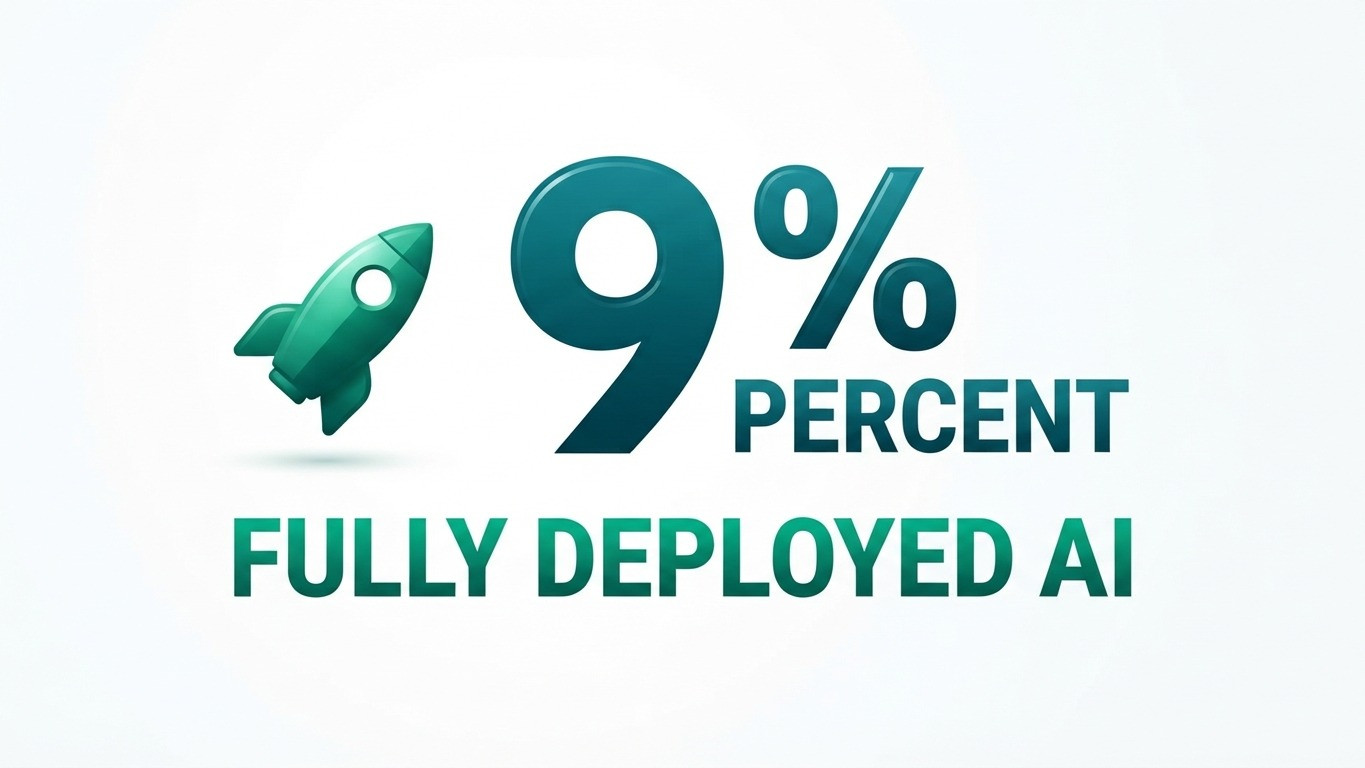
A new industry survey just put a hard number on something most real estate teams already sense but rarely say out loud: testing an AI tool is easy, and actually running it at scale is a different problem entirely. The ai deployment maturity real estate firms gap is now measurable, and it is wider than most brokerages assume. Keyway and The Appraisal’s newest research on real estate AI adoption found that 45% of firms are running active AI pilots, yet only 9% have reached true enterprise-wide deployment, with another 18% stuck at partial, department-level rollouts. The rest are somewhere between testing, planning, and stalled.

A New Survey Exposes the Real Estate AI Pilot-to-Scale Gap
The State of AI Adoption in Real Estate survey, run jointly by Keyway and The Appraisal, polled professionals across acquisitions, lending, asset management, finance, legal, and property management. The headline finding is not that real estate is behind on AI experimentation. It is that experimentation and execution have almost nothing to do with each other right now.
Forty-five percent of respondents said their firm is actively piloting AI tools somewhere in the business. But when the same respondents were asked how far those pilots actually went, only 9% could point to a true enterprise-wide deployment. Eighteen percent had gotten AI into regular use in a single department, usually acquisitions or asset management. The remaining majority, more than seventy percent of firms, are still testing, still planning, or have quietly let a pilot stall out.
The report also flags the most concrete blocker: data. Just 8% of firms described their data infrastructure as fully ready for AI at scale. Fragmented property systems, inconsistent historical records, and a lack of data standardization keep coming up as the reason a promising pilot never turns into a production workflow. Student housing operators currently lead the pack on enterprise-wide deployment, according to the report, while office portfolios show heavy experimentation but the lowest conversion rate from pilot to scale.
Why This Matters for Every Real Estate Team, Not Just Enterprise Shops
It is tempting to read this as a large-firm, institutional-investor problem. It is not. Ai deployment maturity real estate firms looks the same at ten agents as it does at ten thousand: the same pattern shows up at brokerage and team scale every time an agency signs up for an AI feature inside its CRM, runs it for a few enthusiastic weeks, and then watches usage quietly drop off once the person who championed it gets busy with something else. A pilot that never becomes a habit delivers zero return, no matter how good the underlying model is.
Tracking ai deployment maturity real estate firms at the team level is simpler than the enterprise version of the same exercise. It comes down to one question: does every new lead, every new listing, and every new agent hire touch the AI workflow automatically, or does it only work when someone remembers to use it?
The cost of staying stuck in pilot mode compounds. Teams pay for tools they barely use, agents lose trust in “the AI thing we tried last quarter,” and leadership ends up more skeptical of the next tool than they would have been with no pilot at all. Meanwhile, the 9% of firms that did reach full deployment are compounding the opposite way: every new hire inherits a working system instead of a half-finished experiment, and every lead gets the same fast, consistent response regardless of which agent is on shift.
Closing the AI Deployment Maturity Real Estate Firms Gap
Closing the ai deployment maturity real estate firms gap is less about picking a smarter model and more about treating rollout as a deliberate second project, not an afterthought to the pilot. Ai deployment maturity real estate firms is not a technology score, it is a discipline score, and three things separate the 9% from everyone else stuck in the pilot lane.
First, they pick one workflow, not five. Firms that scale successfully tend to fully automate a single high-volume process, most often lead response or lead qualification inside the CRM, before touching anything else. Trying to roll AI into every workflow simultaneously is the fastest way to end up fully committed to nothing.
Second, they fix the data problem before the AI problem. With only 8% of firms calling their data infrastructure AI-ready, cleaning up contact records, deduplicating leads, and standardizing property data inside the CRM has to happen before automation, not after. An AI feature layered on top of messy data just automates the mess faster.
Third, they assign clear ownership. Pilots that stall almost always trace back to no single person being accountable for turning “we tried it” into “we use it every day.” The teams that reach full deployment name an owner, set a 90-day target for full team adoption, and track usage the same way they track closed deals.

Where AI-Enabled CRM Platforms Fit Into the Fix
Most of the AI capability real estate teams need to close this gap is not exotic. It is already sitting inside modern CRM platforms as a feature most teams have not fully turned on. Platforms like Follow Up Boss, kvCORE, and HubSpot all ship with AI-assisted lead scoring, automated follow-up sequencing, or conversational lead qualification built in. The gap is rarely the tool. It is the missing 90-day rollout plan that gets a team from “we turned the feature on” to “every lead touches it automatically.”
Teams evaluating where to start should look for AI features that plug directly into a workflow they already run every day, rather than a standalone tool that adds a new screen to check. The less a team has to change its habits to use an AI feature, the faster that feature moves from pilot to permanent.
Related Reading
For teams evaluating whether their current stack can support AI at scale, our guide to AI CRM for real estate breaks down which platform features actually move a pilot toward production versus which ones just add another dashboard. It pairs well with our deeper look at AI data readiness for real estate brokerages, since data quality is the single biggest blocker this survey identified.
Final Thoughts
The 2026 data makes one thing clear: real estate does not have an AI experimentation problem. Forty-five percent of firms are already past that stage. What the industry has is an ai deployment maturity real estate firms problem, and it is measurable, fixable, and mostly about discipline rather than technology. The firms that close the gap this year will not be the ones with the fanciest model. They will be the ones that picked one workflow, cleaned up their data, and gave someone the job of making sure the pilot actually became a habit.
