
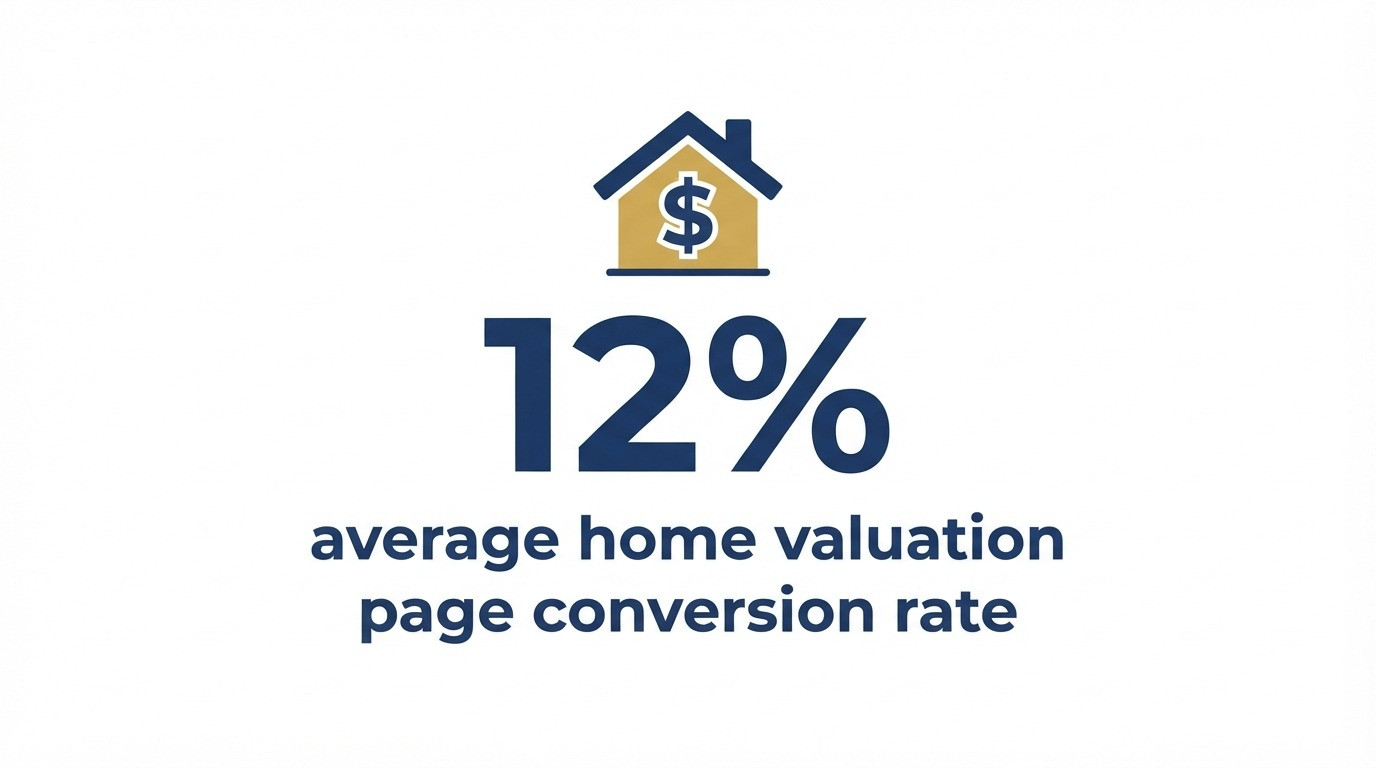
A home valuation landing page is the single most effective seller lead generation tool available to real estate agents. The offer – enter your address and get an estimated value for your home – converts cold traffic consistently at 8 to 15 percent, higher than almost any other real estate lead capture offer. Homeowners are perpetually curious about their home’s value, whether they are planning to sell in 30 days or 3 years. A home valuation landing page captures this persistent intent and puts seller leads into your database months or years before a listing appointment.

Why a Home Valuation Landing Page Outperforms Other Seller Lead Offers
Most seller lead offers require the homeowner to be actively planning to sell. “Request a free listing consultation” requires the homeowner to be ready to have a conversation. “Download our home selling guide” requires interest in the selling process. A home valuation landing page requires only curiosity – and every homeowner with a mortgage is curious about whether their home is worth more than they paid for it.
This broad appeal is what drives the conversion rate advantage. A listing consultation offer might convert 2 to 3 percent of cold traffic because only a small fraction of homeowners are actively thinking about selling at any given moment. A home valuation offer converts 8 to 15 percent because the appeal extends to homeowners at every stage of the decision cycle – those planning to sell soon, those considering selling in a few years, and those who are simply curious. The leads who convert will be at different stages of readiness, which is why the follow-up sequence for home valuation leads needs to be designed for a long nurture cycle.
What Every Home Valuation Landing Page Needs
Address input as the primary form field. The core mechanic of a home valuation landing page is asking for the property address in exchange for the valuation. This should be the first and most prominent form field – ideally with a Google Maps autocomplete integration that shows suggested addresses as the homeowner types. An autocomplete address field reduces form abandonment and ensures you capture a valid address rather than a typo.
A clear statement of what they get. “Find out what your home is worth” is the minimum. “Get your free home value estimate for [City], updated with the latest sales data” is better because it is specific and conveys recency. Avoid vague language like “learn your home’s potential value” – visitors want a number, not a potential.
Contact information fields on the second step. The highest-converting home valuation landing page structure uses a two-step form: Step 1 asks for the property address, Step 2 asks for name, email, and phone. This two-step approach uses the commitment principle – once a homeowner has entered their address, they are more likely to complete the second step than if all fields were presented at once. Conversion rates for two-step forms are typically 20 to 30 percent higher than single-step forms.
Social proof near the form. Two to three short testimonials from past seller clients – “The valuation was accurate and the process was smooth” type quotes with first name and city – placed near the form significantly increase completion rates. For cold traffic seeing your page for the first time, social proof from recognizable community members is the fastest way to build trust.

Platforms for Building a Home Valuation Landing Page
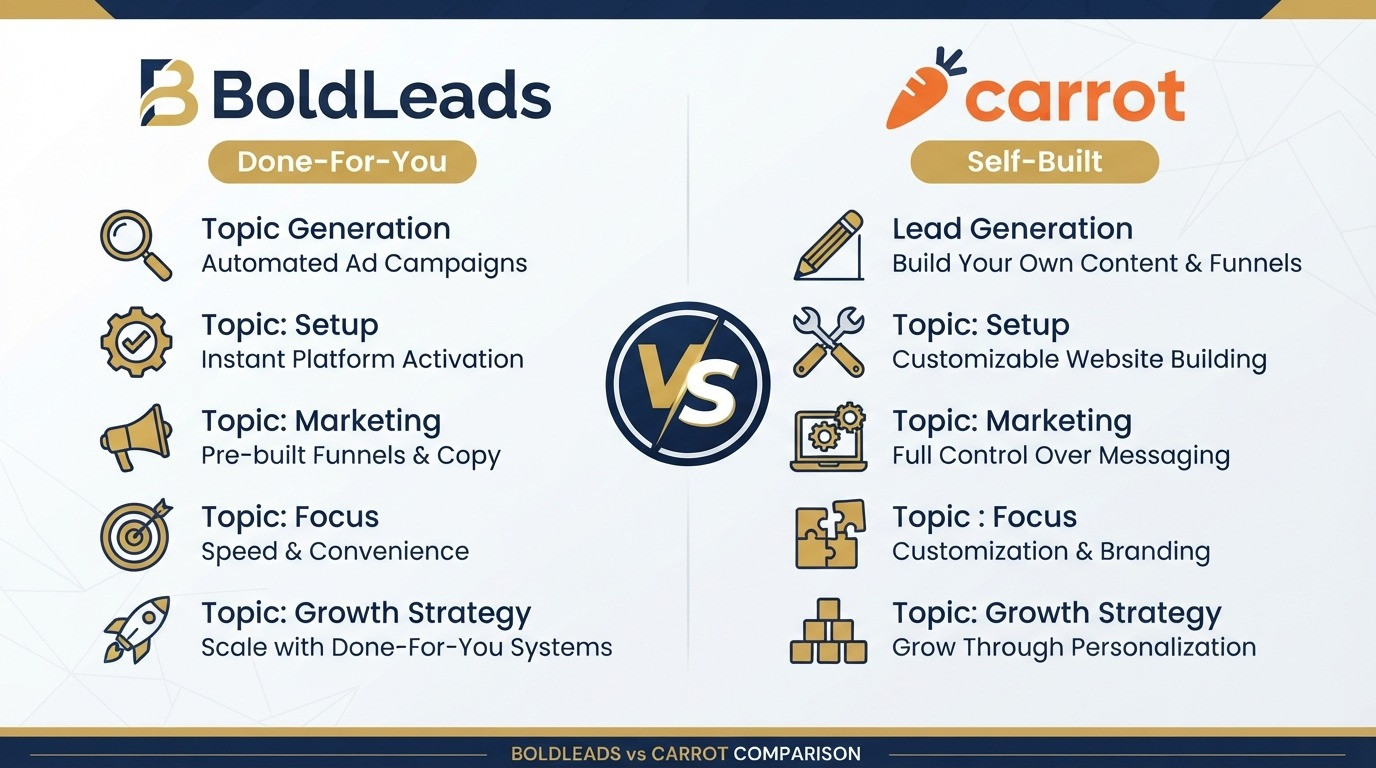
BoldLeads – Best for agents who want a done-for-you home valuation funnel. BoldLeads provides pre-built home valuation landing pages, Facebook ad campaigns, and automated follow-up sequences as a managed service. You do not build anything – BoldLeads runs the entire funnel for you, delivering seller leads to your inbox. The trade-off is cost (around $499 to $999 per month depending on market exclusivity) and less control over the page design and messaging. For busy agents who do not want to build or manage their own lead generation system, BoldLeads eliminates the setup work entirely.
Carrot – Best for agents who want to build and own their home valuation funnel. Carrot includes purpose-built home valuation landing page templates with address autocomplete, two-step form structure, and mobile optimization. You control the design, the messaging, and the follow-up integration. Carrot integrates with most major real estate CRMs for lead routing, and the landing pages are hosted on your own domain which builds your brand rather than BoldLeads’ brand. Plans start around $99 per month.
For agents using all-in-one platforms like Real Geeks or kvCORE, home valuation landing page tools are often included in the subscription. Registrations flow directly into the CRM, which is the most efficient setup for lead follow-up. A home valuation page is one of several seller-focused landing page types – for listing consultation pages, expired listing pages, and neighborhood market report pages, see our complete guide to seller landing pages. For a broader look at landing page options across property types, see our guide to open house registration pages which covers platform options in detail. For connecting your home valuation leads to a long-term nurture sequence, our CRM roundup for slow-burn seller leads covers which platforms handle seller lead nurture best.
Following Up with Home Valuation Leads
Home valuation leads are not ready to list immediately – that is both the challenge and the opportunity. The majority of leads who register on your home valuation landing page will not list their home for 6 to 24 months. This means your follow-up system needs to stay in contact consistently over a long period without being pushy.
The standard approach is a combination of automated email sequences (market updates, neighborhood sales reports, price change alerts) and periodic manual outreach from the agent. The automated emails keep you top of mind during the long pre-listing phase. The manual outreach – a personal phone call or text when the homeowner’s neighborhood has significant market activity – converts the longest-standing leads into listing appointments.
Tracking when a home valuation lead re-engages – opens an email, clicks a market report, or revisits the website – is critical for prioritizing outreach. A lead who registered 18 months ago and just clicked your market update email is much closer to listing than one who has been completely inactive for the same period.
Related Reading
For how a home valuation page fits into your broader landing page strategy, see our guide to every landing page type compared.
Final Thoughts
A home valuation landing page is the most efficient seller lead generation investment available to most real estate agents. It converts cold traffic at 3 to 4 times the rate of typical real estate lead offers, reaches homeowners at every stage of the selling decision cycle, and produces leads that can be nurtured into listing appointments over months or years. The platform matters less than the fundamentals: a specific offer with address autocomplete, a two-step form structure, social proof near the form, and a follow-up system designed for a long nurture cycle.
