
Most real estate agents have a database full of contacts and almost no system for marketing to them. CRM marketing changes that — it turns a passive contact list into an active revenue engine that works around the clock, sending the right message to the right person at exactly the right moment. In 2026, this approach is not optional for agents who want consistent deal flow from their existing database rather than spending endlessly on new lead acquisition.
This guide explains what CRM marketing means for real estate agents, how to build it correctly, and which platforms make it easiest to execute.

What Is CRM Marketing for Real Estate?
CRM marketing is the practice of using the data in your customer relationship management system to run targeted, automated marketing campaigns. Where traditional marketing broadcasts the same message to everyone, CRM marketing segments your database by behavior, stage, and intent — and sends different, personalized messages to each group based on where they are in their journey.
For real estate agents, CRM marketing means your database is doing work while you are doing showings. A buyer who went quiet three months ago gets a market update email automatically. A seller lead who visited your website twice this week gets a personalized SMS asking if they are ready to chat. A past client hits their home anniversary and gets a handwritten-style note from you — all without you lifting a finger.
This is the core promise: turning a database from a static list into a living, revenue-generating asset.
The CRM Marketing Funnel for Real Estate
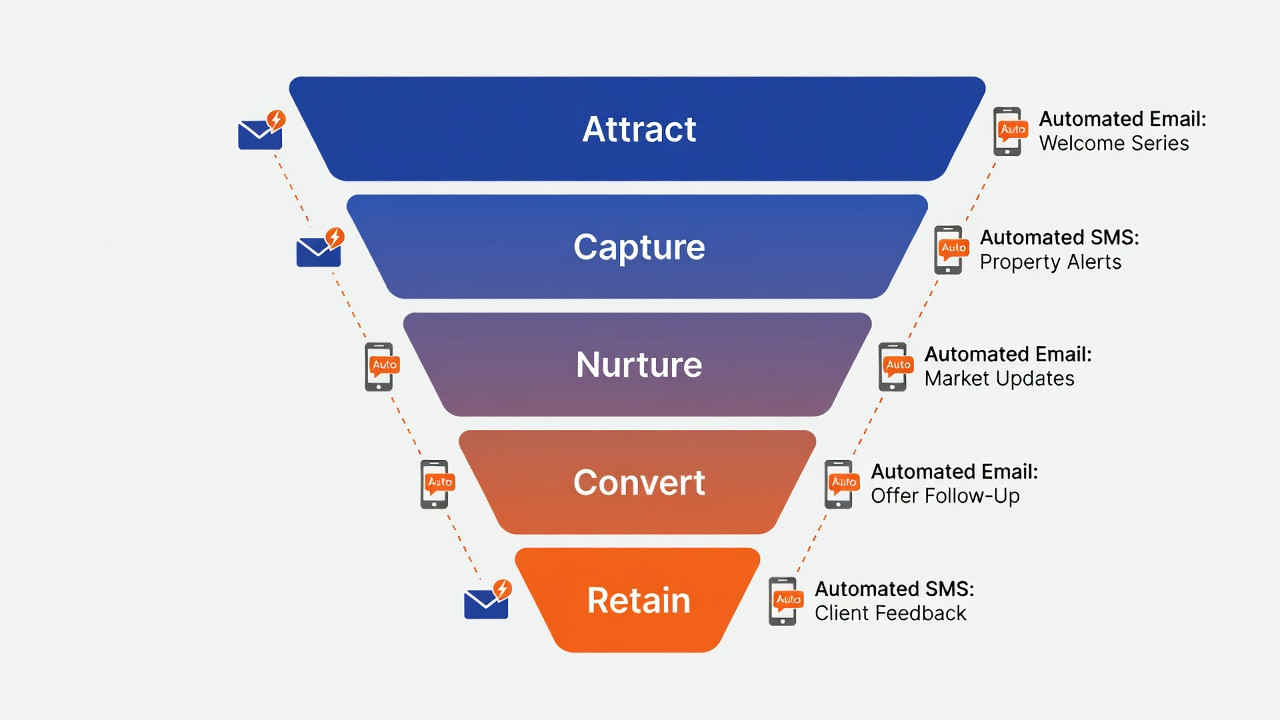
Stage 1 — Attract: CRM marketing starts before a lead enters your database. Your IDX website, social ads, and portal profiles drive traffic. The CRM captures the lead the moment they engage — registering on your website, submitting a contact form, or clicking a Zillow inquiry button. Every source feeds the CRM automatically.
Stage 2 — Capture and qualify: The moment a new lead enters, your CRM marketing system triggers an instant response — a personalized SMS or email within seconds of submission. For AI-powered platforms, that first message starts a qualification conversation automatically, collecting budget, timeline, and property preferences before a human agent needs to engage.
Stage 3 — Nurture: This is where most real estate agents fail and where CRM marketing creates the biggest leverage. Most leads are 6–18 months from transacting. Automated nurture keeps you in front of those leads consistently through drip email campaigns, market update sequences, listing alerts, and behavioral triggers — without you manually scheduling a single touchpoint.
Stage 4 — Convert: When a lead shows buying or selling intent — revisiting listings, changing saved search criteria, opening three emails in a week — your CRM marketing system detects that signal and either alerts you as a hot lead or automatically triggers a higher-urgency follow-up sequence. You engage at exactly the right moment, not randomly.
Stage 5 — Retain: The most overlooked stage in real estate CRM marketing. Your past clients are your most valuable marketing asset. Automated anniversary messages, market value updates, and referral ask campaigns keep you top of mind for the next transaction and for introductions to friends and family.
CRM Marketing Automation: What to Build First
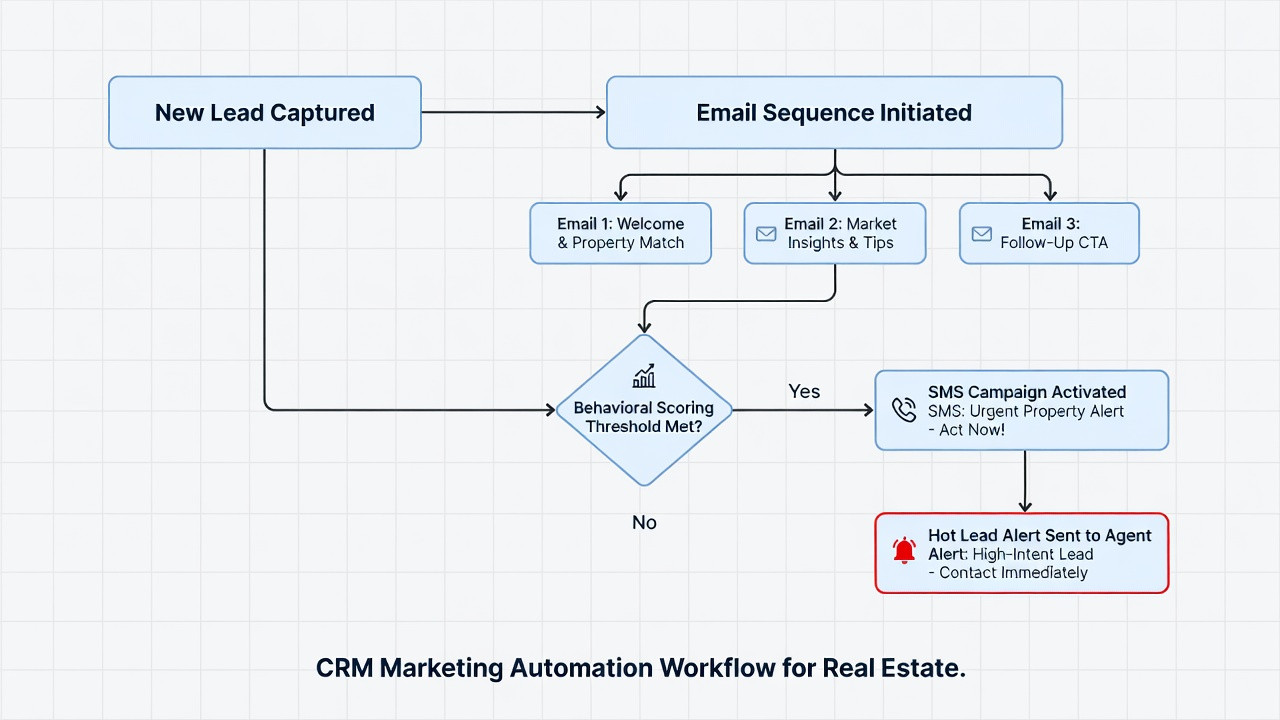
When agents first set up CRM marketing automation, they often try to build everything at once and end up with nothing working well. Start with these three sequences in order — they deliver the most immediate ROI and together cover the full database lifecycle.
New lead instant response sequence: Triggered the moment a lead enters the CRM from any source. An automated SMS goes out within 60 seconds referencing the specific inquiry. If no response, a follow-up email goes out at 2 hours, another SMS at 24 hours, and a final check-in at 72 hours. This sequence alone — if built correctly — dramatically improves your contact rate and conversion on fresh leads. Speed is the single biggest factor in portal lead conversion, and this sequence ensures no lead waits more than a minute for a response.
Long-term buyer nurture sequence: A 12-month drip sequence for leads who are not ready to transact now. Monthly market updates for their target area, quarterly check-in emails, listing alert activations, and a re-engagement SMS at the six-month mark. Most agents abandon leads after 30 days of no response. A properly built CRM marketing sequence keeps you in front of those leads for a year — and captures the transactions that would otherwise go to whoever happened to reach out at the right moment.
Past client retention sequence: Triggered annually for every closed client. Home purchase anniversary message, quarterly market value update for their specific property, and a referral request email around the 11-month mark. Past client CRM marketing sequences cost almost nothing to run and consistently produce the highest-ROI transactions in any real estate business.
CRM Marketing Metrics That Matter for Real Estate
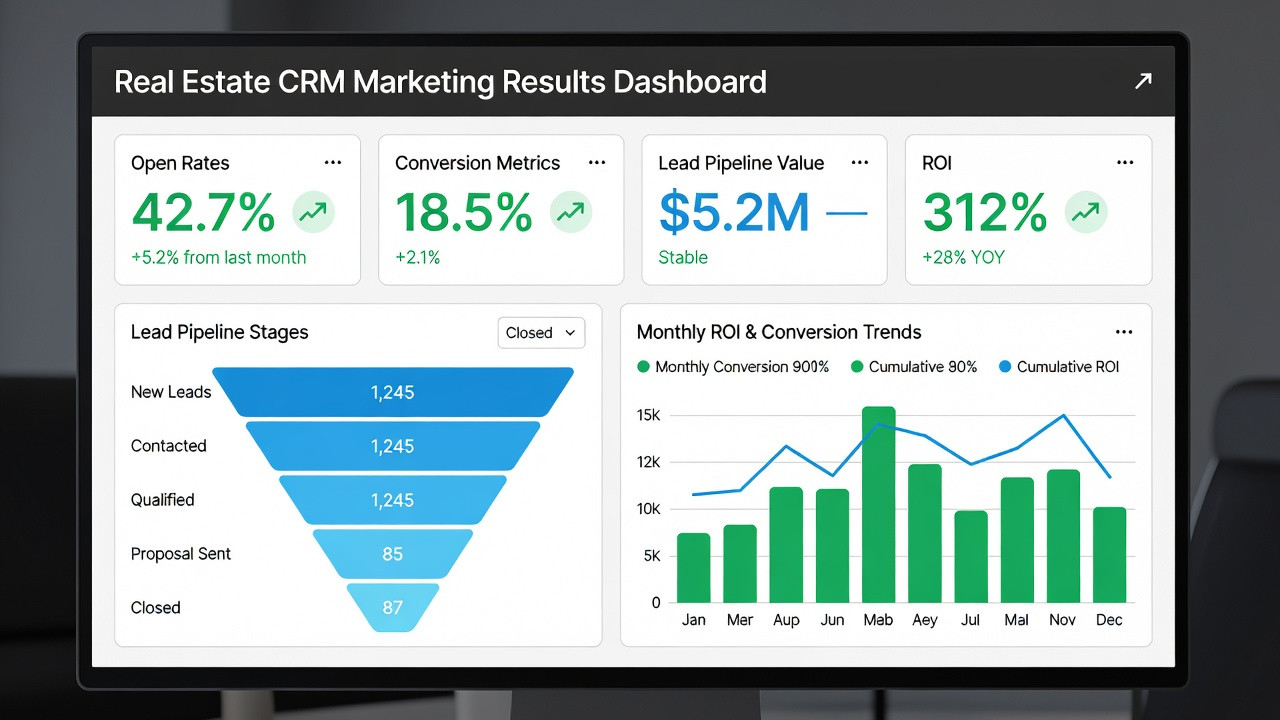
Effective CRM marketing is measurable at every stage. Track these metrics monthly to identify which sequences are working and where leads are dropping off.
Email open rate — Industry benchmark for real estate email marketing is 20–25%. If your CRM marketing emails are below 15%, the problem is usually subject lines, send time, or list hygiene. Above 30% indicates strong personalization and segmentation.
Response rate on automated SMS — A well-written automated SMS in a CRM marketing sequence should generate a 15–25% response rate. Below 10% usually means the message is too generic or the timing is off.
Lead-to-appointment rate — What percentage of your database leads become booked appointments? For most agents running no CRM marketing automation, this rate is under 1%. With a proper nurture system, 3–5% is achievable within six months.
Database reactivation rate — Run a reactivation campaign to your cold leads (no engagement in 90+ days). A strong CRM marketing reactivation sequence should convert 5–10% of those dormant leads into active conversations.
Best CRM Marketing Platforms for Real Estate in 2026
Follow Up Boss delivers the most complete CRM marketing infrastructure for real estate teams. Its action plans automate multi-step follow-up sequences across email, SMS, and tasks. Behavioral triggers fire automatically when leads engage with content or re-enter the pipeline. For teams running high lead volume, Follow Up Boss is the CRM marketing standard.
Wise Agent includes a full email marketing suite inside its CRM at $49/month flat — making it the best value CRM marketing platform for solo agents. Its drip campaigns, newsletter builder, and list segmentation tools give individual agents the same CRM marketing capabilities that enterprise teams pay ten times more for.
kvCORE runs CRM marketing at the brokerage level — behavioral automation triggers nurture sequences when contacts engage with listings, open emails, or revisit the IDX website. Its Smart CRM scores every contact based on behavioral signals, so agents know exactly which leads the CRM marketing system has warmed up and when to call.
ActiveCampaign is the most powerful CRM marketing automation platform for agents who want advanced segmentation and multi-channel workflows. While not real-estate specific, its automation builder allows agents to create sophisticated CRM marketing sequences that rival enterprise marketing departments — at a fraction of the cost.
For a full comparison of CRM platforms across all real estate use cases, see our guide to the Best CRM for Real Estate Agents in 2026. For AI-powered CRM capabilities specifically, read our guide to the AI features worth paying for in a CRM. For a closer look at what separates CRM marketing software from a basic contact manager, see our CRM marketing software guide.
Final Thoughts
CRM marketing is the highest-leverage activity available to most real estate agents — and the most consistently underused. Every agent has a database. Almost none have a system that actively markets to it. The gap between those two realities is where deals are being lost every single month to agents who happen to show up at the right time through automated sequences you have not built yet.
Start with the three sequences above. Get them working, measure the results, and iterate. Within 90 days of consistent CRM marketing automation, most agents see meaningful increases in reactivated leads, appointments from their database, and referrals from past clients — all without increasing their lead acquisition spend by a dollar.
