
Your real estate website is either your best lead generation tool or an expensive business card that sits in a drawer. The difference comes down to platform. Choosing the right real estate website builder determines whether your site captures leads around the clock, integrates with your MLS to display live listings, and converts visitors into consultation requests – or whether it does none of those things and costs you the same monthly fee regardless.
This guide covers the best real estate website builder options available in 2026 for agents, teams, and brokerages – with honest reviews, a side-by-side comparison, and a clear framework for picking the platform that fits your production level and business goals.
- What Is a Real Estate Website Builder?
- What to Look For
- Platform Comparison
- Detailed Reviews
- Website Builder vs. Custom Design
- All-in-One vs. Separate IDX
- How Much Does It Cost?
- How to Choose
- FAQ

What Is a Real Estate Website Builder?
A real estate website builder is a software platform that lets agents, teams, and brokerages create and manage a professional website without custom development. Unlike general-purpose website builders like Wix or Squarespace, purpose-built real estate website builders include MLS/IDX integration out of the box – meaning your site automatically displays live property listings from your local board without manual updates.
The core difference between a real estate website builder and a general website builder is the property search function. When a visitor searches for homes on your site, they are browsing your MLS data in real time. That search function is what keeps buyers returning to your site repeatedly rather than going to Zillow – and it is only available through platforms with active IDX data feeds for your market.
Beyond property search, purpose-built real estate website builders typically include lead capture forms tied to property searches, CRM integration to route leads to follow-up sequences, market report widgets, neighborhood pages, and agent profile sections. These features are either unavailable in general website builders or require expensive third-party plugins to replicate.
What to Look For in a Real Estate Website Builder
Not every real estate website builder is built for the same type of agent. A solo buyer’s agent with 30 leads per month has different requirements than a 50-agent brokerage managing hundreds of active leads across multiple markets. Before comparing platforms, know which of these features matter most for your business.
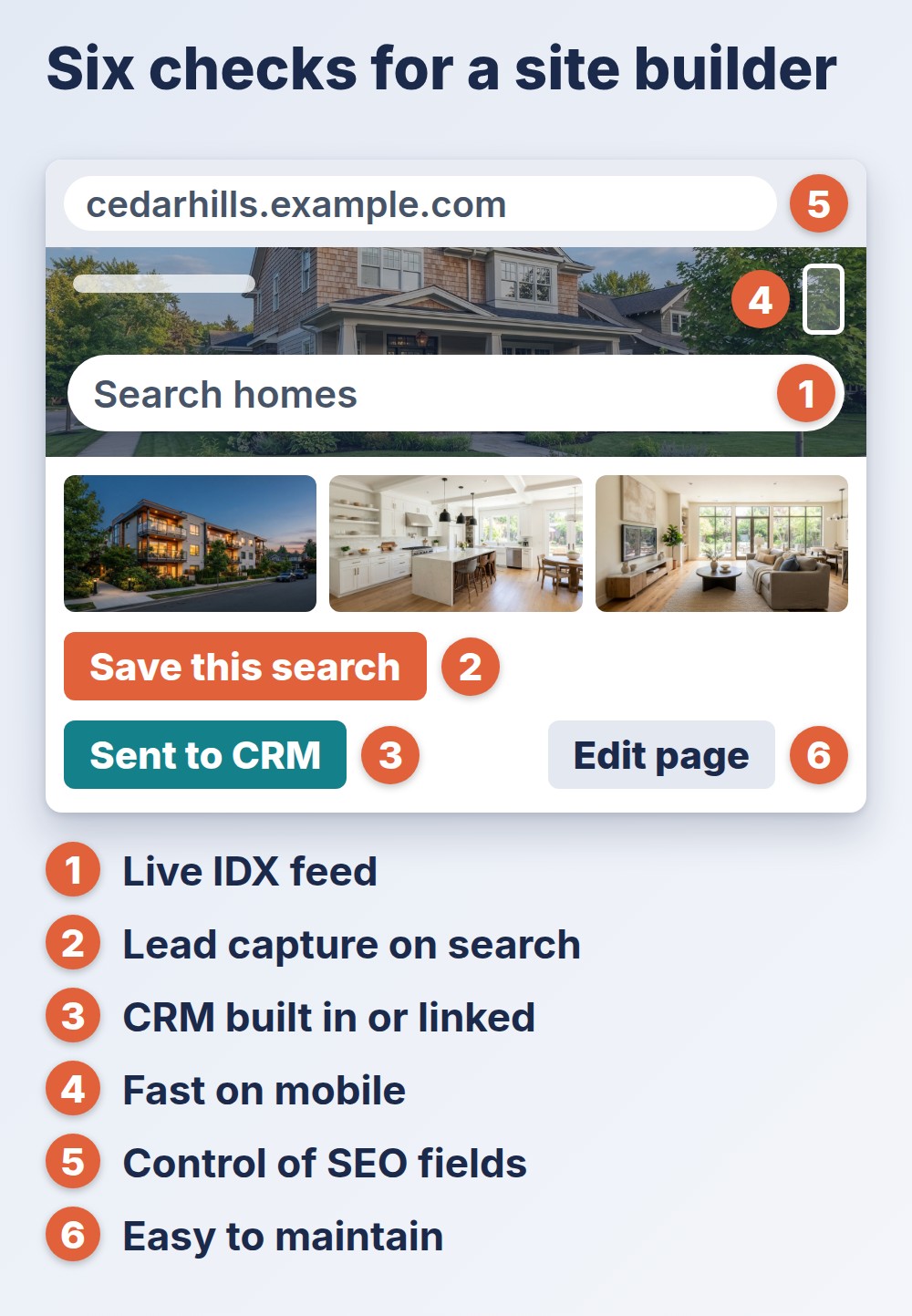
IDX integration. The most important feature in any real estate website builder is a live, active IDX data feed from your local MLS board. Confirm that the platform has an active IDX agreement with your specific board before signing up – not all platforms cover all markets. IDX feed quality also varies: the best real estate website builders update listings every 15 minutes or less, display all required MLS fields, and include a compliant property detail page that meets board rules.
Lead capture tied to search behavior. A real estate website builder generates ROI when it captures visitor information in exchange for access to listing alerts, saved searches, and market reports. The best platforms gate deeper property data behind a registration wall – requiring visitors to create an account to see full listing details, view past sales, or save a search. This converts anonymous traffic into named leads without interrupting the search experience too early.
CRM integration or built-in CRM. Leads captured on your website are only valuable if they enter a follow-up sequence immediately. Look for a real estate website builder that either includes a built-in CRM with automated drip sequences or integrates cleanly with your existing CRM via native connection or Zapier. Platforms with native CRM integration eliminate the gap between lead capture and first follow-up – which is the single biggest factor in contact-to-conversation rate.
Mobile performance. Over 60% of real estate search traffic in 2026 comes from mobile devices. Your real estate website builder must produce pages that load in under 3 seconds on mobile, display property photos correctly, and allow visitors to complete a lead capture form on a phone without pinching or scrolling horizontally. Test the mobile version of any platform before committing.
SEO tools. A real estate website builder that does not give you control over page titles, meta descriptions, and URL structure will limit your ability to rank in local search. Look for platforms that allow custom SEO fields on neighborhood pages and agent profile pages, not just the homepage.
Customization vs. maintenance trade-off. More customization means more maintenance. Highly flexible real estate website builders require more ongoing work to keep the site current. If you do not have a marketing coordinator on staff, choose a platform with strong default templates and automated content updates over one that requires constant manual management.
Best Real Estate Website Builder Options Compared
The table below compares the leading real estate website builder platforms on the factors that most affect lead generation performance. Pricing reflects published starting rates as of mid-2026.
| Platform | Best For | IDX Included | Built-in CRM | Starting Price | Setup Complexity |
|---|---|---|---|---|---|
| Real Geeks | Solo agents and small teams | Yes | Yes | ~$299/mo | Low |
| AgentFire | Agents focused on hyperlocal content | Yes | No (CRM integrations) | ~$149/mo | Low-Medium |
| Sierra Interactive | High-volume teams | Yes | Yes | ~$500/mo | Medium |
| kvCORE | Brokerages (multi-agent) | Yes | Yes | ~$499+/mo | Medium-High |
| Placester | Budget-conscious solo agents | Yes | No | ~$80/mo | Low |
| Squarespace | Agents prioritizing design over IDX | Via plugin | No | ~$23/mo | Low |
Top Real Estate Website Builders – Detailed Reviews

Real Geeks is the most widely recommended real estate website builder for solo agents and small teams who want a complete lead generation system rather than just a website. Its property search is fast, its IDX coverage is broad, and its built-in CRM includes automated email and text drip sequences that fire immediately when a lead registers. The trade-off is design flexibility – Real Geeks sites follow a standard template structure that is clean and functional but not highly customized. For agents who want a platform that works out of the box without ongoing maintenance, Real Geeks is the default choice.
AgentFire is the best real estate website builder for agents who want to build a hyperlocal content strategy. Its neighborhood page system lets you create detailed area guides with automatically updated market statistics, school data, and local business listings – making it significantly easier to rank for neighborhood-specific search terms than generic IDX platforms. AgentFire does not include a native CRM, but it integrates cleanly with Follow Up Boss and other leading real estate CRMs. For agents willing to manage a separate CRM, AgentFire’s design quality and content infrastructure are the strongest in the category.
Sierra Interactive is built for high-volume teams and brokerages that need advanced lead routing, behavioral tracking, and a property search that keeps buyers engaged over long buying cycles. Its IDX search is among the fastest in the category, and its lead scoring system surfaces warm leads based on search frequency and listing saves – so agents know which contacts to call first. Sierra is more expensive than solo-agent platforms and requires more setup time, but for teams generating 200+ leads per month, the lead management infrastructure justifies the cost.
kvCORE is designed for brokerages that need to provision individual agent websites under a shared brand umbrella. Each agent gets their own subdomain with personal bio, listing pages, and lead capture forms, while brokerage leadership sees all leads and activity in a central dashboard. kvCORE’s AI-powered behavioral marketing automatically sends personalized property alerts to leads based on their search history – reducing the manual follow-up load on agents. It is the most complex real estate website builder on this list to set up and manage, but for brokerages with 10+ agents, the operational efficiency gains are significant.
Placester is the most affordable purpose-built real estate website builder for agents who need a professional site with IDX integration at the lowest possible cost. Its template selection is limited compared to AgentFire, and it does not include a built-in CRM, but at roughly $80 per month it is the most accessible entry point into a real estate-specific platform. For new agents who want to establish a professional online presence without committing to a high monthly platform fee, Placester is the right starting point.
Squarespace or Wix are worth considering only for agents who prioritize design and brand expression over IDX functionality. Neither platform includes native IDX integration – you would need to add a third-party IDX widget from a provider like iHomeFinder or IDX Broker, which adds cost and typically delivers a worse search experience than purpose-built platforms. If your business model relies primarily on referrals and sphere-of-influence marketing rather than internet lead capture, a general-purpose builder with a strong design system may serve you better than a purpose-built platform with average aesthetics.
Real Estate Website Builder vs. Custom Web Design
The alternative to a real estate website builder is hiring a web design agency to build a custom site. Custom development typically costs $5,000 to $20,000 upfront plus $200 to $500 per month for hosting and maintenance – compared to $100 to $500 per month for a platform-based real estate website builder with no setup fee.
Beyond cost, the more important difference is IDX integration. A custom-built site still requires an IDX data feed subscription from a provider like IDX Broker or iHomeFinder, which adds $50 to $150 per month and requires ongoing technical maintenance when MLS data specifications change. Purpose-built real estate website builders manage IDX compliance and updates automatically as part of their subscription. For most agents, the lower total cost and eliminated maintenance burden of a real estate website builder makes it the better choice unless you have a specific design requirement that no platform can meet.
All-in-One Builder vs. a General Website Plus a Separate IDX Widget
Some agents choose a general-purpose builder like Squarespace or Wix for the design, then bolt on a third-party IDX widget from a provider like iHomeFinder or IDX Broker separately. This can work, but it introduces coordination problems that an all-in-one real estate website builder avoids by design: the registration wall timing, the lead data structure, and the CRM sync are all engineered to work together inside one platform rather than stitched across two vendors. When a lead registers on an all-in-one platform, their search history, saved listings, and contact details flow into your CRM pipeline instantly, without relying on a Zapier webhook that can fail silently and lose the lead entirely.
There is also a support advantage. When something breaks on a platform where the website and IDX come from the same vendor, you have one place to call. When your website is on Squarespace and your IDX comes from a separate provider, debugging a lead capture failure means first figuring out whether the problem is in the website, the IDX widget, or the connection between them – time an agent dealing with a lost lead rarely has.
Before signing up for any real estate website builder with IDX built in, verify two things directly: that the platform has an active data agreement with your specific MLS board (not every platform covers every board – your board’s member site lists approved IDX vendors), and that the mobile search experience works smoothly on your own phone, since the majority of property searches now happen on mobile and a platform that looks fine on desktop can underperform badly there.
How Much Does a Real Estate Website Builder Cost?
Real estate website builder pricing in 2026 ranges from $80 per month (Placester entry tier) to $500+ per month (Sierra Interactive and kvCORE) depending on the level of CRM integration, IDX coverage, and team features included. Most platforms charge an additional IDX fee of $50 to $100 per month if IDX is not bundled in the base subscription – always confirm whether IDX is included before comparing prices.
For a solo agent, a budget of $150 to $300 per month covers a quality real estate website builder with IDX and basic CRM features. For a team of 5 to 15 agents, expect $300 to $600 per month. Brokerage-level platforms with multi-agent dashboards and advanced lead routing typically start at $500 per month before per-agent fees.
How to Choose the Right Real Estate Website Builder
The right real estate website builder for your business depends on three factors: your current lead volume, your CRM setup, and your technical comfort level.
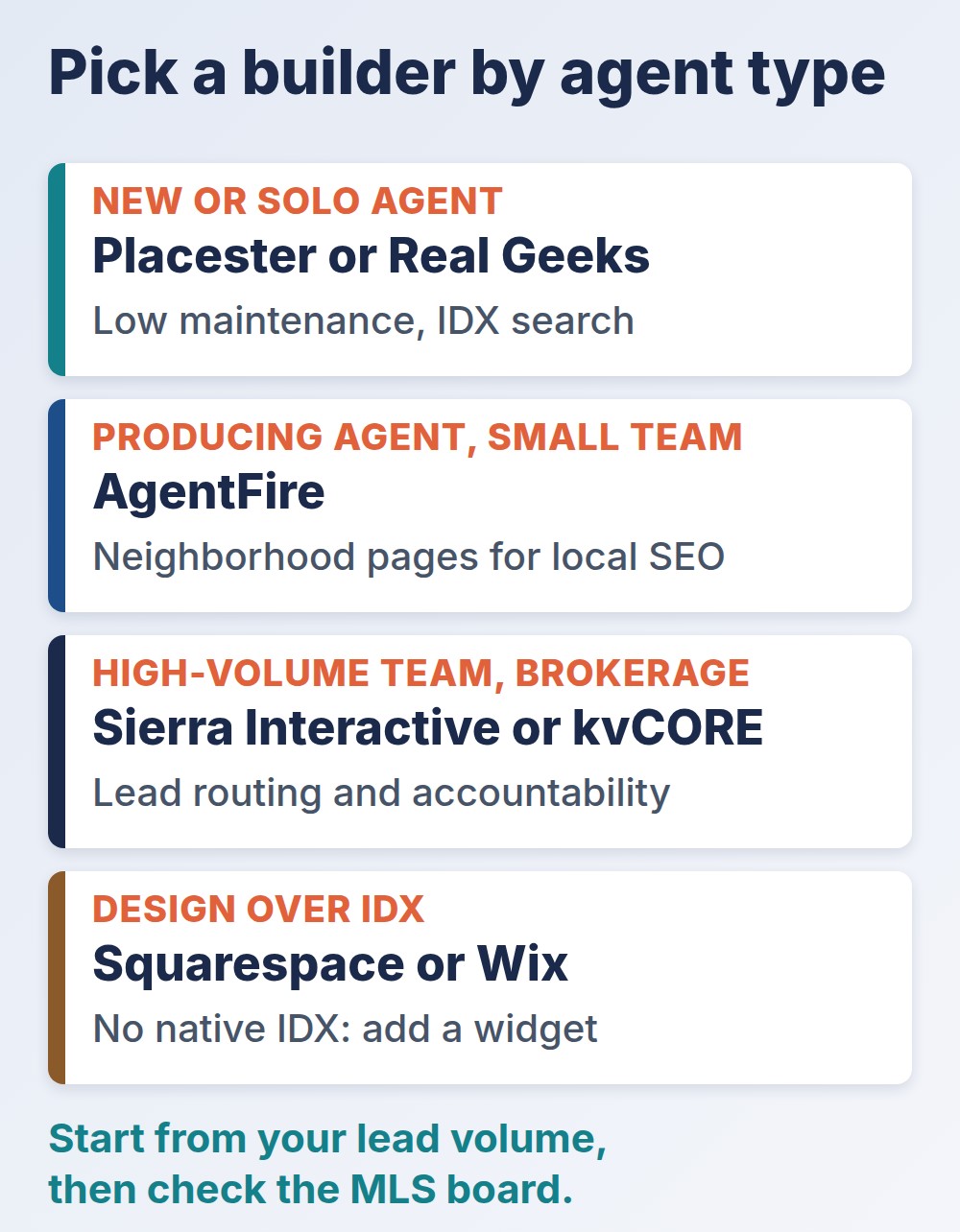
If you are a new agent or solo producer closing fewer than 20 transactions per year, start with Placester or Real Geeks. Both are low-maintenance platforms that establish a professional online presence with IDX search at a price point that makes sense before your website is generating consistent leads.
If you are a producing agent or small team closing 20 to 50 transactions annually and you want to invest in content marketing alongside your IDX site, AgentFire’s neighborhood page system gives you the best infrastructure for local SEO. Pair it with Follow Up Boss or a similar CRM for lead follow-up.
If you are running a high-volume team or brokerage, Sierra Interactive or kvCORE are the platforms built for your operational needs. The higher monthly cost is justified by the lead routing, behavioral tracking, and agent accountability tools that solo-agent platforms do not include.
Related Reading
Your real estate website builder works best when it is connected to a CRM that handles lead follow-up automatically. For platform recommendations, see our CRM platform picks for agents. For teams managing multiple agents, our guide to CRMs for multi-agent teams covers platforms built for shared pipelines. To understand how to integrate your website’s marketing automation with your CRM, see our guide to running campaigns from your CRM.
For more on the specific features covered in this guide, see our deep-dive on best website builder for realtors. For more niche builder options, see our guides to the best agent website builder for solo agents, the free real estate website builder, and the best website builder for real estate investors. For the IDX side of the equation, see our guides to broker IDX, what IDX is in real estate, the best IDX websites for realtors, real IDX website examples, how IDX MLS data feeds work, setting up an IDX feed, and choosing an agent website with IDX.
Frequently Asked Questions
What is the best real estate website builder in 2026?
Real Geeks is the best overall real estate website builder for most solo agents and small teams because it combines IDX property search, a built-in CRM, and automated lead follow-up in a single platform at a mid-range price point. AgentFire is the better choice for agents focused on hyperlocal content and SEO. Sierra Interactive and kvCORE are the top options for high-volume teams and brokerages.
Do I need IDX on my real estate website?
Yes, if your business model involves internet lead generation. IDX integration is what turns your real estate website builder into a lead generation tool rather than a static brochure. Visitors who can search for homes on your site return more often, stay longer, and are more likely to register their contact information than visitors who land on a site with no property search. Without IDX, there is no reason for a buyer to visit your site more than once.
Can I build my own real estate website for free?
Free real estate website builder options exist but come with significant limitations – typically no IDX integration, limited customization, and the platform’s branding on your site. A free general-purpose builder like Wix can create a professional-looking agent bio page, but it cannot replicate the property search functionality that makes purpose-built real estate website builders effective for lead generation. For serious lead generation, budget at least $80 to $150 per month for a purpose-built platform.
How long does it take to build a real estate website?
Most purpose-built real estate website builder platforms can have a basic site live in 24 to 48 hours after account setup and IDX approval. IDX approval from your MLS board typically takes 3 to 10 business days and is the longest part of the process. Plan for 2 to 3 weeks from signup to a fully functional site with active property search.
Should I use Squarespace or a real estate-specific platform?
Use a real estate-specific platform if lead generation is your goal. Use Squarespace or a similar general builder if your primary objective is brand presentation and you generate most of your business through referrals and sphere-of-influence outreach. For most active agents, a purpose-built real estate website builder with IDX integration will generate more ROI than a beautifully designed general-purpose site with no property search capability.
Is AgentFire a good fit for real estate teams, or just solo agents?
AgentFire works for both, but the fit changes with team size. Solo agents and small teams get the most value from its neighborhood page system and content-driven SEO without paying for team-management overhead they do not need. Larger teams and brokerages can still use AgentFire, but they typically pair it with a separate CRM like Follow Up Boss for lead routing and accountability across agents, since AgentFire itself does not include built-in team lead distribution the way Sierra Interactive or kvCORE do.
Final Thoughts
The best real estate website builder for your business is the one that matches your current production level, integrates with your CRM, and generates leads consistently without requiring constant maintenance. For most solo agents, Real Geeks or AgentFire are the right starting points. For teams and brokerages, Sierra Interactive or kvCORE provide the infrastructure to manage lead volume at scale.
Start by confirming IDX availability for your market on whichever platform you are considering. Then evaluate the CRM integration, mobile performance, and your own technical comfort level before committing to a long-term contract. A real estate website builder that generates one extra transaction per year more than pays for itself at any price point on this list – the question is which platform is most likely to produce that result for your specific business model.
