
Circle prospecting means contacting the homeowners around a home you just listed or sold, so you reach people who are already curious about what is happening on their street. It works because the reason for your message is real and local. This guide explains how to choose the circle, which events to act on, what to send or say, and the contact rules that apply. It is one source in our wider real estate lead generation guide.
What Is Circle Prospecting?
Circle prospecting is the practice of contacting homeowners in a radius around one of your listings or recent sales to ask whether they, or anyone they know, wants to buy or sell. HousingWire’s guide to circle prospecting uses almost that wording. It adds that agents traditionally do it by phone, and that you can add door knocking, mailers and email.
It differs from a farm in one way: timing. A farm is a fixed area you work on a calendar for a year or more. A circle forms around an event, such as a new listing, and you work it for a few weeks. If you already run a farm, read our guide to real estate farming too, because the two methods support each other.
This table separates three methods that often get mixed up.
| Method | What Starts It | How Long You Work It |
|---|---|---|
| Farming | A fixed area you choose in advance | A calendar, often for a year |
| Circle prospecting | A listing or sale nearby | A few weeks around the event |
| Door knocking | A choice of channel, used in either method | A weekly block of time |
When Should You Use Circle Prospecting?
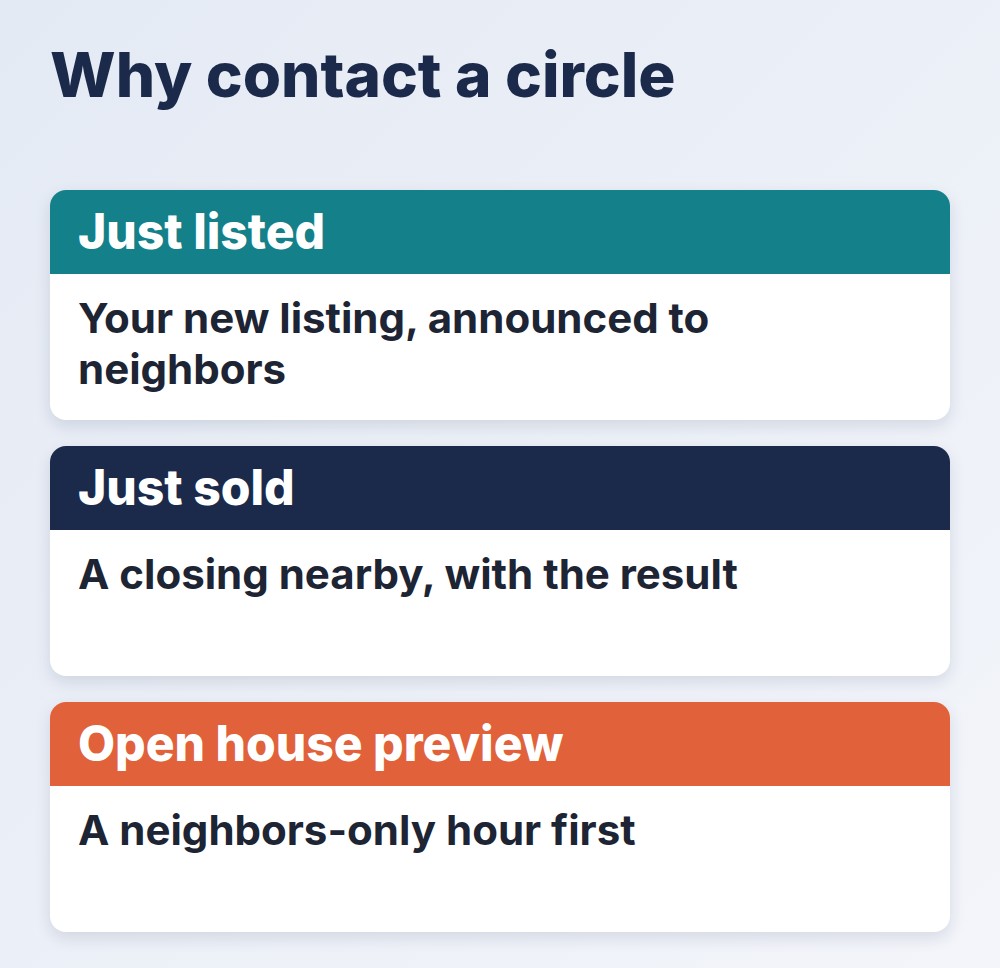
Use it when something real has just happened nearby. Three events work well, and each gives you a natural first sentence.
- Just listed. You have a new listing, and neighbors often want to know the price and the story.
- Just sold. A closing nearby gives you a result to share. Homeowners tend to care what a neighbor’s home sold for.
- Open house preview. HousingWire describes a neighbors-only preview the hour before the public event, which gives neighbors a reason to visit.
A listing that just expired nearby is a fourth opening, because the owner may be looking for a new agent. See our guide to finding expired listings and reaching the owners for how to handle that case.
How Do You Pick the Circle?
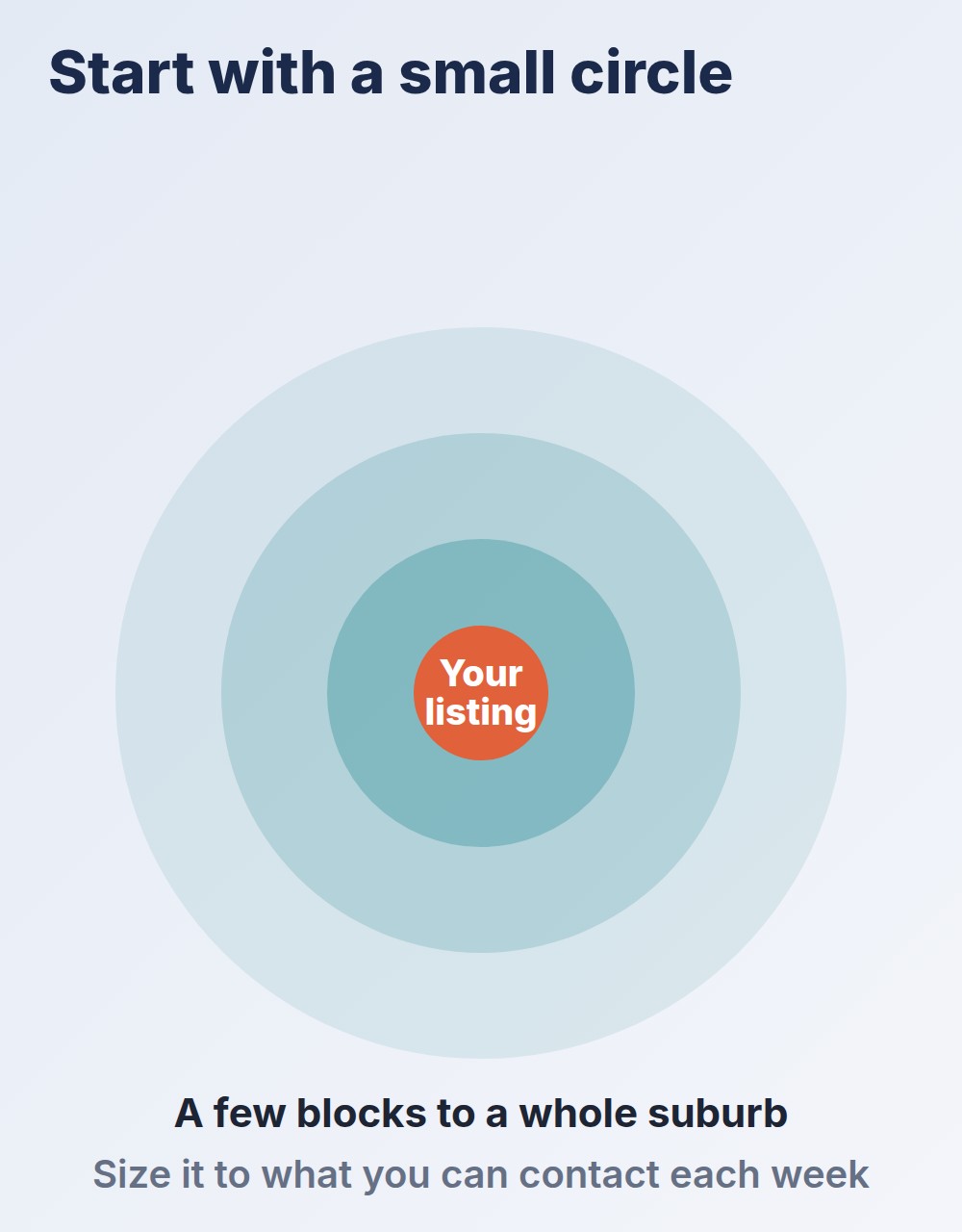
Pick a circle you can finish. ResiMpli’s circle prospecting guide says a circle can be as small as a few neighborhood blocks or as extensive as an entire suburb. None of the guides we checked give a fixed radius or home count, so we do not either. Count the homes around your listing and choose the number you can contact properly in a week.
Start smaller than you think. A circle of the closest homes, contacted twice, beats a wide circle contacted once. If the first circle produces conversations, widen it for the next event.
What Do You Send or Say in Circle Prospecting?
Lead with the event, not with a pitch. Follow Up Boss’s circle prospecting call flow: tell the person you recently listed or sold a home near them, ask whether they would be interested in selling, and if not, ask how long they plan to stay and what they would look for in a new home. If they are not ready, ask whether you may send an occasional email about local conditions.
Mail works well too. HousingWire suggests a postcard or letter followed by a pop-by at the home. A just sold card with the address, the result and a short note is a good fit; see our guide to real estate postcards and mailers for layouts. Keep the tone neighborly. Your goal is a first conversation, not an immediate listing, and Follow Up Boss makes the same point: the objective is not necessarily an immediate transaction.
Here is a short opening you can adapt: “Hi [Name], this is [Your name] with [Brokerage]. We just listed a home on [Street], and I wanted to let you know in case neighbors have questions. Do you have a minute?”
What Rules Apply to Circle Prospecting?
The rules depend on how you reach the person. This is general information, not legal advice, so ask your broker before you start.
- Calls. Check the registry and your own do-not-call list first. The FTC’s Do Not Call Q&A for telemarketers says you must synchronize your lists with the registry at least every 31 days. Our cold calling scripts and DNC rules guide has the full table.
- Visits. Local solicitation rules vary by city and county, so check them before you knock. Our door knocking guide covers a safe routine.
- Wording. Describe the sale and your service, not the people who live nearby, as 24 CFR 100.75 explains.
What Does a Weekly Circle Prospecting Routine Look Like?
A routine keeps the work small enough to repeat. This is our suggestion, so adjust the days to your week.
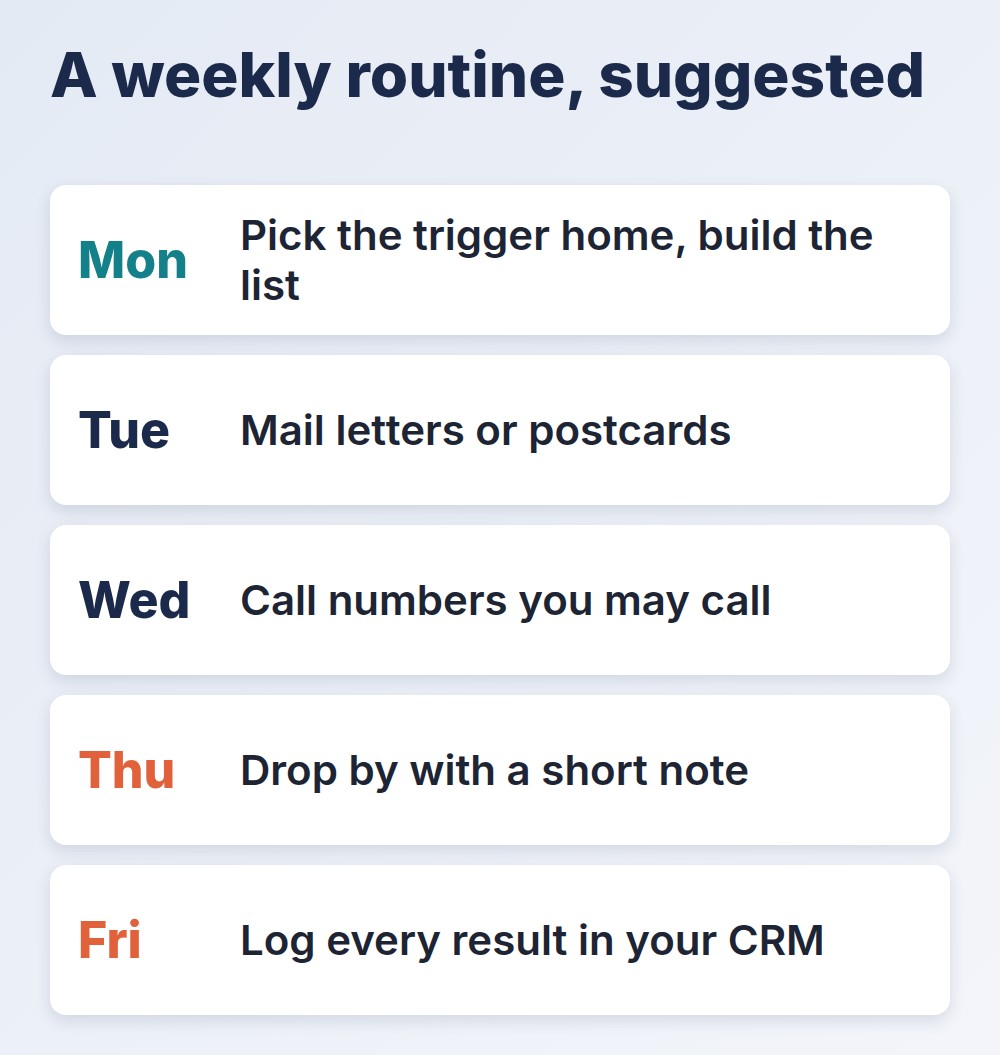
Pick the trigger home on Monday and build the list from your MLS or public records. Send letters or postcards on Tuesday, call numbers you may call on Wednesday, drop by with a short note on Thursday, and log every result in your CRM on Friday. Then repeat the cycle at the next event.
What Does a Circle Prospecting Example Look Like?
Here is an illustration with made-up numbers. You list a home, and your circle holds 80 homes. Tuesday brings a just listed card to all 80. After a registry check on Wednesday, you find that you may call 55 of them and phone them over two sessions. Thursday is for dropping a short note at the 20 homes nearest the listing. By Friday you have logged 12 conversations, and 3 homeowners have asked about their value.
Those 3 owners get a value estimate and a follow-up date, and the other 9 go on a monthly email list if they agree. These numbers are not a benchmark. Your market, your price range and your message will change them, which is why the log matters.
How Do You Measure and Follow Up?
Count four numbers for each circle: homes contacted, conversations, appointments and listings. Divide your spend and time by the listings to see whether the method pays. Our guide to real estate lead follow-up automation shows how to schedule the next touch for people who say not yet.
Most neighbors will not be ready, and that is normal. Follow Up Boss suggests calling not-ready leads about every six months, and a short email list is a gentler way. Neighbors who like you also join your sphere, so see our guide to working your sphere of influence. If you want to sort circle prospecting beside other seller sources, our listing leads guide shows how.
Common Circle Prospecting Mistakes
- Making the circle too big. A small circle contacted well beats a large one touched once.
- Calling without a registry check. It is the fastest way to a complaint.
- Pitching instead of informing. Lead with the event and ask a question.
- Sounding scripted. Use a script as a guide, not a speech.
- Stopping after one touch. Mail, a visit and a call work together.
- Not logging results. Without records you cannot tell which events paid.
Final Thoughts
Circle prospecting works because it starts with something true and nearby. Act on a real listing or sale, pick a circle you can finish, mix mail, a visit and a call where the rules allow, and log every result. Judge each circle by the conversations and listings it produces, widen the next one only after the first works, and keep your follow-up ready.
