
Real estate lead generation is the work of finding people who may buy or sell a home soon and earning the right to follow up with them. It is not one tactic but a mix of sources, from the people who already know you to paid portals, and each source costs a different amount of money, time and effort. This guide compares ten of them, shows how to pick a mix for your stage, and covers the rules to check before you contact anyone.
What Is Real Estate Lead Generation?
Real estate lead generation is any activity that produces a named person with a likely need to buy or sell, plus a lawful way to contact them. A lead can be a buyer, a seller, or an introduction from someone who trusts you. A lead is not a closing. It is the first step in a pipeline that still needs follow-up, a conversation and usually a signed agreement.
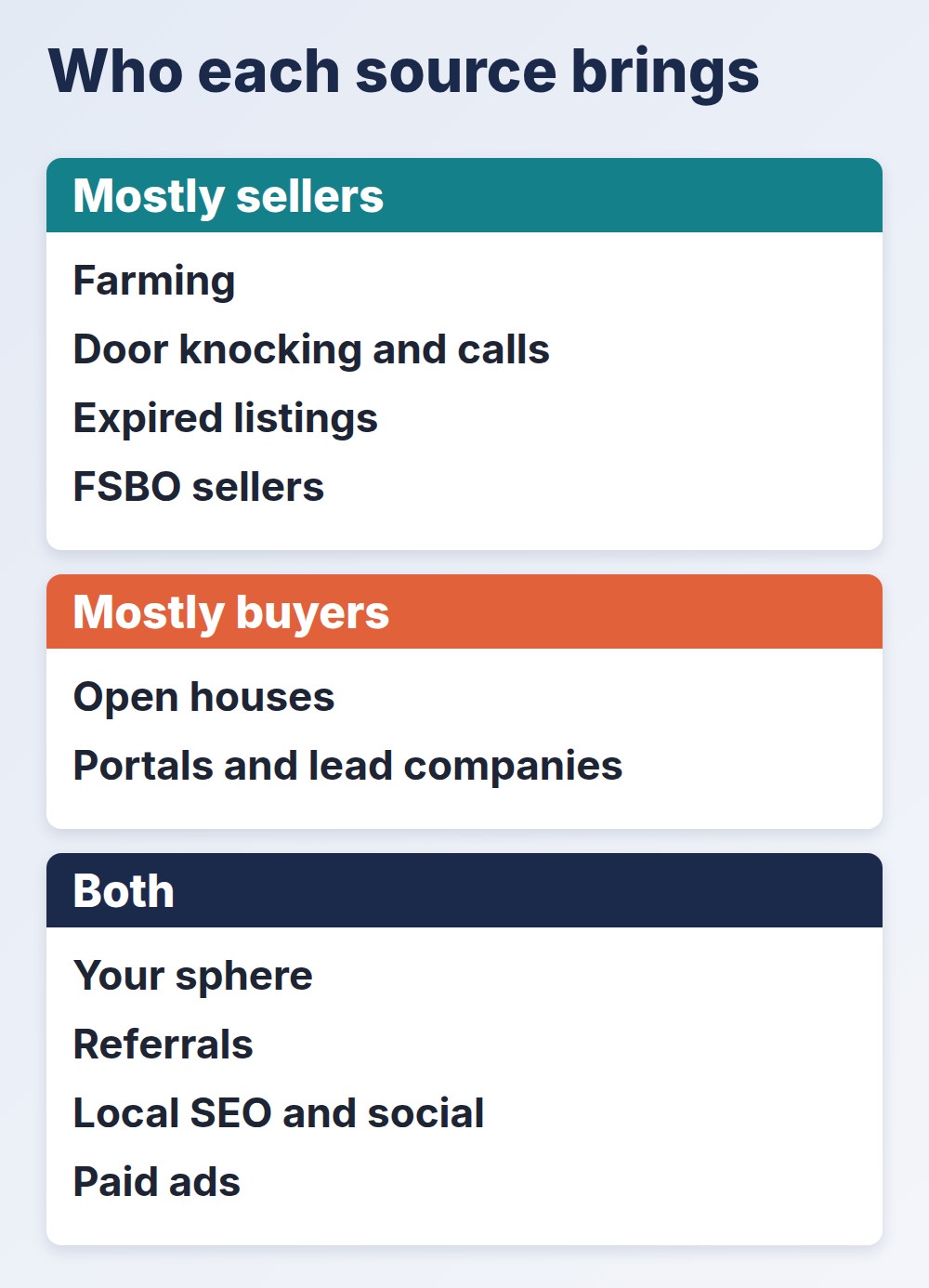
Two kinds of leads shape your plan. Buyer leads are people looking for a home, and they are easier to find, because they search, browse portals and walk through open houses. Seller leads are homeowners thinking of selling, and they are harder to find but lead to listings, which bring the next round of buyers to you. Our guide to finding seller leads and winning listings goes deeper on the second kind.
Where Do Real Estate Agents Actually Get Leads?
NAR’s 2026 Member Profile feature sheet reports that in 2025 the typical REALTOR® earned 28% of their business from repeat clients and customers and another 22% through referrals from past clients and customers. Together that is about half of a typical agent’s business coming from people who already know them.
NAR’s 2025 member trends report adds that past clients remain a key source of leads. It also says agents use websites to reach prospective clients in the research phase, and use social media, particularly Facebook, LinkedIn and Instagram, to connect with leads. Neither page breaks out paid ads, cold calls or farming, so you cannot read their results from NAR’s numbers. That is why you need your own tracking, covered below.
The practical reading is simple: protect and use the contacts you already have before you spend on strangers. Our guide to real estate marketing shows how that fits into a wider plan.
Real Estate Lead Sources Compared
This table compares ten sources. The cost and timing columns are our estimates, not measured benchmarks, so treat them as a way to rank your options rather than as promises. Your market, price range and follow-up speed will move every number.
| Lead Source | Cash Cost | Time to First Lead | Effort | Best For |
|---|---|---|---|---|
| Your sphere and past clients | Very low | Days to weeks | Steady, weekly | Any agent with a contact list |
| Referral requests | Very low | Weeks to months | Low per ask | Agents with happy past clients |
| Farming and direct mail | Medium (postage, printing) | Months | Monthly for a year | Agents who can repeat on schedule |
| Open houses | Low | Same day | One weekend per event | New agents, buyer leads |
| Door knocking and cold calls | Low cash, high time | Days to weeks | Daily blocks | Agents with time and a checked list |
| Expired listings | Low to medium | Weeks | Daily calls and mail | Listing-focused agents |
| For-sale-by-owner sellers | Low | Weeks | Weekly outreach | Agents who want listings |
| Local SEO, Google profile and social | Low cash, high time | 3 to 12 months | Weekly content | Agents playing a long game |
| Paid ads | Medium to high | Days | Needs tuning and fast replies | Agents with budget and a follow-up system |
| Portals and lead companies | Medium to high, sometimes a share of commission | Days | Fast reply required | Agents who answer fast and close well |
Sources fall into groups. Warm sources, your sphere and referrals, are the cheapest and the slowest to scale; see our guide to getting referrals and paying fees correctly. The neighborhood ones need repetition. A real estate farm works over twelve months, and a well-run open house brings buyers and nearby neighbors the same afternoon.
Door knocking and calling trade money for time. Read door knocking for real estate agents before you go out, and real estate cold calling scripts before you dial. Sellers who need an agent now, such as expired listings, respond well to prospecting letters sent before a call.
Online sources compound slowly. Start with your Google Business Profile and local search basics, then add a weekly social media routine. For paid sources, compare Google Ads setup and targeting with Facebook lead ads for realtors, and send the traffic to a seller landing page that converts.
Which Real Estate Lead Generation Source Should You Start With?
Pick by your situation, not by what a coach or vendor is selling this month. Most agents do better with two lead sources worked well than with six worked badly.
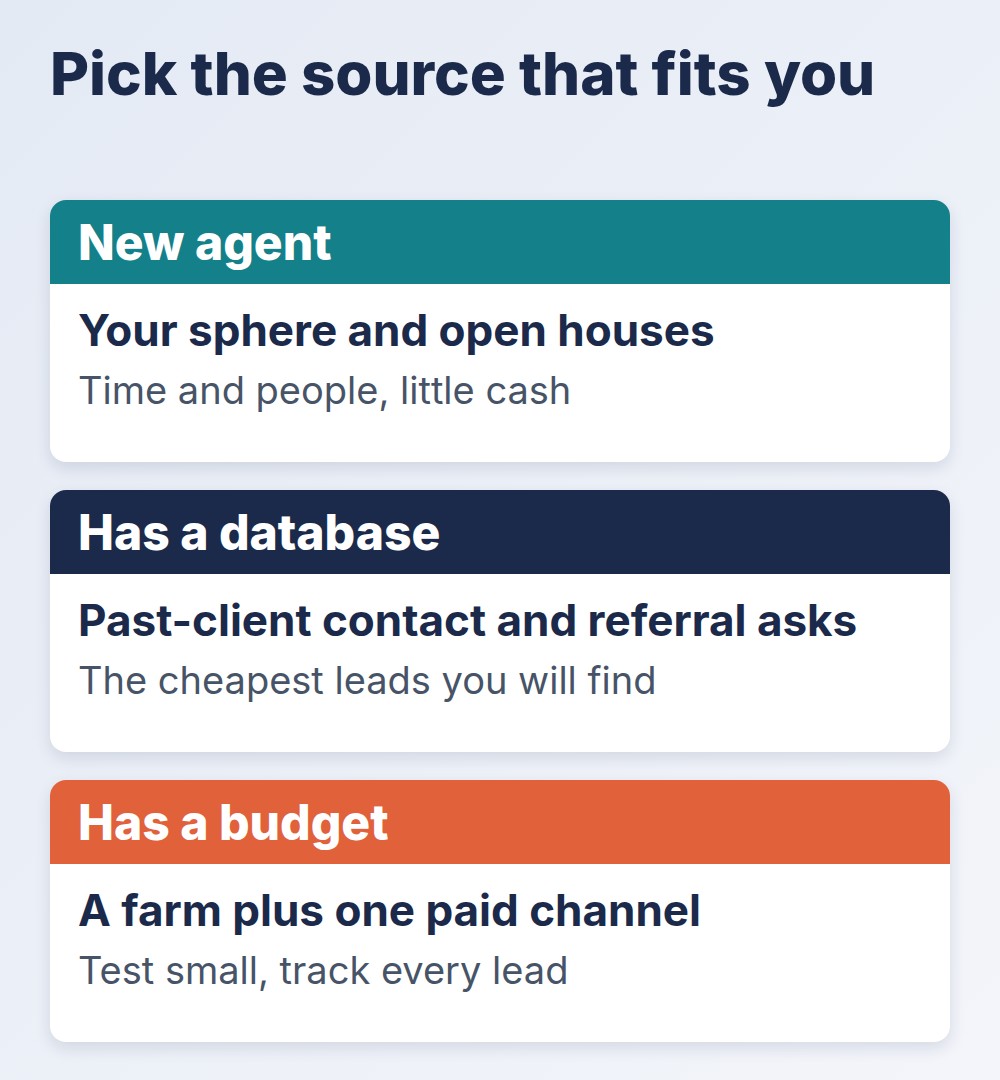
- New agent, little budget. Start with your sphere and open houses. They cost time and people, not cash, and they teach you how real estate lead generation conversations go.
- Agent with a database. Contact past clients on a schedule and ask for introductions. A list of people who already know you is the cheapest source you will find, and our guide to CRM marketing shows how to keep it current.
- Agent with a budget. Add a farm or one paid channel and test it small for one quarter. Compare tools in the best lead generation software for realtors before you buy, because a tool supports real estate lead generation but does not replace the sources.
If listings are the goal, weight the mix toward sources that find sellers. The listing leads guide sorts them by who you already know, which neighborhood you work and which sellers need an agent right now.
How Do You Build a 90-Day Real Estate Lead Generation Plan?
A real estate lead generation plan needs a calendar, because sources only pay off when you repeat them. The plan below is our suggestion, not a formula. Adjust the hours to your week, and do not add a source you cannot keep up for the full quarter.
- Month one: set up the basics. Add a required lead source field to your CRM, clean your contact list, and contact your top past clients with a short, useful note.
- Month two: add one neighborhood or seller source. Choose a farm, circle prospecting, open houses or expired-listing letters, and run it on a fixed weekly day.
- Month three: test one paid or online source small. Set a budget you can lose, send the traffic to one page, and decide your reply time before the first lead arrives.
- End of the quarter: review and cut. Count leads, conversations, appointments and closings by source, then drop the weakest one and keep the rest.
Repeat the cycle each quarter and change one thing at a time. If you change five things at once, you will not know which one moved your numbers.
What Does a Lead Cost, and How Do You Track It?
Cost per lead is what you spend divided by the leads you collect. Divide the same spend by the deals that close and you get cost per closing, the number that decides whether a source is worth keeping. A cheap lead that never answers the phone costs more than an expensive one who signs. Our guide to what a lead really costs for agents walks through that difference.
Here is a sample year to show the math. USPS lists Every Door Direct Mail Retail flats at $0.26 per piece when we checked, with no special permit needed. Twelve monthly mailings to 500 homes cost about $1,560 in postage before design and printing. If that farm produced two closings, postage works out to $780 per closing. These figures are illustrations, not a forecast.
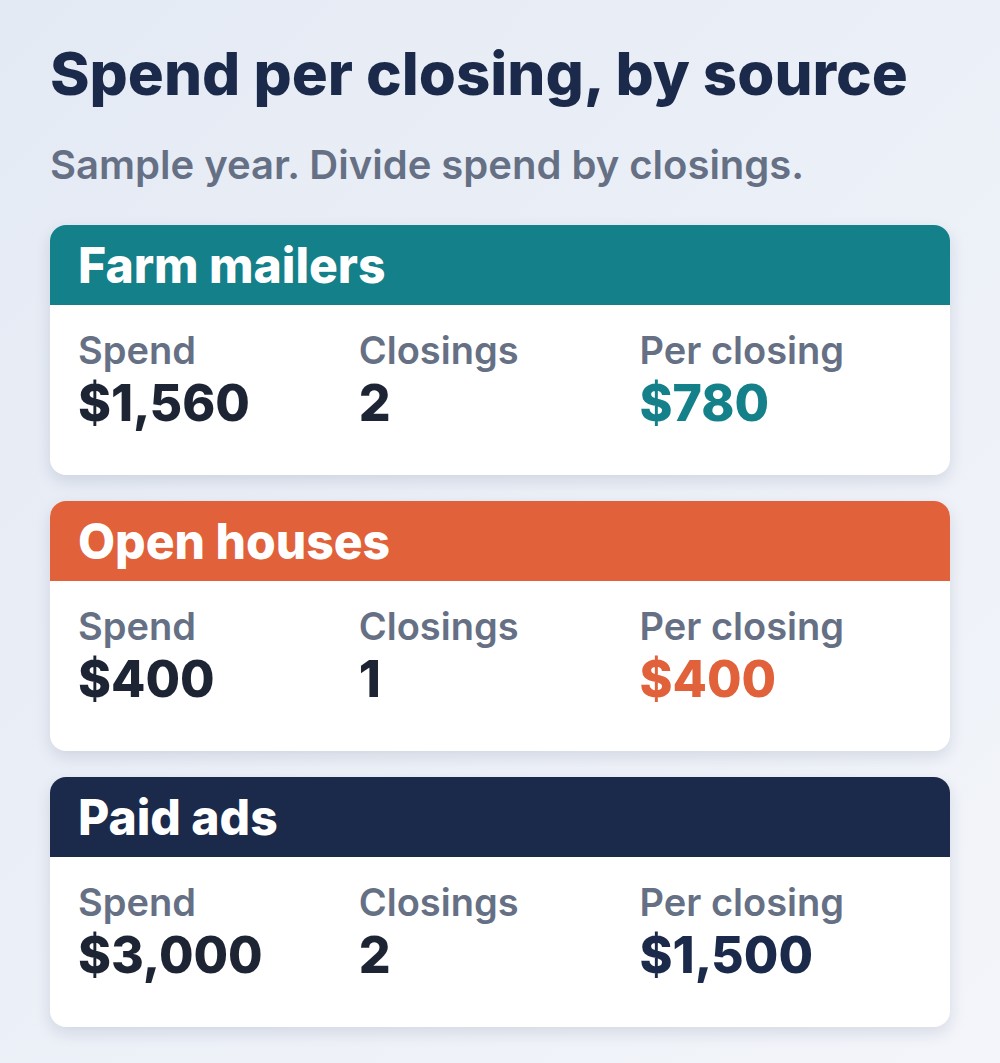
In the sample, the paid ads might bring many more leads, say 60 for $3,000, which is $50 per lead. Even so, two closings means $1,500 each, the highest of the three. You only see that if you record a lead source on every contact and update it when a deal closes, the simplest habit in lead tracking. Ask three questions each quarter: which source gave the most conversations, which gave the most closings, and which cost the most per closing.
What Rules Apply Before You Contact a Lead?
Real estate lead generation is full of rules that depend on how you reach someone. The points below are general information, not legal advice, so check with your broker before you build a list or a campaign.
- Do Not Call. The FTC’s Do Not Call Q&A for telemarketers says you must synchronize your lists with the registry at least every 31 days. A company may call for up to 18 months after a consumer’s last purchase, delivery or payment and for three months after an inquiry, unless the person asks you to stop. Fines can reach $53,088 per violation. The cold calling guide linked above has a plain-language table.
- Texts and autodialers. Consent rules apply on top of the registry. Read our guide to TCPA compliance for real estate agents first.
- Paying for referrals. 12 CFR 1024.14 bars giving or accepting a fee, kickback or other thing of value for referring settlement service business tied to a federally related mortgage loan. Ask your broker before you pay or accept anything for a lead.
- Fair housing. Advertising and targeting should describe the home and your service, not who should live there, as 24 CFR 100.75 explains.
How Do You Qualify a Lead Before You Invest Time?
Not every lead deserves the same effort, and a short set of questions saves hours. Ask when the person plans to move, whether they own or need to sell first, whether they have talked to another agent, and how they prefer to be contacted. Write the answers in your CRM, and let the timeline decide the cadence: a buyer touring this weekend gets a call today, and a homeowner thinking about next year gets a monthly note.
Qualifying is also where you protect yourself. Record how the person gave you their details, because that record shows whether you may call or text them later. A lead who filled in a form asking for a callback is different from a name on a purchased list, and the rules in the previous section treat them differently.
What Happens After a Lead Arrives?
The lead is only the start, and most of the money is lost in the days after it arrives. A form sits unread, a call goes to voicemail, and the person talks to the next agent instead. Our guide to real estate lead follow-up automation covers the setup, and our piece on speed to lead and your CRM explains why the first reply matters.
Infina AI, our own product, is an AI assistant for real estate agents that helps with follow-up and listing questions, so a lead from any source hears back while the interest is fresh. Whatever you use, the rule is the same: decide who replies, how fast, and what happens when nobody answers.
Common Real Estate Lead Generation Mistakes
Most problems come from a short list of habits, and each one is fixable this quarter.
- Chasing every source at once. Two sources done well beat six done badly.
- Judging by cost per lead. Cost per closing is the number that matters.
- Not recording the source. Without a lead source field you cannot tell what works.
- Buying leads before using your own contacts. Your sphere is the cheapest source you have.
- Skipping the compliance check. Registry, consent and fee rules apply before the first call.
- Slow follow-up. A paid lead that waits a day is often a lost lead.
Related Reading
These guides go deeper on the sources and the steps around them.
- Sort seller lead sources by situation if listings are your goal.
- Run a farm you can sustain.
- Plan open house ideas before, during and after.
- Write letters to sellers and expired listings.
- Build a referral system that earns introductions.
- Check what a lead costs per closing.
- Compare lead generation software for realtors.
- Turn clicks into appointments with a home valuation landing page.
- Answer every lead fast with an automated follow-up system.
- See where this fits in the full real estate marketing plan.
Final Thoughts
Real estate lead generation works when you choose a small number of sources, record where every lead came from, and answer fast. Start with the people who already know you, add one neighborhood or paid source you can sustain, and judge each one by cost per closing after a full quarter. Check the contact and referral rules before you scale, and keep your follow-up ready, because a lead you cannot answer is a lead you paid for twice.
