
Luxury real estate marketing is not standard marketing with a bigger budget. The buyer pool is smaller, discretion matters more, and the agent’s own brand does more of the selling. This guide explains how luxury is defined, what changes in luxury real estate marketing and luxury real estate branding, how to present a high-end listing, and the private listing rules you need to know.
What Counts as Luxury Real Estate?
Luxury is relative to your market, not a fixed price, which is the first thing to settle in any luxury real estate marketing plan. The Institute for Luxury Home Marketing, in its article on what luxury real estate really means, says a property’s price must fall in its market’s top 10 percent price range, and that a price tag alone does not define luxury. A $900,000 home can be luxury in one town and ordinary in another.
The same article points agents to a threshold lookup tool by ZIP code, so check yours before you describe yourself or a listing as luxury. It also notes that the word has become overused, so a listing that earns the label in the numbers and in the presentation stands out more than one that only uses the word.
How Is Luxury Real Estate Marketing Different?
The difference is less about channels and more about standards, privacy and proof. This table shows where the approach changes.
| Area | Standard Marketing | Luxury Real Estate Marketing |
|---|---|---|
| Audience | Wide, many buyers | Small, specific and often reached through networks |
| Presentation | Clear photos and facts | Editorial photography, video, floor plans and a story about the home |
| Pace | Public launch on day one | Planned launch, often with private previews first |
| Privacy | Open houses and public posts | Screened showings and discretion about the seller |
| Brand | Friendly and approachable | Polished, consistent and restrained |
| Proof | Reviews and testimonials | Market data, past sales and a clear plan |
Start with the basics in our guide to marketing for real estate agents, then adjust each row for the price tier you work in. If you are new to this segment, change one row at a time rather than rebuilding everything.

What Does Luxury Real Estate Branding Involve?
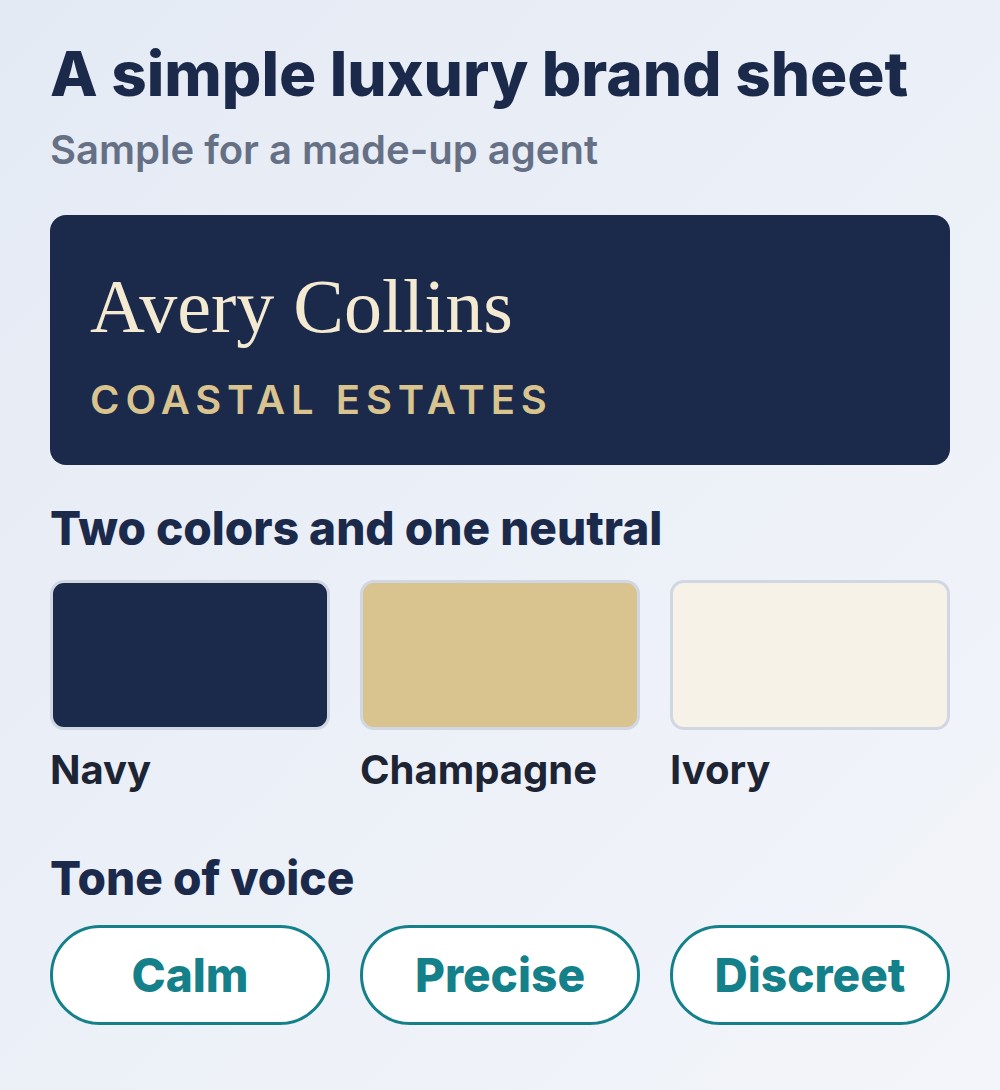
Good luxury real estate branding is mostly about consistency and restraint. Buyers and sellers at this level notice small signals: how your logo looks on a card, whether your site and signage match, and how you write. Our guide to positioning, look and voice covers the full process. At the high end, a few points matter most.
- Pick a narrow promise. Say who you serve and where, such as waterfront homes in one county, rather than everything to everyone.
- Keep the look simple. Two colors, one or two typefaces and plenty of space. Our guide to real estate logos shows how to design one that holds up on a card and a sign.
- Match every touchpoint. Your business card, agent bio and listing brochure should look and sound like one brand.
- Use real photos of yourself. A calm, professional portrait does more than a stock image.
- Build the website to match. Our guide to luxury real estate website design covers the features that signal premium to buyers.
How Do You Market a Luxury Listing Step by Step?
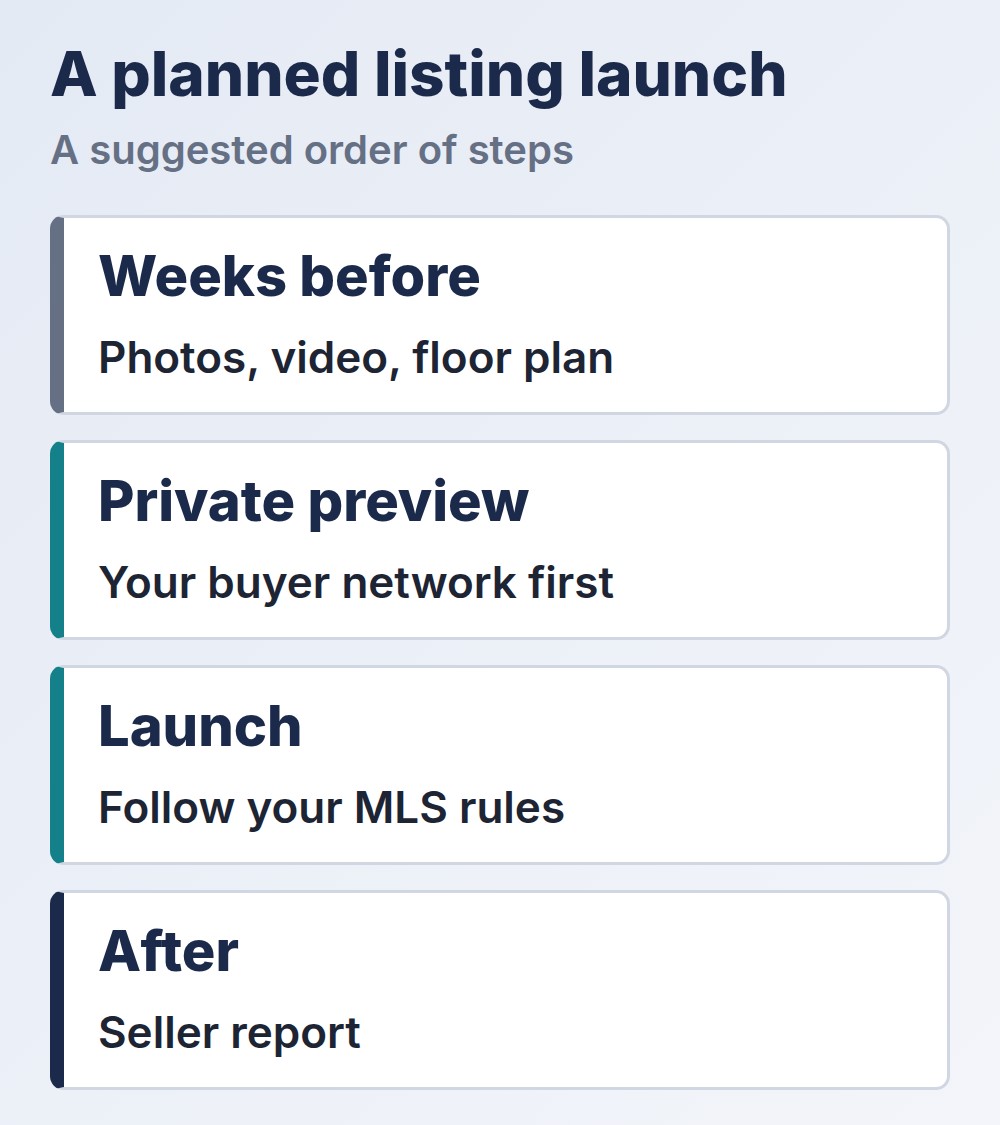
- Agree the price with data. Bring comparable sales, days on market and price per square foot to the listing appointment. The Institute suggests using luxury market report data to build credibility there.
- Invest in presentation. Professional photography, a floor plan and a video give buyers what they expect. Our guide to real estate video marketing covers the basics of clips and scripts.
- Give the home its own page. A single-property site with a registration form lets you capture interested buyers. See our guide to an open house landing page for what to include.
- Reach your network first. Send a private preview to your buyer contacts and to agents who work this price tier.
- Use print with care. A short, well-made mailer to a chosen area works better than a large mailing. Our guide to real estate postcards and mailers covers the layout.
- Report to the seller. Share who viewed, who toured and what feedback came back.
What Are the Rules for Private Listings?
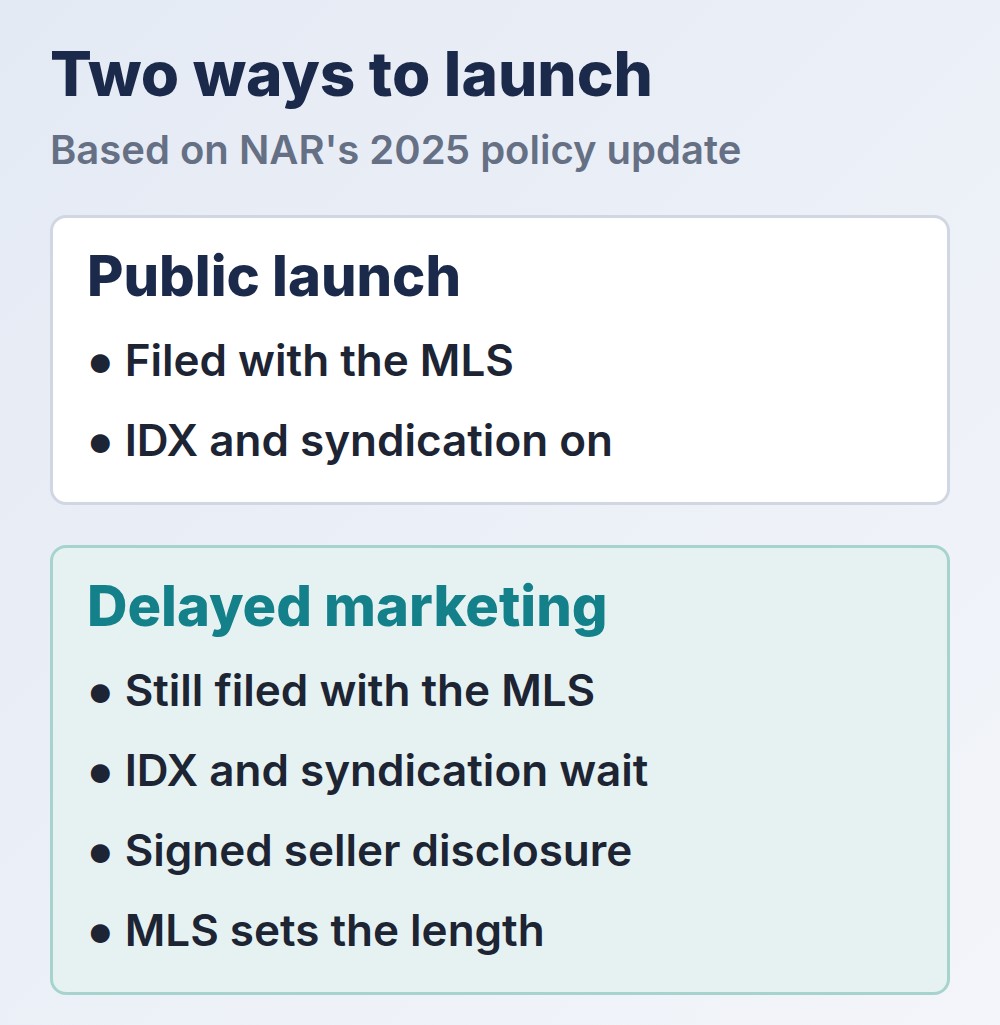
Discretion is a real reason sellers ask for private marketing, and it is also where the rules get strict. NAR’s announcement on the Clear Cooperation Policy says the policy remains in place: a listing must be submitted to the MLS within one business day of marketing it to the public. It also created “delayed marketing exempt listings,” which let a seller delay IDX and syndication for a set period.
Two details matter. The listing agent must get a signed seller disclosure documenting informed consent, and each MLS decides how long the delay can last. Your local MLS rules decide what you can do, so read them before you promise a seller anything.
Also explain the trade-off. HousingWire’s piece on private listings argues that less exposure can mean fewer offers, so a seller should hear both sides before choosing privacy.
How Do You Build Credibility in the Luxury Market?
Show proof, not adjectives. Use real sales you have closed, local data and a clear plan for the listing. The Institute offers a designation for agents who close three residential sales of $1 million or more within 24 months, which gives you a specific goal if you are working toward this segment. Our guide to a listing presentation template and script shows how to put the proof in front of a seller.
Service also counts. High-end clients expect prompt, accurate answers. Infina AI, our own product, is an AI assistant for real estate agents that helps with follow-up and listing questions, so a serious inquiry does not wait for you to finish a showing. Fair housing rules apply as they do at every price, so keep descriptions about the property, as set out in 24 CFR 100.75.
Luxury Real Estate Marketing Ideas for Your First Quarter
If you are moving into this segment, a plan for the first 90 days keeps the work practical. These are our suggestions, not a fixed formula:
- Month one: define the segment. Look up your local luxury threshold, list the neighborhoods and price range you want, and write one sentence about who you serve.
- Month two: fix the brand. Update your logo, card, bio and site so they match, and remove anything that looks dated.
- Month three: show the work. Publish a page of your past sales with a short story for each, and ask permission before you name a client or an address.
Repeat this luxury real estate marketing routine each quarter, and add one new proof point every time, such as a market report for your neighborhood or a short video tour of a recent sale.
Common Luxury Real Estate Marketing Mistakes
- Using the word luxury without the numbers. Check your market’s threshold first.
- Cheap photos. At this level, weak images cost credibility.
- An inconsistent brand. A mismatched card, site and brochure weakens trust.
- Promising privacy you cannot give. MLS rules set the limits.
- Skipping the seller report. Sellers want to know who looked and what they said.
- Copying a big brokerage. Your narrow, clear promise is the advantage.
Final Thoughts
Luxury real estate marketing rewards precision. Know your market’s luxury threshold, make a narrow and consistent brand, present each listing with a planned launch, respect the Clear Cooperation rules and show proof instead of adjectives. Start with one change to your luxury real estate branding, such as a sharper brand sheet or a better listing launch plan, and build from there.
